Keep the Momentum Going: Building on the Success of SikhVOTE
Keep the Momentum Going: Building on the Success of SikhVOTE
By: Jaslin Kaur, SALDEF Senior Manager of Civic Engagement and Community Outreach
At SALDEF, we understand how vital the Sikh American voice is to shaping national and local policies. That’s why we spent the last year expanding our SikhVOTE initiative to boost voter turnout and educate voters about what’s on the ballot. As we approach a new administration, we reflect on our efforts this year and prepare ourselves to deliver the dignity our sangat deserves.
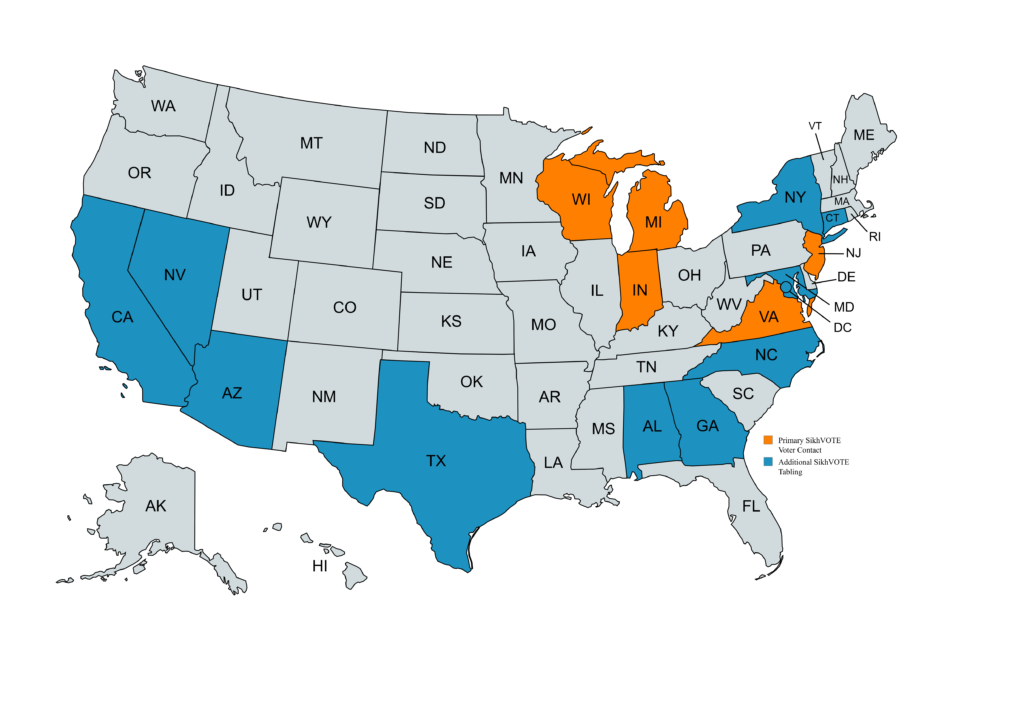
The SikhVOTE initiative is over a decade in the making and became the largest Sikh voter mobilization effort in the United States this year. However, milestones like this aren’t made by accident – they’re made on purpose by the staff, volunteers, and community members who wanted their voices heard at the ballot box. We made a plan to expand our presence in 18 states, touching every region of the country from Oak Creek, Wisconsin to Bessemer, Alabama.
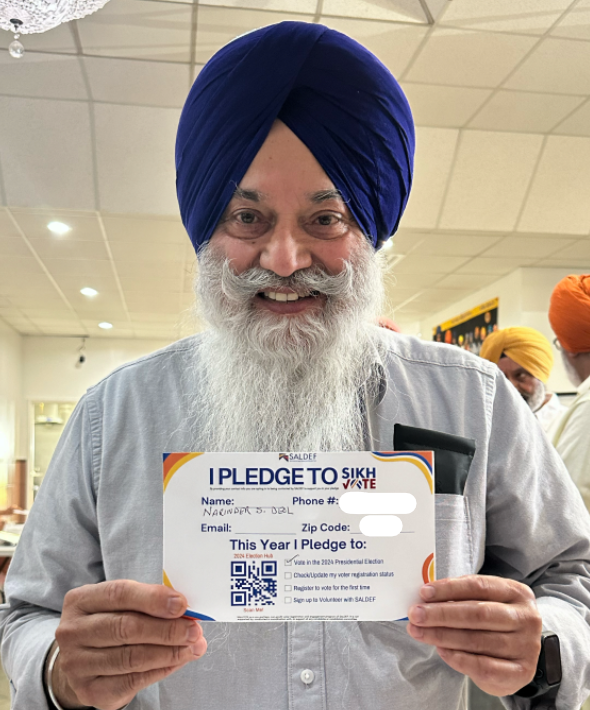
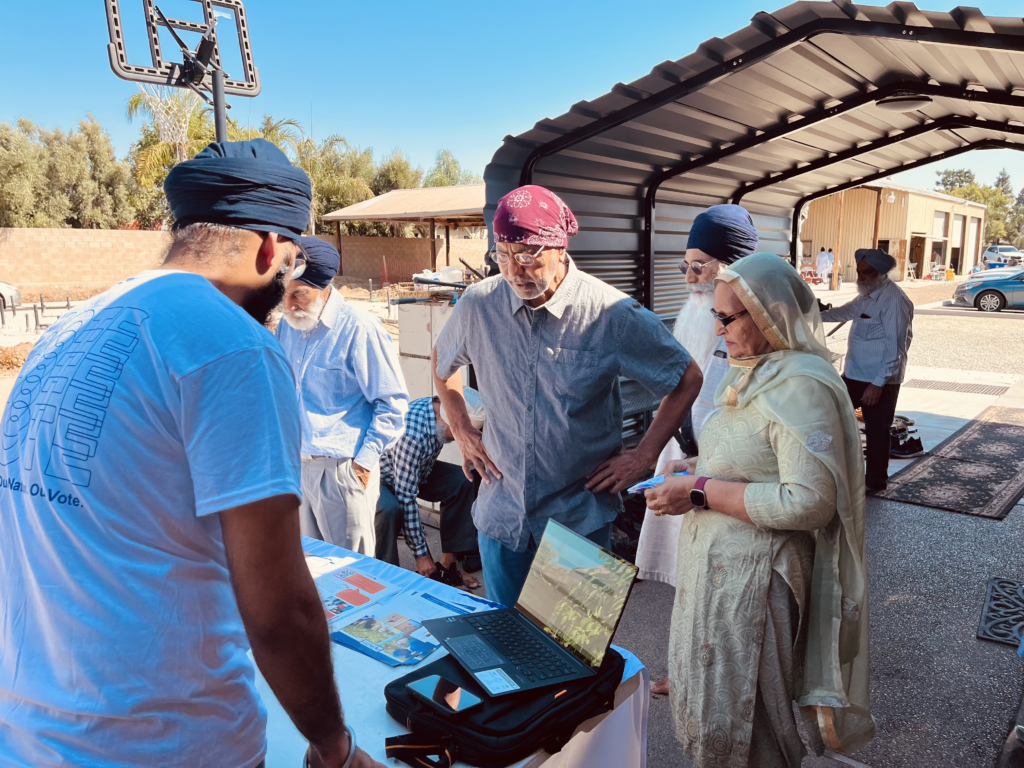
Our staff and volunteers traveled to several states to conduct outreach in-person at local gurdware. We learned about an array of voter experiences across our sangat that helped us tailor our outreach. Some moved to Indianapolis years ago, but had never updated their voter registration to vote in their new state. Some have found community in Oak Creek, and were newly naturalized citizens who made a plan to vote for the first time in 2024. Others could not vote due to their citizenship status, but expressed an excitement about voting and a commitment to gathering their families to vote.
That’s part of the ethos of SikhVOTE – we do not vote for our individual interests. Rather, we vote because of the impacts of voting as a collective. When we participate in democracy and participate often, we build our civic engagement muscle and look for more ways to bring a decent quality of life to our communities and see ourselves in leadership. We shared that narrative with community members who expressed indifference about voting in a high-pressure election cycle. However, we noticed that education about how many races and propositions were on the ballot encouraged people to seek change in their local districts, too. In Wisconsin, someone asked if anyone Sikh was on the ballot. He remarked, “If not, someone Sikh should really represent this Sikh neighborhood.”
Our volunteers felt the real-time impact as well. In California, Harnoor and her mother tabled together at gurdware in San Jose and Fremont. She said she liked having a voice and a say in this year’s turnout – “I gained confidence speaking to my sangat in Punjabi. I felt proud that I could change people’s minds about voting.” In that sense, SikhVOTE made the case that political ads and mailers won’t turn out our community to the polls. We need to hear the message spoken and written in Punjabi, from people who care about us, and will spend the time to help answer our questions at the places where we gather such as the gurdwara. That investment on Sundays alone sparks a lifetime of civic engagement.
This year, SikhVOTE got creative and cultural, too. While our in-person outreach and face-to-face contact generated useful insights, we saw that phone banking and text banking in Punjabi was incredibly helpful, too. You may have received a text or call from us that opened with “Sat sri akal” or “Waheguru ji ka Khalsa, Waheguru ji ki Fateh.” This created an unusually high response rate in our texts, more engaging conversations over the phone, and overall, more commitments and pledges to vote in November.
Overall, in-language voter engagement has always been a winning strategy. And while we tabulate our metrics and assess our overall impact, it’s clear that there has been a dearth of Punjabi-language voter outreach, especially in Sikh American communities not represented by other Sikhs in government. It creates a damaging cycle in which elected representatives face a language or cultural barrier to Sikhs, so the Sikh community doesn’t vote, and therefore Sikhs are not seen as a strong electorate. We need to invest in specific outreach initiatives like SikhVOTE if we want to see significant changes in voter behavior and patterns in our sangat.
At SALDEF, we have a lot to celebrate regarding our SikhVOTE work and a lot to build upon. If you voted this year, thank you! If you didn’t, it’s never too late to begin those conversations with your family and friends. It’s also never too late to consider attending your local PTA, school board, or city council meetings. The best time for Sikh Americans to get civically engaged in their communities was years ago. The second best time is now.
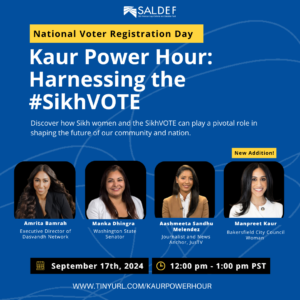
(RNS) — On National Voter Registration Day, Sikh women leaders spoke at ‘Kaur Power Hour,’ a webinar dedicated to raising up ‘the minority within the minority’ to recognize their voting power in this upcoming election.
The Sikh faith has a long history of political activism in India. On National Voter Registration Day Tuesday (Sept. 17), Sikh women drew on that legacy to encourage their community in the U.S. to vote in the upcoming presidential election.
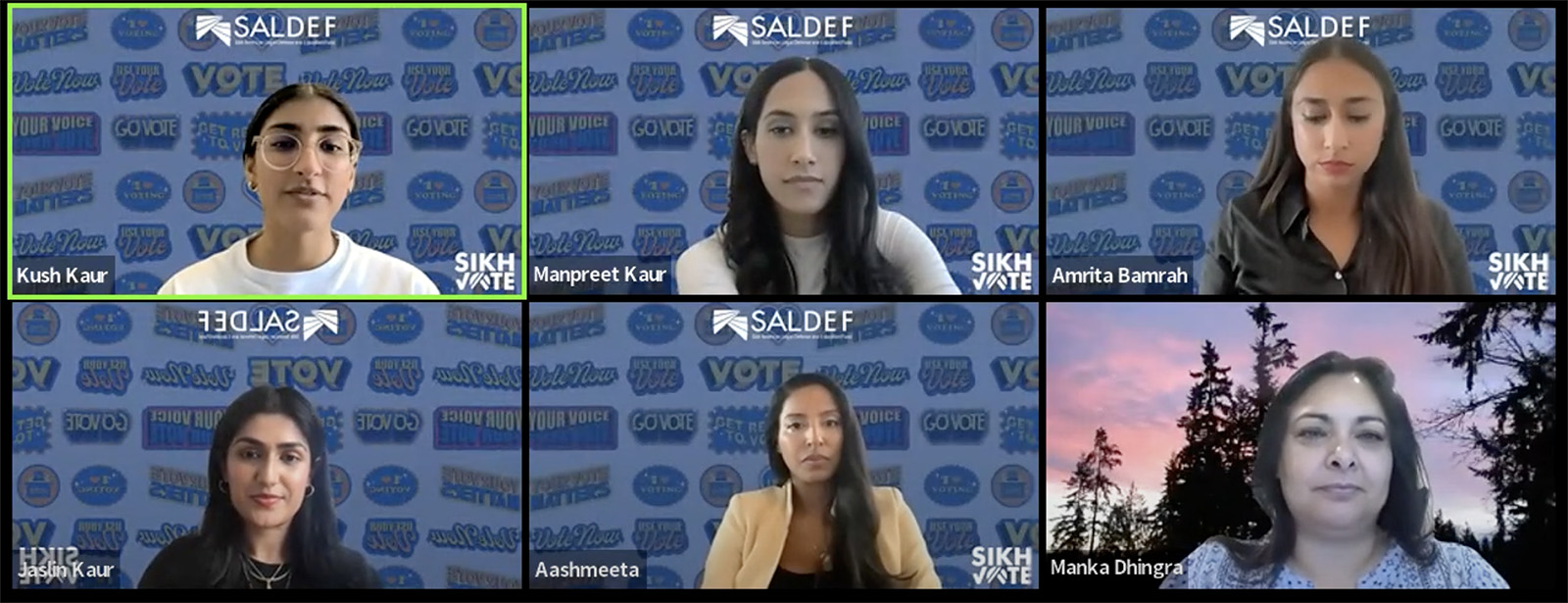
Amrita Bamrah, executive director of Dasvandh Network, a nonprofit fundraising platform based in the Sikh value of giving, spoke to more than a hundred “Kaurs,” or Sikh women, for “Kaur Power Hour,” an online event hosted by the Sikh American Legal Defense and Education Fund.
“Our ancestors didn’t wait for change, they made it,” Bamrah told those gathered online. “And today, in that same spirit, our vote is one of the most powerful tools that we have to really continue that legacy.”
Kaur, the surname or middle name taken by many Sikh women as a symbol of equality and spiritual empowerment, was as much of a catchy webinar title as it was a call to action. Sikhism, also called Sikhi, is an Indic faith native to Punjab, India, that teaches scripture from the Guru Granth Sahib.
“We are a part of a history just woven with angles of those who stood up for justice, equality and the rights of individuals,” Bamrah said. “Our faith is built on these principles of courage and compassion and time and again, when we look at history, our community has risen to confront oppression, to uplift those who were silenced, and to create change where it was needed.”
The organizers of Kaur Power Hour said in the U.S. there is still work to be done to politically motivate the community. Though Sikhs can be found “truly everywhere,” reaching out to women is especially crucial, said Jaslin Kaur, Sikh organizer and former Queens City Council candidate.
Jaslin Kaur addresses the Kaur Power Hour virtual event, hosted by the Sikh American Legal Defense and Education Fund. (Video screen grab)
“Unfortunately, campaigns already don’t reach out to Sikhs enough, but they sure don’t reach out to Sikh women,” she said to the audience. “I think it’s our job as fellow sisters to reach out behenji (sister) to behenji and ensure that our fellow Sikh women are registered and ready to vote.”
The Power Hour, said SALDEF’s executive director, Kiran Kaur Gill, had a twofold objective: getting as many Sikh Americans as possible registered to vote and emphasizing how important Sikh women are in the national conversation.
As the oldest Sikh advocacy organization in the nation, SALDEF has led a voter education program called SikhVote for over a decade. Directly after 9/11, many Sikhs — especially those wearing turbans and other outward signs of their faith — were racialized and attacked over their misperceived Muslim identity. That galvanized many Sikh Americans to get involved in the political sphere. Sikhs organized especially for issues of religious freedom, hate crimes and workplace discrimination, including the protected ability to carry a kirpan, or Sikh sword, and the right to wear a turban in the U.S. military.
But according to Gill, while Sikh women are incredibly involved with their cultural, social and religious leadership, they have not necessarily been at the forefront of political engagement.
“We noticed that with phone banking, one of our volunteers mentioned that when he would call and ask about voter registration, sometimes, you know, women would hand the phone over to their husband,” she said. “And so, we are trying to say: ‘No, you know, this conversation is for everyone. Everyone has the right to vote and should exercise that right.’”
There are an estimated half a million Sikh Americans in the U.S., and the number continues to grow, according to the Sikh Coalition, a nonprofit advocacy group. But civic participation has been hampered by language, citizenship status and a feeling among some members of the religious minority that their voice doesn’t matter.
Reaching the largely immigrant sangat, or Sikh fellowship, at their gurdwaras has been a key mission of SALDEF. Connecting U.S. political engagement with the Sikh value of seva, or service, has been especially rewarding for grassroots organizers such as Kush Kaur, Texas native and Sikh American National Youth Council Southern chair.
“I remember when an elderly uncle approached my table who had been a U.S. citizen for over a decade, but had never voted, believing his voice wouldn’t matter,” she told the audience. “But after a conversation about the power of each vote and the importance of Sikh representation, he was eager to begin his voting registration process and to tell his grandchildren about our conversation.”
The organizers believe that with this presidential election, the stakes are especially high.
“When Donald Trump won, I was really concerned for the future of this country, because we had just elected a man who brags about sexually assaulting women, a man whose rhetoric has resulted in having some of the most increases in hate crimes in our country, and a man who made fun of people with mental health issues,” said Manka Dhingra, the first Sikh woman elected to the Washington state Legislature. She started her career as a prosecuting attorney, overseeing issues of domestic violence and sexual crimes that she said more commonly affect women of color.
“For our national election, I am concerned that misogyny will rear its ugly head, and we cannot let it,” she said. “We have to make sure we trust women, we believe women, and we are going to follow the lead of women, because we know that when women are elected, they elevate everyone.”
More Sikh women than ever have been elected to political offices, noted Manpreet Kaur, the city councilwoman of Bakersfield, California, where Punjabi is the third most spoken language and the economy mirrors the agricultural society of Punjab.
“Kaurs are leaders, both in the home and clearly in governance as well, and that’s very important, because I also watched Kaurs lead within my own household and within my gurdwara,” Manpreet Kaur said, telling the story of her nani, or grandmother. “I don’t know anyone who was as excited to vote as my nani when she obtained citizenship. But it was more exciting to see my nani actually be able to read her own voter information ballots and information packets in Punjabi.
“That was a moment that will always stand out to me, because it really built on the history about the Kaurs before me and the Kaurs that are going to come beyond me,” she added.
Mayor Neena Singh of Montgomery Township, New Jersey, is the first Indian and Sikh woman elected to that post in her state. She spoke about the excitement she sees among Sikh youth. Finding a place of belonging, especially amid hateful rhetoric and ignorance, she said, is easier when there is representation in place.
“I think when we are in leadership, we have such an opportunity to empower not just our own community, but to let others know who we are and what we stand for, because I think that helps not just us, but our kids, and that’s the reason representation matters,” Singh said.
Indian Americans, after passing Chinese in U.S. population, are awakening to their political power
After Indian Americans surpassed Chinese Americans as the largest Asian-alone population in the U.S., experts say they’re solidifying themselves as a political force — and a group politicians can’t ignore in 2024. From grassroots activism to voter registration to running for office, Indian Americans are a burgeoning presence in U.S. politics.
“This is a community that’s waking up to the power they have in the electoral space,” said Chintan Patel, executive director of the voter engagement organization Indian American Impact.
Those who identified as “Indian-alone” — or 100% Indian — on the 2020 U.S. Census number 4.4 million, overtaking the “Chinese-alone” population, which was previously the highest. When multiracial Americans are considered, Chinese is still the largest Asian group in the country, but the milestone pointed to how the Indian population has rocketed over the last decade.
In many states and counties where races are tight, winning a sizable portion of the Indian American vote could make the difference for many candidates, Patel said. In states like Arizona, where the number of Indian Americans is bigger than President Joe Biden’s margin of victory in 2020, their turnout could be decisive.
“What’s really important is to not take our communities for granted, not think of them as simply turn-out voters who will show up and vote, as they’ve always done,” Patel said. “But also to consistently talk to them and persuade them and listen to the concerns within the community. Because, again, they make up the margin of victory now.”
One of the most heavily Democratic-leaning groups in the country, at 68%, Indian Americans are beginning to ask tough questions of both parties, he said.
2016, 2018 and 2020 all saw record voter turnouts for Asian Americans, including South Asians. But experts say many are beginning to question Biden’s record on issues like Gaza.
Karthick Ramakrishnan, founder and executive director of AAPI Data, says that Biden’s presidential approval rating has dropped among AAPI communities. For Indian Americans specifically, it now sits at 43%.
But Ramakrishnan says he doubts this dip will mean less Indian voters showing up at the polls or refusing to vote Democratic. He says issues like abortion, racism and discrimination, which are key issues for the demographic, are much more likely to sway their vote.
“Indian Americans are disappointed with Biden,” he said. “But if you look at Biden’s favorability versus Trump’s favorability and unfavorability, it’s unlikely that Trump is going to make a lot of headway among Indian American voters.”
While Indian Americans have flourished in many industries, politics has been an area in which their representation is sorely lacking, Patel said. But he sees the tide changing. Issues of the day are sparking an interest in voters and potential candidates both old and young, immigrant and U.S.-born, he said.
Like other Asian Americans, their top priorities include inflation, immigration and climate change. They’re strong supporters of reproductive rights and gun control, experts said, and they’re unlikely to support a candidate who doesn’t align with them on issues of racism, a report from AAPI Data/AP-Norc showed.
“Our concerns, while they align broadly with the American population and the national discourse, our lived experiences also lead us to places that add particular emphasis on anti-AAPI hate, discrimination and what we need to do as a nation to fight that — particularly with the rise of Islamophobia right now,” Patel said.
What two first-time SA voters think
Kirti Moteka, 20, a student at the University of Texas at Austin, says that, as a young adult voting in her first presidential election, she’s formed some clear thoughts on what’s driving her to the polls.
“The main issues that are most important to me, both as a student in Texas and also a South Asian and an immigrant daughter, would definitely be reproductive rights,” she said. “I want to be able to know, decisively, where I have the freedom to choose what I want to do with my body and where I don’t, especially because it’s so up in the air.”
Post-Covid, she says access to health care is a major priority for her, and so are educational equity and student loans. She also said that, though there is a large South Asian population in Texas, she hopes to see more people in her community register to vote and get involved.
“I’m sure a lot of immigrants are afraid at times to publicly express their opinion or to go out and vote, or they think their vote doesn’t matter,” she said. “I’d love to see how that could be changed.”
For Sri Vedachalam, 40, this November will also be his first presidential election as an eligible voter. Vedachalam immigrated to the U.S. in 2005, and though he’s always closely followed U.S. politics, he only became a citizen in 2021.
The Virginia resident says he was deeply disappointed with Donald Trump’s handling of Covid, as well as his demeanor during the Jan. 6 Capitol riot. He’s leaning toward voting for Biden, who he says has worked to grow the middle class, mitigate inflation and bring jobs back.
But one major stain on Biden’s presidency for Vedachalam is his handling of Israel’s war in Gaza.
“I think the U.S. has a lot of leverage to stop the ongoing war in Gaza, but we are failing to do so,” he said. “The daily casualties and the relentless bombing is hard to see.”
Gaza is igniting young South Asian voters
Experts say Gaza is a major issue that’s been on the minds of South Asians and other Asian Americans this election cycle. In a survey from March, two thirds of AAPI adults said they disapproved of Biden’s handling of the war.
Among young voters, this is even more pronounced, with the same report revealing 77% of AAPIs from the ages of 18 to 29 disapprove of how the president has handled things.
Antony Gnalian, 30, who is an Indian American from Pennsylvania, voted for Biden in 2020 and has voted Democratic since he was eligible to vote. This year, he says he won’t be doing that.
“Donald Trump is just not even someone I want to even consider as a person for that seat in office, after the insurrection and all of the blatant Islamophobic policies,” Gnalian said. “But I’m even more disappointed in the Biden administration. Where my disappointment lies is obviously the situation in Gaza.”
Gnalian describes himself as a single-issue voter this cycle, saying his support for candidates depends on if they support a permanent cease-fire. He plans to vote uncommitted in the primary, and either vote Green Party or write-in for president.
“The Biden administration continues to provide political cover, they continue to present money over, they continue to send weapons over, for Israel to continue to inflict harm on innocent civilians,” he said. “So I’ve just found that lack of human rights to be really appalling.”
Sumer Shaikh, 30, who is Indian American and Muslim, says she’s grappling with the election as she’s watching Islamophobia rise in the U.S. She’s always seen a Democrat in the White House as a positive thing, she said, but this year, she feels Muslim Americans are going unheard.
“All this bad stuff is happening right now with a Democratic president,” she said. “What is going to be different come November if our leaders really just don’t listen to voters and the communities that put them in office in the first place, which is very true of President Biden.”
One voter pushing the Trump-Modi connection in her canvassing
New Jersey Republican voter Priti Pandya-Patel, 54, says one reason she plans on voting for Trump is his friendship with Indian Prime Minister Narendra Modi and how it has strengthened the relationship between the U.S. and India.
“He is so proud of India and he is so proud of the Indian community,” she said. “I feel like we were so much better off when he was president.”
Patel leads the South Asian Coalition of the state’s Republican Party, and she says she’s traveled all over New Jersey trying to bring more Indian Americans to the polls. She’s disappointed by Biden for many reasons, she said, including that she feels inflation is out of control. She says homeless people in neighboring cities aren’t getting the resources they need, and she worries about undocumented immigrants getting them instead.
“The cost of living has gone up triple, everything is up, but the salaries aren’t there,” she said.
As a health care consultant, she says she also sees these shifts in the medical field. Underfunded hospitals, poor quality of care and rampant drug addiction all concern her.
“Hospitals are not making money, physicians are not making money,” she said “Health care providers, facilities, we’re not able to take care of patients the way that we need to.”
Sikh Americans engaging, running for office
Kavneet Singh, acting executive director of the Sikh American Legal Defense and Education Fund, says he sees concerns in his community on issues ranging from AI to voting rights to religious profiling.
Many Sikh Americans work in fields that aren’t normally associated with the Indian American diaspora. Their long history in the U.S. includes Sikh railroad workers, truck drivers and small-business owners. Singh says they’re concerned about getting fair minimum wages, gas prices and the automation of their labor like self-driving cars.
The community is taking these matters into their own hands by running for office, he said.
“I think you’ve seen this generation realize the responsibility that they have to give back through public service as well as for us to begin to really take leadership in shaping the policies of the states or localities that we live in,” he said.
The rise of the South Asian American candidate
Over the last few years, Patel says he’s noticed an explosion in South Asian Americans launching campaigns for office. Last year saw a historic number of Indian Americans serving in Congress. They’re emerging at all election levels, he said, from City Council to state office to presidential.
“The candidates reflect their communities,” he said. “The shared South Asian values really do come through. These are candidates who care about giving back to their communities. They care about a strong economy, strong education, climate and safety.”
Community members are divided on the most prominent Indian American in public office, Vice President Kamala Harris, whose approval rating among Indian voters dropped from 62% to 56% from 2022 to 2023. But Patel says there’s no doubt her presence on the national stage has propelled people to put forth their own campaigns.
“That really thrust into a national scene that South Asians can be involved in politics and can be successful in politics at such a high level,” Patel said. “I think that really did inspire a lot of South Asian volunteers and activists; folks in the community who had been engaged, but never really imagined themselves on the ballot.”
The two most prominent Indian American candidates this year — Nikki Haley and Vivek Ramaswamy — didn’t make much of an impression on the South Asian community. But experts said it proves that, while representation can drive engagement, voters want someone who aligns with their values. For Indian Americans, those values tend to be progressive.
“Our community knows what they want,” Patel said.
But 2024 means fresh faces in the arena, and the new candidates range from young, second-generation Americans — like 24-year-old Ashwin Ramaswami who is running for state Senate in Georgia — to immigrants like Anil Kumar, who worked as a doctor for 30 years and is now running for U.S. Congress in Michigan.
“They really are a diverse subsection of the entire South Asian diaspora,” Patel said. “They are candidates who are well ingrained in their communities and responsive to the needs of their communities as well.”
Join SALDEF for a special Kaur Power Hour event on National Voter Registration Day. Discover how Sikh women and the SikhVOTE can play a pivotal role in shaping the future of our community and nation.
In this webinar, you will:
Learn about the importance of voter registration and its impact on Sikh representation.
Get inspired by stories of Sikh women who have made a difference through their civic engagement.
Learn practical tips and resources to help you register to vote and encourage others to do the same.
Don’t miss this opportunity to connect with other Sikhs, get informed, and take action!
With the help of SALDEF volunteers, staff, and generous supporters like you, SALDEF continues to build the electoral power of Sikh Americans across the country through concerted civic engagement efforts.
We witnessed the power of youth in mobilizing their communities. Equipped and trained by SALDEF staff members, over 50 SikhVOTE volunteers worked tirelessly to preserve our democracy. By focusing on linguistically and culturally competent voter registration, education, and mobilization efforts, SALDEF mobilized over 100,000 Sikh voters across America.
From Maryland to California, Sikh youth across America hosted tabling sessions at their local gurdwaras and called voters in both English and Punjabi. Collectively, they emphasized the importance of voting and making our voices heard at the ballot box. We are so grateful for all of their seva, time and energy.
Thank you again for the critical role you’ve played in this election. For us, and for voters everywhere, YOU are the Heroes of Democracy! Keep up your great work, we need you now more than ever. Help guarantee the promise of democracy for the next generation, click here to support SALDEF.
Who can make the Sikh American voice heard? You.ELECTION DAY IS NOVEMBER 8—Register to Vote Today!Protect Your Rights on Election Day Voter Rights Information – in English and Punjabi Voter Protection Hotline and Legal Aid – Lawyer’s Committee for Civil Rights 1-866-OUR-VOTE Quarter Sheet handouts (in English & Punjabi) – Full page (four to a page) and 4.25″x5.5″ You can do a lot in your own community to empower Sikhs across America. One of the easiest things to do is encouraging people to vote. Why should you? In 1923 the Supreme Court said Sikh Americans could not become citizens — we could not vote and were denied a voice in our country. Today, we have the right to vote, the right to share our voice and determine the direction of our nation. By voting, we can influence the decisions our elected officials make which impact our rights. Increasing the number of Sikh Americans registered to vote is one of the best ways to build and strengthen our community’s voice, presence and political capacity. But how do you do it? Join SikhVOTE! Volunteer at a registration drive or register new Sikh American voters at your local Gurdwara and encourage registered Sikh Americans to vote on Election Day, Tuesday, November 3, 2015. You will find a series of tools and information updated through Election Day for you to use. If you have any questions, send us an email.Tools & Resources SikhVOTE Voter Registration Toolkit Online Registration Widget Calendar, Deadlines & State Information Resources SikhVOTE Voter Registration Toolkit SikhVOTE Volunteer Voter Registration Toolkit – download here Election Day & Know Your Rights Poster (in English & Punjabi) – download here Survey & Pledge to Vote – download here Email Sign Up Sheet – download here Voter Rights Information – in English and Punjabi Quarter Sheet handouts (in English & Punjabi) – Full page (four to a page) and 4.25″x5.5″ Sample gurdwara announcement (in English & Punjabi) – download hereOnline Registration Widget Want to put an online registration widget on your website? Get it here.Resources National Voter Registration Form – http://www.eac.gov/voter_resources/register_to_vote.aspx Instructions for the National Voter Registration Form in Punjabi (unofficial) – download here Absentee Ballot Information – http://www.longdistancevoter.org/absentee_ballots State Specific Information – http://www.rockthevote.com/election-center/ Voter Protection Hotline, Legal Aid, and Resources – http://www.866ourvote.org/ State Voter ID Laws – http://www.ncsl.org/legislatures-elections/elections/voter-id.aspx APALC – www.apalc.org APIAVote – www.apiavote.org 18 Million Rising – www.18mr.org SikhVOTE is a project of the Sikh American Legal Defense and Education Fund (SALDEF) with the purpose of empowering Sikh American voters. SALDEF is a 501(c)3 non-partisan organization that does not advocate on behalf of any party, candidate, or campaign. Use of these materials does not constitute an endorsement by SALDEF.
Who can make the Sikh American voice heard? You. You can do a lot in your own community to empower Sikhs across America. One of the easiest things to do is encouraging people to vote on Election Day, Tuesday, November 6, 2012. Earlier this year, volunteers around the country joined SALDEF to launch SikhVOTE, a national, non-partisan project to increase Sikh American voter registration, engagement, and turn out. College students and SikhLEAD alumni are in the middle of voter registration campaigns in eight states across the country aimed at increasing the number of Sikh American voters. In 1923 the Supreme Court said Sikhs could not become citizens –we could not vote and were denied a voice in our country. Today, we have the right to vote, the right to share our voice and determine the direction of our nation, but estimates put our rate of registration at one of the lowest in the country. Register to vote today to protect your rights in the future. TAKE ACTION: Raise the Voice of Your Sangat – Join SikhVOTE Join SikhVOTE volunteers in California, Illinois, Maryland, Missouri, New Jersey, New York, Texas, Virginia, and elsewhere around the country by registering new voters and encouraging voters in your community. To help SikhVOTE has created a set of resources for you to use:
Step by Step Voter Registration Drive Toolkit
Online Voter Registration Application
Posters, Handouts, and Resources in English & Punjabi
Voter Rights Resources
And More!
All of these items are available at www.saldef.org/vote. We will be updating that website with more resources for use as Election Day gets closer. Please contact info@saldef.org for more information or assistance in setting up your voter registration program, to share why voting is important to you, or to share pictures of your voter engagement team in action. SikhVOTE is a project of the Sikh American Legal Defense and Education Fund (SALDEF) with the purpose of empowering Sikh American voters. SALDEF is a 501(c)3 non-partisan organization that does not advocate on behalf of any party, candidate, or campaign. Use of these materials does not constitute an endorsement by SALDEF or its partners, APALC, APIAVote, or 18 Million Rising.
Want to put the SikhVOTE registration widget on your website? Just pick the size of the banner you want and copy and paste the code below onto your website! 100×100 Put this code on your website:
Hear the campaigns of the Presidential candidates, President Barack Obama (D) and Governor Mitt Romney (R), address issues important to the Sikh American and Asian Pacific Islander American community.
Host a viewing event at your gurdwara so your local sangat can see what the candidates have to say. All you need is a computer with access to the internet. (Be sure to connect it to a project and speakers so everyone can hear it.) Send us an email letting us know your gurdwara is open to the sangat and co-hosting the town hall!
Download a poster to put up in your gurdwara – English and Punjabi Download an announcement to give at your gurdwara – English and Punjabi Download a sign in sheet to help us learn how many people watched at your gurdwara – Sign in Sheet


 Who can make the Sikh American voice heard? You. ELECTION DAY IS NOVEMBER 8—Register to Vote Today! Protect Your Rights on Election Day Voter Rights Information – in


