SikhLEAD Interns Host Langar on the Hill to Promote Sikh Values

SikhLEAD Interns Host Langar on the Hill to Promote Sikh Values

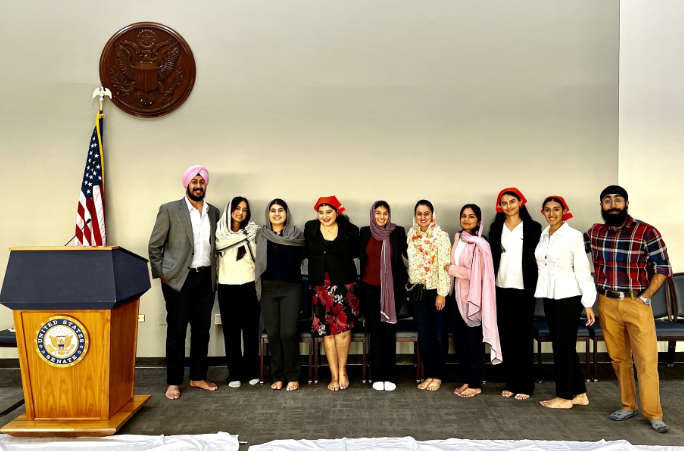
Nearly 150 people, including members of Congress, attended the annual Langar hosted by the Sikh American Legal Defense and Education Fund (SALDEF)’s SikhLEAD Internship class and the office of Rep. Chuck Schumer, on Capitol Hill on July 26.

Langar is a 500-year old Sikh tradition that aims to eradicate segregation and classicism and promote food justice. Among the members of Congress who attended the event included Representative Judy Chu (CA-28) and Representative Shri Thanedar (MI-13).

Speaking on the occasion, SALDEF Executive Director Kiran Kaur Gill explained the importance of Langar in the context of the Sikh American experience.

“Sikh Americans have a long history of innovative community engagement and leadership, from the Honorable Dalip Singh Saund who was one of our great pioneers in Congress, to the advocates at SALDEF. Having the occasion to share a meal as equals is a strong reminder about the values of equality and universal friendship.”

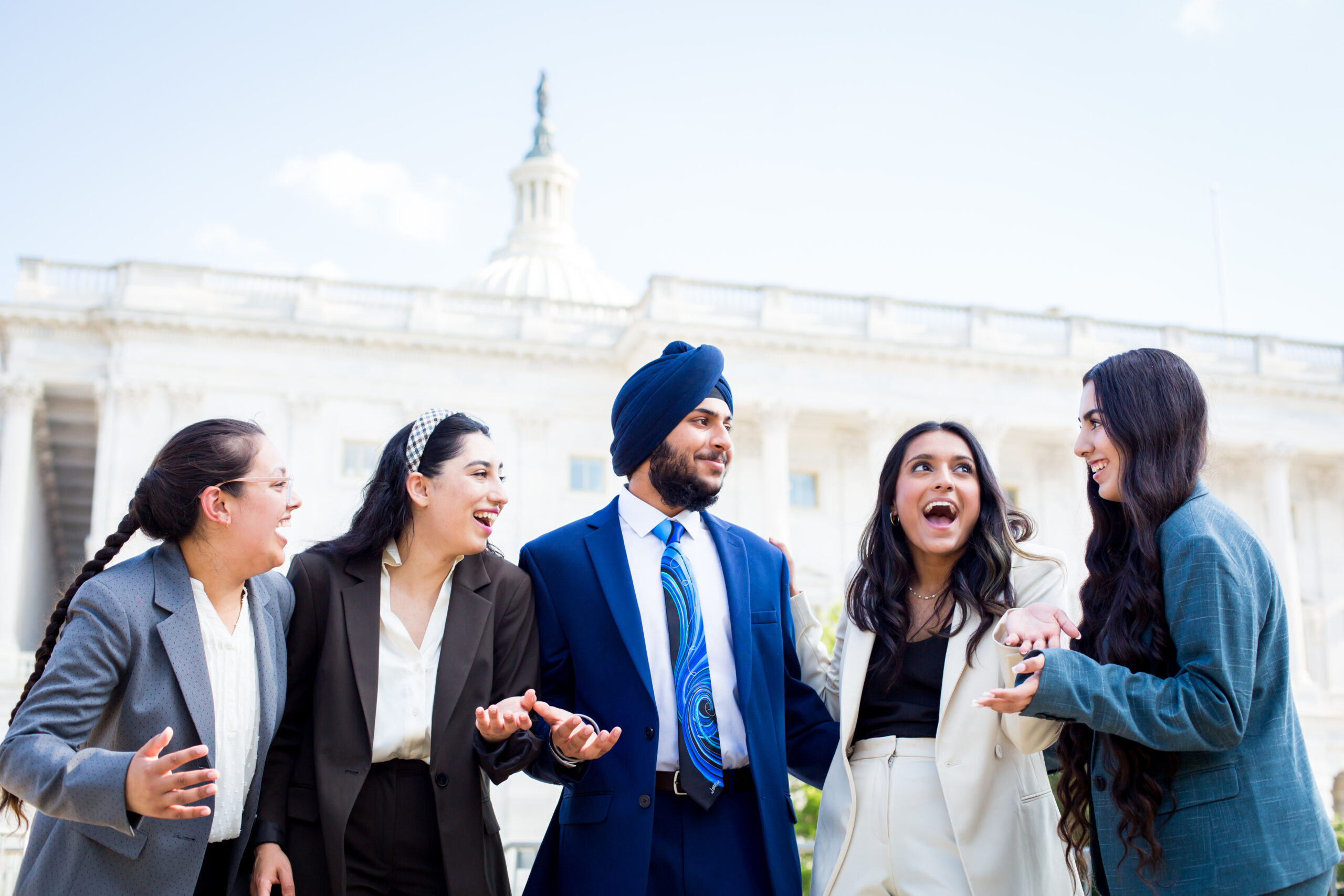
While Sikh Americans have a 125-year history in the United States, there are still a lot of misperceptions about the community. Langar on the Hill is a significant opportunity for us to introduce our American history and Sikh values, including equality for all. Moreover, it is a unique opportunity for this rising generation to express to our nation’s leaders how we intend to deepen our civic participation.

We’d like to take the time to thank the volunteers and all our supporters across the nation who donated to this event and contributed to its success.

(Washington, DC) — The Sikh American Legal Defense and Education Fund (SALDEF) is deeply disappointed with President Biden’s decision to celebrate Indian Prime Minister Narendra Modi with a state visit, and with Congressional leaders’ accompanying decision to honor PM Modi with an address to a joint session of Congress.


“We, alongside advocates for other Indian diasporic minorities undergoing intensely antidemocratic censorship, discrimination, and extrajudicial violence, are disheartened to see PM Modi receive the highest honors our federal government can bestow on a head of state,” said Kiran Kaur Gill, Executive Director of SALDEF. “As extensively documented by civil society, the US Commission for International Religious Freedom, and increasingly the State Department, the Modi regime is an appropriate designee of Country of Particular Concern status under the International Religious Freedom Act due to its widespread and escalating human rights violations. In this context, we feel deep disappointment that the administration and members of Congress have elected to turn a blind eye and to uncritically celebrate an autocratic regime in the name of geopolitics.”


From banning BBC documentaries about Modi’s career to raiding Western media offices in India to forcing social media platforms to comply with censorship demands, the Indian state demonstrates extraordinary commitment to pursuing its autocratic agenda globally.


“We are deeply appreciative of those in Congress who are opposing these decisions to overlook and minimize the struggle of communities like ours, and look forward to supporting their actions to demonstrate solidarity,” continued Gill.

Like many Sikh Americans, Tej Dhingra knows how it feels to not have his background fully understood. He was born and raised in Texas, where Sikhs make up only .05% of the state population. After noticing a lack of alternatives for turbans when it came to athletic sportswear, Tej decided to create his own solution.

Currently a sophomore at Bowdoin College, Tej is the founder of TAJ, which creates lightweight, breathable turbans designed for physical activity. Over the summer, Tej was accepted into the SALDEF Innovation Fellows program, where he was able to continue building TAJ with the support of a large Sikh network. 

The Innovation Fellows program provides the opportunity for aspiring Sikh American entrepreneurs to develop professionally through the exposure and evaluation of breakthrough technologies emerging out of federal laboratories and academic research centers. Fellows were given the opportunity to pitch their startups at the 2022 SikhLEAD Innovation Startup Competition. 

TAJ, which means “crown” in Punjabi, was selected as the winner of this competition. 

Turbans are a significant article of the Sikh faith. It represents equality, self-respect, and commitment to their religion: most visibly, long and uncut hair which observant Sikh men and some women wrap in a turban. Although he does not personally wear a turban, Tej has heard his Sikh peers and family members complain about the overheating and excessive sweating that turbans cause while exercising. 

“Sports meant everything to me as a child and it still occupies a huge role in my life,” said Tej, who grew up playing competitive tennis year-round. “The court is a safe space that gives me peace, confidence, and the ability to express myself in a unique way. So, the motivation behind TAJ was pretty simple. I wanted to create a product that allowed Sikh athletes to feel confident in their hair, and that didn’t force them to sacrifice comfort for their religious expression.”

Tej leveraged the Innovation Fellows Program to bring his idea to fruition. A major draw of the program for him was the mentorship that participants received. 

“The most valuable piece of advice I received was that before jumping to develop a solution or product, you need to first become obsessed with the problem itself, and analyze it from all angles.” 

Tej acted on this advice by conducting ‘customer insight interviews’ with dozens of Sikh athletes, college students, hair scientists, designers, and leaders in the smart-fabric industry. 

“Each conversation I had not only gave me a deeper insight into the emotional significance that turbans hold but also challenged assumptions I had previously held regarding the major pain points for Sikhs. This allowed me to tweak my strategy as I transitioned into prototype development.” 

The new and improved rendition of the product features a 100% polyester base and an elastic, spandex-like band to ensure a snug fit for the wearer. In his pitch, Tej also discussed incorporating anti-microbial elements such as copper to combat the bacteria that typically build up underneath the turban cloth.

Now, as an aspiring business leader, Tej hopes to continue channeling his passion for both sports and entrepreneurship to empower the Sikh community.

“The sports industry fascinates me, and I think there is definitely a rising demand for innovation centered around increasing diversity in sports. That is why I’m so excited to continue working on TAJ and hopefully raise awareness towards the Sikh American community in the process.”

(Washington, DC) – SALDEF is deeply concerned about the ongoing situation in Punjab, including reports about the suspension of internet services and restrictions on the social media accounts of non-government-aligned reporters, organizations, and members of the public in India and throughout the world.

The Sikh American community stands with the global sangat expressing their concerns about limitations on the rights of reporters, human rights, and free expression in India. Free expression is a cornerstone of an engaged and active democracy.

As demonstrated in SALDEF’s report on global censorship of our community during the 2020-21 Punjab Farmers’ Protest, “When #Sikh Was Banned Worldwide,” the Indian government has a record of using similar tactics to limit the voice of the Sikh community in India and around the globe.

SALDEF is connecting with the Biden Administration to share concerns. We encourage you to contact your public officials and the media to raise awareness and encourage them to speak out on the ongoing situation.  There are many ways you can help join the fight:

Background Information on the History of Censorship:

As outlined in our Censorship Report and by numerous human rights organizations, including ENSAAF and Amnesty International, the Indian government has a history of using repressive tactics to stifle protest and oppose dissent. These include:

  • Shutting down internet access in regions of the country
  • Restricting access to social media accounts and ordering take-down notices to tech companies, including the accounts of journalists, activists, and elected officials from around the world
  • Arrests and detention of activists, lawyers, and human rights organizers
  • Limiting the freedom of assembly and the freedom of the press

For many Sikhs in the diaspora, the current tactics of the Indian and state governments echo the experiences of minority communities across India. They remind people of traumas they and their families experienced in Punjab during the 1970s through the 1990s. These concerns have been heightened due to the actions taken during and in response to the Farmer’s Protests of 2020-2021.

SALDEF Investigates Decrease in Reported Anti-Sikh Incidents in Updated FBI Hate Crime Data

IMMEDIATE RELEASE: March 16, 2023
Contact: Jyot Singh | Research and Policy Manager | jyot.singh@saldef.org

The Federal Bureau of Investigation (FBI) released an updated 2021 national hate crime report, documenting 185 incidents of anti-Sikh hate crimes. While the vast majority of targeted groups saw an increase that corrected for the underreporting in the first release, the Sikh community  had 30 fewer incidents reported in the updated statistics, down from 214.

“We are gravely concerned that, in a side-by-side comparison of the original and updated hate crime data which corrects for underreporting, every non-Christian religious group saw an increase in reported incidents–except Sikh Americans. We are reaching out to the Department of Justice and other agencies to understand why correcting for underreporting resulted in 30 incidents of anti-Sikh hate disappearing,” said Kiran Kaur Gill, Executive Director of the Sikh American Legal Defense and Education Fund (SALDEF). “While 185 incidents is still extremely significant, we are working to understand why our community–which has historically high bias and hate incidents per capita year-over-year–has been the only one with such a significant reduction.” 

The original 2021 hate crime report released in December 2022 did not include data from at least 22% of law enforcement agencies across the country, including those in New York, Los Angeles, Chicago, and Phoenix (all areas with significant Sikh populations). This new dataset intends to fill those gaps in data, and overall does show significantly higher numbers of incidents across the board.

“The updated data to correct for underreporting reflect a 13.6% decrease in the reported number of anti-Sikh hate crimes. We are alarmed by this discrepancy, and we look forward to  conversations to determine the exact cause of this and to prevent erasure of our community in future federal hate crimes data,” continued Gill.

Governor Signs Bill Requiring Educators to Provide Anti-Bullying Materials

Sikh Americans in California commend Governor Jerry Brown, who recently signed a historic bill to counter school bullying. The Safe Place to Learn Act will now protect Sikh, Muslim, and other students when they are harassed in schools.

The legislation (AB 2845) will require the California Department of Education to assess whether schools adequately provide information to educators and community members regarding students who are subject to discrimination and bullying based on actual or perceived religious affiliation.

“When we reached out to Sikh Americans in California to contact their elected officials, they responded,” said SALDEF Executive Director Deepinder Singh. “We’ll use the momentum from this legislative victory to continue expanding our work so every student can achieve their full potential without fear of harassment.”

AB 2845 was introduced by Assemblymember Das Williams. SALDEF advocated for its passage as part of a diverse coalition that includes Asian Americans Advancing Justice – California, Council on American-Islamic Relations, California Chapter, and the Sikh Coalition.

The bill also requires the Superintendent of Public Instruction to post anti-bullying resources related to affiliation or perceived affiliation with any religion, nationality, race, or ethnicity on its website.

If you have any questions about bullying and harassment in schools, please email info@saldef.org or call our national office at 202-393-2700. Thank You

SALDEF Appoints Professional with Nonprofit, Academic and Military experience

WASHINGTON, D.C. — Deepinder Singh—an accomplished academic, nonprofit trail-blazer, and U.S. Army veteran—was recently chosen to lead the Sikh American Legal Defense and Education Fund (SALDEF) into its third decade. Most recently, Deepinder served as Director for the Center for Catholic Studies and Interfaith Dialogue and a full-time faculty member in the Philosophy and Religious Studies Department at Madonna University in Michigan. “Deepinder stood out among a number of impressive candidates during our search because of the depth and breadth of his experience,” said SALDEF Board Chair Manjit Singh (no relation), who serves on President Obama’s Advisory Council on Faith-based and Neighborhood Partnerships. “We are thrilled that Deepinder will be leading SALDEF into its third decade so we can continue developing innovative programs to create a more inclusive society.” “I am honored and privileged to join an organization with such a phenomenal record of empowering the Sikh Americans–and, indeed–all Americans,” said Deepinder. “All the volunteers, board members, and staff during the last two decades have created the ideal conditions to make the organization even more impactful.” Deepinder Singh succeeds Jasjit Singh (no relation), who immediately followed his seven-year tenure at SALDEF by becoming a Senior Policy Advisor at the White House Advisory Council on Faith-based and Neighborhood Partnerships in Washington, DC earlier this year. Deepinder Singh’s bio appears below. He is available for TV, print, and web interviews. — Deepinder Singh has played an important role in academics, advancement, policy research and implementation in the roles of professor, academic administrator and director for numerous centers in the fields of academics and nonprofit, civil-rights advocacy. Deepinder comes to us from Madonna University in Michigan, where he was concurrently Director for the Center for Catholic Studies and Interfaith Dialogue while serving as a full-time faculty member in the Philosophy and Religious Studies Department. Deepinder has a B.A. in history and philosophy and a Masters in philosophy from Western Michigan University. His doctoral dissertation and research is in political philosophy. Deepinder has presented his research at academic conferences, held workshops at major research institutions, and has been the recipient of numerous grants and awards. Outside of academics, Deepinder is a United States Army Veteran and has served honorably in numerous areas of conflict. He is from Chelsea, Michigan. -End-

Who can make the Sikh American voice heard? You. ELECTION DAY IS NOVEMBER 8—Register to Vote Today! Protect Your Rights on Election Day Voter Rights Information – in English and Punjabi Voter Protection Hotline and Legal Aid – Lawyer’s Committee for Civil Rights 1-866-OUR-VOTE Quarter Sheet handouts (in English & Punjabi) – Full page (four to a page) and 4.25″x5.5″ You can do a lot in your own community to empower Sikhs across America. One of the easiest things to do is encouraging people to vote. Why should you? In 1923 the Supreme Court said Sikh Americans could not become citizens — we could not vote and were denied a voice in our country. Today, we have the right to vote, the right to share our voice and determine the direction of our nation. By voting, we can influence the decisions our elected officials make which impact our rights. Increasing the number of Sikh Americans registered to vote is one of the best ways to build and strengthen our community’s voice, presence and political capacity. But how do you do it? Join SikhVOTE! Volunteer at a registration drive or register new Sikh American voters at your local Gurdwara and encourage registered Sikh Americans to vote on Election Day, Tuesday, November 3, 2015. You will find a series of tools and information updated through Election Day for you to use. If you have any questions, send us an email. Tools & Resources SikhVOTE Voter Registration Toolkit Online Registration Widget Calendar, Deadlines & State Information Resources SikhVOTE Voter Registration Toolkit SikhVOTE Volunteer Voter Registration Toolkit – download here Election Day & Know Your Rights Poster (in English & Punjabi) – download here Survey & Pledge to Vote – download here Email Sign Up Sheet – download here Voter Rights Information – in English and Punjabi Quarter Sheet handouts (in English & Punjabi) – Full page (four to a page) and 4.25″x5.5″ Sample gurdwara announcement (in English & Punjabi) – download here Online Registration Widget Want to put an online registration widget on your website? Get it here.     Resources National Voter Registration Form – http://www.eac.gov/voter_resources/register_to_vote.aspx Instructions for the National Voter Registration Form in Punjabi (unofficial) – download here Absentee Ballot Information – http://www.longdistancevoter.org/absentee_ballots State Specific Information – http://www.rockthevote.com/election-center/ Voter Protection Hotline, Legal Aid, and Resources – http://www.866ourvote.org/ State Voter ID Laws – http://www.ncsl.org/legislatures-elections/elections/voter-id.aspx APALC – www.apalc.org APIAVote – www.apiavote.org 18 Million Rising – www.18mr.org SikhVOTE is a project of the Sikh American Legal Defense and Education Fund (SALDEF) with the purpose of empowering Sikh American voters. SALDEF is a 501(c)3 non-partisan organization that does not advocate on behalf of any party, candidate, or campaign. Use of these materials does not constitute an endorsement by SALDEF.

SALDEF Conducts Cultural Awareness Presentation for Baltimore Office of EEOC

On March 28th, SALDEF conducted a cultural awareness presentation for the U.S. Equal Employment Opportunity Commission (EEOC) District Office in Baltimore, MD. The entire Baltimore staff was invited to attend. Participants were informed about the Sikh faith and religious practices through these trainings, along with providing recommendations for interacting with the Sikh American community. SALDEF staff discussed the various employment related challenges faced by the Sikh American community and shared examples of cases from different industries and professions. SALDEF believes that through these trainings, employment discrimination cases against Sikh Americans will be more effectively and efficiently handled.

To read about our recent engagement with EEOC offices in Washington, DC and Los Angeles, click here.

SALDEF Attends Congressional Forum About Racial Profiling and Shooting of Trayvon Martin

On March 28, SALDEF staff attended a Congressional Forum addressing racial profiling, federal hate crimes enforcement and issues surrounding the shooting death of Trayvon Martin, in an effort to support the call for a full investigation by the Department of Justice into this tragic death.

On February 26 2012, Trayvon Martin, 17, was walking in a gated neighborhood in Sanford, Florida. He was returning to his father’s house after buying a bag of candy and a can of iced tea from a local convenience store. George Zimmerman, a neighborhood crime watch volunteer, said Martin looked “suspicious” and decided to follow and confront Martin against the instructions of a 911 police dispatcher. The exact chain of events following this confrontation is not fully known. What is known, however, is that Zimmerman shot and killed Martin. Although a homicide occurred, the Sanford Police Department chose not to press charges or arrest Zimmerman because he claimed he shot Martin in self defense.

Many argue that Martin was racially profiled and targeted because of the way he looked – the color of his skin, and the clothes he was wearing. SALDEF believes racial profiling is wrong and ineffective. Support the End Racial Profiling Act here by notifying your Senator/Congressman.

SALDEF Joins Other Organizations in Support of Immigration and Civil Rights

SALDEF joined the Leadership Conference on Civil and Human Rights, the Southern Poverty Law Center and over 100 other local and national civil rights and faith groups, have signed-on to an amicus brief filed with the U.S. Supreme Court. The brief argues that Arizona’s S.B. 1070, an anti-immigration bill, and copycat bills passed in other states, fundamentally conflicts with federal law and would have an unprecedented negative impact on the lives of American citizens and lawful permanent residents, as well as many others living in the U.S. legally.  Recounting real-life examples, the brief documents how law-abiding Americans, particularly minorities, will now be subject to constant scrutiny, lengthy detentions, and false arrests.

Additionally, SALDEF has signed-on to a letter drafted by the Rights Working Group asking Attorney General Eric Holder and the Department of Justice to revise the June 2003 Guidance Regarding the Use of Race by Federal Law Enforcement Agencies. The June 2003 Guidance is in need of revision as it does not prohibit profiling based on religion or national origin and contains loopholes in the context of border and national security.

2012 Sikh American Pocket Calendars Still Available

This handy resource can be used in your local community to educate and increase awareness of Sikhs and Sikhi.  The calendars feature full-color images of Sikh Americans, along with examples of core Sikh values and facts about Sikhs in the United States. On the inside, the cards have a 2012 calendar in an easy-to-use design. Sikhs across the nation have distributed them at their workplace, schools, convenience stores, gas stations, taxi cabs, senior citizens centers, and public libraries. The calendars are available in bundles of 100 for $10 plus shipping and handling.  .

SALDEF Invited by DHS Secretary to Participate in Faith Based Advisory Council

At the request of Secretary Napolitano, a faith based advisory council comprised of leaders from state and local government, the private sector, and academia was created to provide advice and recommendations to the Secretary on matters related to homeland security. The Council has been tasked to explore current and potential security enhancement opportunities and methods between DHS and the faith-based communities. It will address how DHS can best support local security officers and organizations” efforts to keep faith-based communities safe, secure, and resilient.

SALDEF Conducts Training of Transit Police Academy in Massachusetts Bay

On March 28, 2012, SALDEF conducted a training for the Massachusetts Bay Transit Authority Policy Academy (MBTA). The MBTA provides law enforcement services to designated areas within all public transportation associated areas and is one of the oldest law enforcement agencies in the country.  More than 50 members of the service were in attendance and received the training.  SALDEF recognizes and specially thanks Jaswant Singh Chani as a dedicated SALDEF volunteer and Law Enforcement Trainer.

SALDEF Attends White House Event With First Lady
SALDEF was invited to attend the Centennial Cherry Blossom Festival in Washington DC on March 27th. 100 years ago, First Lady Helen Herron Taft and Viscountess Chinda, wife of the Japanese Ambassador to the United States, planted the first cherry blossom trees in Washington, DC.  The 3,000 trees were presented to the country as gift symbolizing the friendship between the United States and Japan. First Lady Michelle Obama joined Japanese Ambassador Ichiro Fujisaki, Secretary of the Interior Ken Salazar, and President Taft’s great-grandson William H. Taft IV at the Tidal Basin to plant a new cherry blossom sapling.  The First Lady spoke of her hope that this friendship between the United States and Japan could be celebrated again one hundred years from now.

Interested in Working in the World of Intelligence?

Interested in obtaining an exciting job that requires a security clearance? CAPAL and the Sejong Society will be holding an informative discussion with representatives from the CIA, other government agencies, and private sector organizations in order to provide interested individuals with necessary information on how to apply and acquire such jobs. These agencies will also have job recruiters present and will be collecting resumes. Please RSVP if you plan to attend the event by Tuesday April 10 by clicking here. The event is on Thursday April, 12 from 6-8:30 pm at the Johns Hopkins SAIS in Washington, DC.

Upcoming Events

  • April 18 — Dept. of Justice Training– Lexington, KY
  • April 22 — Bullying Workshop, Khalsa Care Foundation — Los Angeles, CA
  • May 6 — Know Your Rights Forum — San Jose, CA
  • May 13 — Know Your Rights Forum — Seattle, WA
  • May 25-28th — SikhLEAD Leadership Development Program Retreat — Los Angeles, CA

Educate your neighbors, friends, and co-workers about Sikh Americans in an easy, informative way through our annual pocket calendars.

In their ninth year of production, the 2012 calendars feature full-color images of Sikh Americans, along with examples of core Sikh values and facts about Sikhs in the United States. In a new folded style, the cards have a 2012 calendar in an easy-to-use design that fits the sizing of standard business cards.

To reach out even more effectively, Spanish language versions are also available.

The annual SALDEF Pocket Calendars have already been widely distributed; today! This handy resource can be used in your local community to educate and increase awareness of Sikhs and Sikhi.

“The pocket calendars are a great way to introduce myself to my customers. They are a must have for all Sikh businesses.”

– Oregon Small
Business Owner

The calendars are perfect for distribution at your workplace, schools, convenience stores, gas stations, taxi cabs, restaurants, senior citizens centers, or public libraries. Sikhs across the nation have shared them with their friends, neighbors, customers, and local officials.

SALDEF encourages the Sikh American community to take initiative in informing and educating others about their culture and faith.

The calendars are available in bundles of 100 for $10 plus shipping and handling fees.