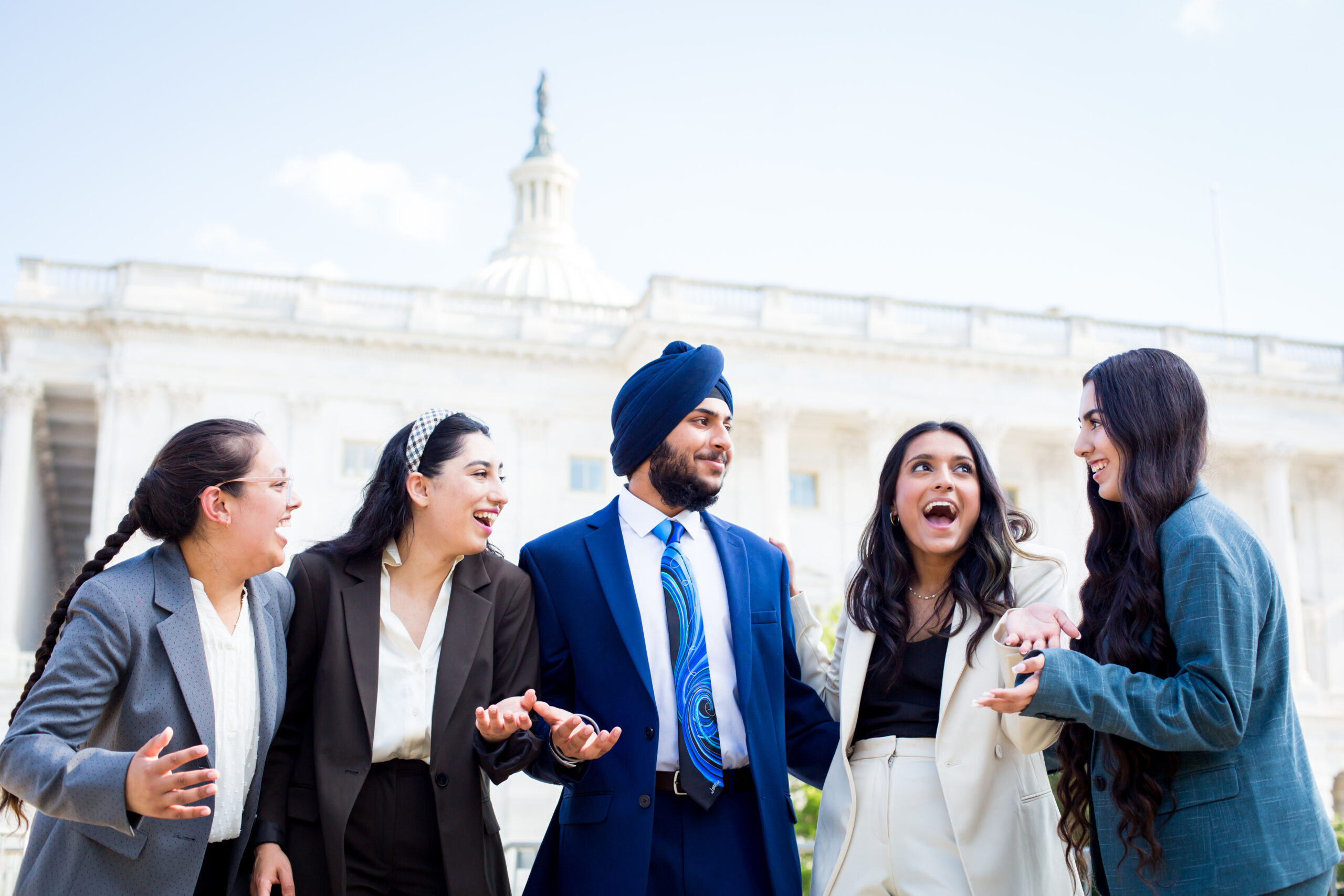
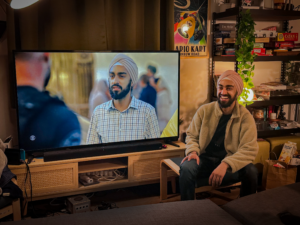
Jeevin Singh Neelam, a former SikhLEAD intern, recently made waves by appearing in a major role on CBS’s hit TV show S.W.A.T.!
In this insightful interview, we delve into Jeevin’s journey, from his early days as a SikhLEAD participant to his big-screen debut. We also discuss the importance of authentic Sikh representation in media and the role of organizations like SALDEF in empowering young Sikh talent.
How did being cast in this role personally impact you, and what did it mean to see yourself represented on a major platform like CBS?
Being cast in this role is my first “big, professional” role I guess you could say in this industry.
Being able to say I booked a guest star role on a Paramount CBS show is a huge honor and I am immensely grateful for the opportunity. It gives me the confidence to believe that pursuing a career in this industry as an actor is possible, regardless of my visible identity. It also signifies that Hollywood is becoming more and more ready for diversity and hopefully this will only continue to grow.
Can you discuss the process of developing your character?
Playing Raj was an incredible journey for sure, but speaking frankly, I think by the time I got the script it was pretty authentic to Sikh representation.
I think it’s also important to point out that just like any other actor, I am playing a character; my own viewpoints about certain topics don’t necessarily have to replicate those of Raj’s.
How did your experience as a SikhLEAD intern prepare you for this opportunity? Did the skills and knowledge gained through the program contribute to your success?
SikhLEAD was a great internship I had earlier on in college that allowed me to leverage working in a professional setting when interviewing for future internships/jobs. For example, I was able to talk about SikhLEAD in my interviews for HBO where I interned and worked at for the two summers after I interned at SikhLEAD. In this way, the program aided me to get my foot in the door in the entertainment industry.
How does this role contribute to the broader goal of promoting authentic Sikh representation in media? What impact do you hope this will have on the Sikh community and wider society?
I think one inspiring aspect of this whole experience was, as far as I know, this is the first time a Sikh male with turban and beard is the “hero” of a major Hollywood studio production. (obviously I could be mistaken!!). As a kid growing up, it would have been so cool to see a Sikh guy as a hero or even just a character in a show, and I am hoping this leads to more writing/casting of Sikh characters in Hollywood.
What are your hopes for the future of Sikh representation in media? What kind of stories do you want to see told?
I want Sikhs to be portrayed in every way – the hero, the villain, the sexy love interest, the nerdy man behind the camera, etc. Because while Sikhi is often the first identity someone thinks of when they see me, my personality is made up of many different identities and I hope that can be reflected in stories on screen.
Feeling inspired by Jeevin’s story? You can follow in his footsteps!
SikhLEAD internships are tailored to YOUR career interests. Whether you’re a high school student or a post-graduate student, we have opportunities for you.
FOR IMMEDIATE RELEASE Wednesday, December 11th, 2024 Contact: media@saldef.org
SALDEF Issues Clarification on Statement Regarding Harmeet Dhillon’s Nomination to DOJ
WASHINGTON D.C. — SALDEF (Sikh American Legal Defense and Education Fund) acknowledges the concerns raised by members of our community regarding our initial statement on the nomination of Harmeet Kaur Dhillon for Assistant Attorney General for Civil Rights at the Department of Justice. Upon reflection, we recognize that our statement fell short of aligning with our mission and our duty to hold our leaders accountable. Our mission guides us to lead with nimrata (humility) and serve our sangat (community) with integrity and accountability and we thank all those who offered their feedback and counsel.
Our intention was to recognize the historical significance of Ms. Dhillon’s being the first Sikh American nominated for this role, given her prior contributions to civil rights advocacy, including her volunteer work with SALDEF and other Sikh causes in the years following 9/11. At that time, Ms. Dhillon actively supported efforts to address workplace discrimination, bullying, and the accommodation of Sikh articles of faith. In 2013, she was recognized by SALDEF for her contributions to civil advocacy, including serving on the board of the Northern California ACLU. In our original statement, we failed to appropriately address the deeply concerning aspects of her recent record.
While we acknowledge Ms. Dhillon’s past contributions, we also recognize her more troubling recent positions and actions that warrant critical examination. In recent years, Ms. Dhillon has pursued positions and legal actions that undermine the very communities SALDEF is committed to advocating for by showcasing a concerning pattern of prioritizing partisan interests over civil rights protection. Representation alone is not enough—true leadership in civil rights must be rooted in the defense of all communities and the values of equity, justice, and inclusion.
We urge the Senate Judiciary Committee to fulfill its constitutional role to advise and consent by thoroughly vetting Ms. Dhillon’s record. Her nomination should rise or fall on the merits of her ability to lead the Civil Rights Division as a nonpartisan champion for justice, rather than in service of the short-term political goals of any administration.
If confirmed, SALDEF will work with Ms. Dhillon and the Department of Justice to advance the rights of all communities and hold them accountable to the highest standards of civil rights protections by speaking out on any failure to uphold these principles. Our commitment remains steadfast: to ensure that the civil rights of all Americans, including Sikh Americans, are respected and protected at every level of government.
Since 1996, SALDEF has been dedicated to defending the rights of all Americans, especially those most marginalized and vulnerable to injustice. We thank our community for holding us accountable and reaffirm our pledge to act in service of sarbat da bhalla (welfare for all).
SALDEF Congratulates Harmeet Kaur Dhillon as the First Sikh American Nominated for Nation’s Top Civil Rights Post
Washington, D.C.— SALDEF (Sikh American Legal Defense and Education Fund) proudly recognizes the historic nomination of Harmeet Kaur Dhillon as Assistant Attorney General for Civil Rights at the U.S. Department of Justice by President-elect Donald J. Trump. If confirmed, Ms. Dhillon will be the first Sikh American to hold this critical position, marking a significant milestone in the advancement of Sikh representation in public service.
Harmeet Kaur Dhillon is a distinguished attorney and Republican Party official. She earned her Bachelor of Arts from Dartmouth College and her Juris Doctor from the University of Virginia School of Law, where she served on the editorial board of the Virginia Law Review. Following law school, she clerked for Judge Paul V. Niemeyer of the U.S. Court of Appeals for the Fourth Circuit. Ms. Dhillon is the founder and managing partner of the Dhillon Law Group Inc., a firm specializing in commercial litigation, employment law, First Amendment rights, and election law matters. She also established the Center for American Liberty, a nonprofit organization dedicated to defending civil liberties.
Her leadership roles include serving as the former vice chairwoman of the California Republican Party and as a National Committeewoman of the Republican National Committee for California.
“As a community, we are proud to see a Sikh American woman nominated to a position charged with protecting the civil rights of all Americans,” said SALDEF Board Chair Kavneet Singh. “This nomination underscores the progress our community has made in gaining recognition and representation at the highest levels of government.”
SALDEF also acknowledges the significant responsibilities of the Assistant Attorney General for Civil Rights, a role that directly impacts the safeguarding of fundamental freedoms, addressing hate crimes, combating racial and religious profiling, and expanding voting rights.
“As we celebrate the historic nature of this nomination, we look forward to working with Harmeet to ensure the Department of Justice protects the civil rights of all communities,” said Kiran Kaur Gill, SALDEF’s Executive Director. “SALDEF remains committed to working with the Department of Justice and the incoming administration to fight for the civil rights of all Americans and ensure that the Sikh American community is represented fairly.”
Ms. Dhillon’s relationship with SALDEF spans over two decades. As a volunteer lawyer, she worked on critical civil rights matters, including cases involving employment discrimination.
###
For Immediate Release
Date: October 25, 2024
Contact: media@saldef.org
Valadao introduces House Resolution recognizing the Sikh Genocide of 1984
WASHINGTON – Today, Congressman David G. Valadao (CA-22), co-chair of the Sikh American Congressional Caucus, and Congressman Jim Costa (CA-21) introduced a resolution to formally recognize and commemorate the Sikh Genocide of 1984. California is home to the largest Sikh population in the U.S., with the majority residing in the Central Valley.
“Sadly, many Sikhs have been targeted for their religious beliefs throughout history, including during the 1984 genocide,” said Congressman Valadao. “The Central Valley is home to a vibrant Sikh community and I’m proud to stand with them in demanding recognition and accountability for this horrific event in their history. This resolution is a small but important step to commemorate this tragedy and honor the innocent victims who lost their lives while practicing their faith.”
“As we mark the 40th anniversary of the Sikh Genocide, we remember a dark chapter in history that inflicted pain on Sikh families and communities. This is not just a distant tragedy—it hits home for us here in the San Joaquin Valley, where so many of our Sikh neighbors have shared their stories of loss, survival, and resilience. This resolution is more than a symbol — it’s a time to recognize this horrific time that our Sikh community experienced,” said Congressman Costa.
Reps. Valadao and Costa were joined in introduction by Reps. Josh Harder (CA-09), Vince Fong (CA-20), and John Duarte (CA-13).
The resolution is supported by the Sikh American Legal Defense and Education Fund (SALDEF), American Gurdwara Parbandhak Committee, American Sikh Caucus Committee, Ensaaf, Jakara Movement, Sikh Coalition, Sikh Coordination Committee East Coast (SCCEC), and the United Sikhs.
“This resolution is a historic acknowledgment of the deep scars the Sikh genocide of 1984 has left on our community. It not only honors the memory of those we lost but also empowers Sikh Americans and allies who have been fighting for decades to ensure that these atrocities are not forgotten. We are especially grateful to Congressman David Valadao for his unwavering support and for bringing this issue to the forefront of American consciousness. Today, we see a step toward justice and the validation of our truth,” said Kiran Kaur Gill, Executive Director, Sikh American Legal Defense and Education Fund (SALDEF)
“This resolution marks a pivotal moment in our ongoing quest for justice and truth. The American Gurdwara Parbandhak Committee, representing Sikh religious institutions across the nation, has long advocated for the recognition of the atrocities committed during the 1984 Sikh Genocide. We thank Congressman Valadao for his courageous leadership and reaffirm our commitment to ensuring that the stories of our martyrs are preserved, and that justice is pursued relentlessly,” said Gudev Singh, Acting President, American Gurdwara Parbandhak Committee (AGPC).
“This resolution is a turning point in our community’s decades-long pursuit of justice and recognition. For too long, the horrors of 1984 have been hidden from the global stage. Today, we honor the memory of those who suffered and ensure their voices will never be silenced. We extend our deepest gratitude to Congressman David Valadao for his leadership of the American Sikh Congressional Caucus, and in championing this cause, marking a momentous step toward accountability and healing for Sikh Americans and Sikhs worldwide,” said Dr. Pritpal Singh, Founder, American Sikh Caucus Committee.
“This resolution marks a crucial victory in the battle for truth and justice for the victims of the 1984 Sikh Genocide. It stands as a testament to the resilience of our community, which has sought justice for decades. While we still have a long road ahead in terms of accountability, this first step of recognition in the U.S. House of Representatives gives us hope that justice one day will prevail,” said Sukhman Dhami, Co-Director, Ensaaf
“The introduction of this resolution is not just about acknowledging the past but ensuring that future generations understand the truth about the 1984 Sikh Genocide. For Sikh youth and activists, this is more than a political milestone—it’s a validation of the pain our elders endured and a commitment to never allow history to forget. The Jakara Movement looks forward to working alongside Congressman Valadao to continue shining a light on this dark chapter and to ensure that justice for the victims remains a priority for all,” said Naindeep Singh, Executive Director, Jakara Movement.
“This is the first time a federal resolution has been introduced to recognize the 1984 Sikh Genocide, and it sends a powerful message: the world is watching, and the atrocities committed against Sikhs will not go unnoticed. We are deeply thankful to Congressman David Valadao for his leadership in this effort, and we look forward to building a broad coalition of support to ensure its ultimate passage. Today’s recognition fuels our resolve to continue advocating for justice and accountability,” said Harman Singh, Executive Director, Sikh Coalition.
“The introduction of this resolution is a significant step forward for Sikhs worldwide, especially for those of us who have been tirelessly advocating for the truth to be recognized. The Sikh Coordination Committee East Coast stands united with our brothers and sisters in the continued pursuit of justice for the victims of 1984. This resolution acknowledges not only our pain but our perseverance, and we are grateful to Congressman Valadao for standing with us in this cause,” said Himmat Singh, Sikh Coordination Committee East Coast (SCCEC).
“As a global humanitarian organization, United Sikhs has long championed the cause of justice and human rights for the Sikh community. The introduction of this resolution in the U.S. Congress is a watershed moment for our community’s struggle for truth and justice. It is an acknowledgment that the international community is listening, and it reinforces our collective resolve to ensure that the horrors of 1984 are neither ignored nor repeated. We extend our deepest gratitude to Congressman Valadao for his leadership and solidarity,” said Hardayal Singh, United Sikhs.
Background:
In June 1984, Indian Prime Minister Indira Gandhi ordered a military assault on Sri Darbar Sahib, a sacred place of worship more commonly known as The Golden Temple. During Operation Blue Star, the Indian Army used heavy artillery and tanks to lay siege on The Golden Temple complex, murdering thousands of civilians as an attempt to suppress Sikh religious rights and freedoms. This tragedy is considered by many as the beginning of the Sikh Genocide.
Following the death of Indian Prime Minister Indira Gandhi on October 31, 1984, the Indian government launched a multi-day campaign of state-sponsored violence and repression against Sikhs that included disappearances, targeted killings, and coordinated mass violence. Political unrest in India throughout 1984 resulted in the loss of thousands of Sikh lives. Today, transnational repression is still a widespread issue impacting the Sikh community.
SALDEF Commends the DOJ for New Charges Against Indian Government Employee Targeting Sikh Americans
SALDEF (Sikh American Legal Defense and Education Fund) is deeply alarmed by the Department of Justice’s announcement of charges against Vikash Yadav, an Indian government employee, in connection with a plot to assassinate a U.S. citizen and Sikh activist on American soil. This is a stark reminder of the escalating and dangerous reality of transnational repression targeting diaspora communities in the United States.
We commend the Department of Justice, FBI, and the federal government for their vigilance and commitment to protecting the safety and sovereignty of Americans. However, this incident highlights the urgent need for continued and comprehensive action to protect vulnerable communities in America, particularly the Sikh diaspora, who have been increasingly targeted for their activism and dissent against foreign governments.
The Sikh American community in the United States has a fundamental right to advocate for human rights and justice without fear of intimidation, violence, or retaliation from foreign actors. SALDEF urges the U.S. government to continue its efforts in holding foreign governments accountable for any attempt to silence or harm American citizens within our borders.
“We are outraged and deeply concerned by the attempted assassination of plot a Sikh American on U.S. soil, orchestrated by an Indian government employee,” said Kiran Kaur Gill, Executive Director of SALDEF. “This is a grave violation of our community’s rights and a threat to American democracy. We applaud the Department of Justice and federal law enforcement for their swift action, but we must do more. The United States must take concrete steps to protect all Americans from foreign repression, as seen with the charges filed today. We call on Congress to pass the Transnational Repression Reporting Act, championed by Representative Adam Schiff, to ensure transparency and accountability in addressing these threats. Sikh Americans, like all communities in the United States, have the right to live without fear of foreign intimidation or violence.”
SALDEF remains committed to advocating for the safety and rights of Sikh Americans and other diaspora communities affected by transnational repression. We urge the government to continue making strong public statements and enacting legislation that safeguards our constitutional rights and protects our communities from foreign interference.
FOR IMMEDIATE RELEASE
October 2, 2024
Contact: Amrita Kular, SALDEF Director of Communications
(202) 393-2700 | media@saldef.org
Joint Sikh Organizational Statement on Anti-Sikh Sentiments and Narratives in California
October 2, 2024 (Sacramento, CA) — The Sikh American Legal Defense and Education Fund (SALDEF), the Sikh Coalition, the Jakara Movement, and the American Sikh Caucus Committee issued the following joint statement in response to the Sacramento Bee’s October 2 story, “In the shadow of a freeway shooting lurks the fear of Sikhs threatened in California.”
“As organizations working for the civil rights of the Sikh community throughout the United States, we are grateful to the Sacramento Bee for their comprehensive reporting on these critical issues. We have long raised concerns about a concerted effort to blur the lines between Sikhs, supporters of Khalistan, and terrorists or extremists; much of the information and many of the claims made by those quoted in this article validates those fears.”
“First, we are deeply disturbed to know that advocacy groups have been pushing a political agenda in their trainings to law enforcement. It is in the interest of all communities that crimes—including acts of vandalism at houses of worship—are investigated promptly and transparently so that perpetrators can be held to account; to our knowledge, there is no evidence that pro-Khalistan or Sikh individuals are responsible for any such crimes in California. In any case, it is incumbent on law enforcement to ensure that they are receiving objective information about threats to the communities that they serve. We look forward to conducting our own outreach in the interest of correcting any misinformation or disinformation that may have been shared.”
“Second, we are alarmed at the reports of the October 2023 meeting between Fresno Mayor Jerry Dyer, former Fresno Chief of Police Paco Balderrama, and numerous activists of unknown background or qualifications. The idea that individual Sikh community members are being singled out, accused of links to terrorism, and suggested to be ‘monitored’—all without any evidence of wrongdoing—is profoundly disturbing. To think that one community could do this to another in a post-9/11 world is beyond disheartening.”
“And finally, we are angered by the insinuation of Hindu America Foundation (HAF) Community Outreach Director Ramya Ramakrishnan that northern California gurdwaras (Sikh houses of worship) are somehow institutionally connected to drugs, weapons, and organized crime. Given the shared reverence in the Hindu and Sikh faith traditions for the importance of houses of worship, we fully expect that HAF will issue a public apology for these remarks immediately.”
(RNS) — On National Voter Registration Day, Sikh women leaders spoke at ‘Kaur Power Hour,’ a webinar dedicated to raising up ‘the minority within the minority’ to recognize their voting power in this upcoming election.
The Sikh faith has a long history of political activism in India. On National Voter Registration Day Tuesday (Sept. 17), Sikh women drew on that legacy to encourage their community in the U.S. to vote in the upcoming presidential election.
Amrita Bamrah, executive director of Dasvandh Network, a nonprofit fundraising platform based in the Sikh value of giving, spoke to more than a hundred “Kaurs,” or Sikh women, for “Kaur Power Hour,” an online event hosted by the Sikh American Legal Defense and Education Fund.
“Our ancestors didn’t wait for change, they made it,” Bamrah told those gathered online. “And today, in that same spirit, our vote is one of the most powerful tools that we have to really continue that legacy.”
Kaur, the surname or middle name taken by many Sikh women as a symbol of equality and spiritual empowerment, was as much of a catchy webinar title as it was a call to action. Sikhism, also called Sikhi, is an Indic faith native to Punjab, India, that teaches scripture from the Guru Granth Sahib.
“We are a part of a history just woven with angles of those who stood up for justice, equality and the rights of individuals,” Bamrah said. “Our faith is built on these principles of courage and compassion and time and again, when we look at history, our community has risen to confront oppression, to uplift those who were silenced, and to create change where it was needed.”
The organizers of Kaur Power Hour said in the U.S. there is still work to be done to politically motivate the community. Though Sikhs can be found “truly everywhere,” reaching out to women is especially crucial, said Jaslin Kaur, Sikh organizer and former Queens City Council candidate.
Jaslin Kaur addresses the Kaur Power Hour virtual event, hosted by the Sikh American Legal Defense and Education Fund. (Video screen grab)
“Unfortunately, campaigns already don’t reach out to Sikhs enough, but they sure don’t reach out to Sikh women,” she said to the audience. “I think it’s our job as fellow sisters to reach out behenji (sister) to behenji and ensure that our fellow Sikh women are registered and ready to vote.”
The Power Hour, said SALDEF’s executive director, Kiran Kaur Gill, had a twofold objective: getting as many Sikh Americans as possible registered to vote and emphasizing how important Sikh women are in the national conversation.
As the oldest Sikh advocacy organization in the nation, SALDEF has led a voter education program called SikhVote for over a decade. Directly after 9/11, many Sikhs — especially those wearing turbans and other outward signs of their faith — were racialized and attacked over their misperceived Muslim identity. That galvanized many Sikh Americans to get involved in the political sphere. Sikhs organized especially for issues of religious freedom, hate crimes and workplace discrimination, including the protected ability to carry a kirpan, or Sikh sword, and the right to wear a turban in the U.S. military.
But according to Gill, while Sikh women are incredibly involved with their cultural, social and religious leadership, they have not necessarily been at the forefront of political engagement.
“We noticed that with phone banking, one of our volunteers mentioned that when he would call and ask about voter registration, sometimes, you know, women would hand the phone over to their husband,” she said. “And so, we are trying to say: ‘No, you know, this conversation is for everyone. Everyone has the right to vote and should exercise that right.’”
There are an estimated half a million Sikh Americans in the U.S., and the number continues to grow, according to the Sikh Coalition, a nonprofit advocacy group. But civic participation has been hampered by language, citizenship status and a feeling among some members of the religious minority that their voice doesn’t matter.
Reaching the largely immigrant sangat, or Sikh fellowship, at their gurdwaras has been a key mission of SALDEF. Connecting U.S. political engagement with the Sikh value of seva, or service, has been especially rewarding for grassroots organizers such as Kush Kaur, Texas native and Sikh American National Youth Council Southern chair.
“I remember when an elderly uncle approached my table who had been a U.S. citizen for over a decade, but had never voted, believing his voice wouldn’t matter,” she told the audience. “But after a conversation about the power of each vote and the importance of Sikh representation, he was eager to begin his voting registration process and to tell his grandchildren about our conversation.”
The organizers believe that with this presidential election, the stakes are especially high.
“When Donald Trump won, I was really concerned for the future of this country, because we had just elected a man who brags about sexually assaulting women, a man whose rhetoric has resulted in having some of the most increases in hate crimes in our country, and a man who made fun of people with mental health issues,” said Manka Dhingra, the first Sikh woman elected to the Washington state Legislature. She started her career as a prosecuting attorney, overseeing issues of domestic violence and sexual crimes that she said more commonly affect women of color.
“For our national election, I am concerned that misogyny will rear its ugly head, and we cannot let it,” she said. “We have to make sure we trust women, we believe women, and we are going to follow the lead of women, because we know that when women are elected, they elevate everyone.”
More Sikh women than ever have been elected to political offices, noted Manpreet Kaur, the city councilwoman of Bakersfield, California, where Punjabi is the third most spoken language and the economy mirrors the agricultural society of Punjab.
“Kaurs are leaders, both in the home and clearly in governance as well, and that’s very important, because I also watched Kaurs lead within my own household and within my gurdwara,” Manpreet Kaur said, telling the story of her nani, or grandmother. “I don’t know anyone who was as excited to vote as my nani when she obtained citizenship. But it was more exciting to see my nani actually be able to read her own voter information ballots and information packets in Punjabi.
“That was a moment that will always stand out to me, because it really built on the history about the Kaurs before me and the Kaurs that are going to come beyond me,” she added.
Mayor Neena Singh of Montgomery Township, New Jersey, is the first Indian and Sikh woman elected to that post in her state. She spoke about the excitement she sees among Sikh youth. Finding a place of belonging, especially amid hateful rhetoric and ignorance, she said, is easier when there is representation in place.
“I think when we are in leadership, we have such an opportunity to empower not just our own community, but to let others know who we are and what we stand for, because I think that helps not just us, but our kids, and that’s the reason representation matters,” Singh said.
SALDEF Welcomes FBI’s Release of Punjabi PSA on Transnational Repression
SALDEF Acting Executive Director, Kavneet Singh said, “By releasing this announcement in Punjabi, the FBI is validating the ongoing and very real threat of transnational repression against Sikhs in America”.
WASHINGTON D.C. : The Sikh American Legal Defense and Education Fund (SALDEF) welcomes the Federal Bureau of Investigation (FBI) for releasing a public service announcement (PSA) in Punjabi, addressing transnational repression.
“By releasing this announcement in Punjabi, the FBI is validating the ongoing and very real threat of transnational repression against Sikhs in America, ” said SALDEF Acting Executive Director, Kavneet Singh. “This release builds on months of discussions with the Administration on how to effectively ensure the safety of the community in light of deep concerns shared with us by the sangat and other minority communities. Issuing it in Punjabi means that this information will reach the most members of our community as possible. This public service announcement underscores how seriously the government is taking our concerns around the safety, security, and sovereignty of America and its residents.”
The PSA highlights various forms of transnational repression such as surveillance, stalking, harassment, and cyberattacks. It underscores the FBI’s commitment to protecting individuals in the United States from foreign threats and ensures that reports of repression are taken seriously, without the fear of information being shared with foreign governments.
This critical development is a direct result of SALDEF’s continuous advocacy and engagement with the FBI, Congress, and the Administration to protect the rights and freedoms of the Sikh American community.
With detailed research reports in the past and a forthcoming report on transnational repression, SALDEF continues to lead the charge engaging with national leaders regarding the safety and advancement of Sikh American civil rights. SALDEF urges community members and the press to listen to and share the PSA, and to report any instances of transnational repression. The PSA is a crucial tool in our collective efforts to combat intimidation and threats from foreign entities.
Contact: Amrita Kular, SALDEF Director of Communications
(202) 393-2700 | media@saldef.org
Schiff Introduces the Transnational Repression Reporting Act to Track Cases of Foreign Repression in the U.S.
Washington, D.C.— Today, Representative Adam Schiff (D-Calif.) introduced the Transnational Repression Reporting Act of 2024 which would require the Attorney General, in coordination with other relevant federal agencies, to submit a report of cases of transnational repression against U.S. citizens or people in the United States. Schiff’s bill comes after the 2023 attempted assassination against prominent Sikh activist, Gurpatwant Singh Pannun.
“With transnational repression on the rise, the American people deserve to know if foreign governments are working to intimidate, harass, harm or kill individuals within the United States whom they view as hostile to their regimes,” said Rep. Schiff. “My bill will require a comprehensive report on cases of foreign governments targeting individuals here at home and American citizens abroad. I will continue to work with my colleagues to safeguard fundamental rights and freedoms, both domestically and around the world.”
Transnational repression violates the fundamental rights to free speech and privacy granted to all individuals in the United States – including foreign citizens, U.S. residents, and naturalized and U.S.-born citizens. According to the FBI, the most common targets of transnational repression are political and human rights activists, dissidents, journalists, political opponents, and members of religious or ethnic minority groups. Methods of transnational repression may include physical and digital stalking, harassment, computer hacking, criminal threats, assaults, attempted kidnappings, coerced repatriation, and detaining family members in the home country.
“The Transnational Repression Reporting Act is a major step forward in protecting the freedom of speech and civil rights of Americans,” said Kiran Kaur Gill, Executive Director of the Sikh American Legal Defense and Education Fund (SALDEF). “When foreign governments infringe upon American sovereignty, there must be full transparency around the violation for the safety of our communities. Through this bill, Congress sends a strong message to both allies and adversaries that violating the constitutional rights of Americans will not be tolerated. SALDEF and the Sikh American community thank Congressman Schiff for his leadership in protecting the rights of all Americans.”
“We are deeply grateful to Congressman Schiff for proposing this legislation and taking the continuing threat of all transnational repression, including India’s recent targeting of Sikhs, seriously. It is essential for our national security that the United States is not seen abiding such egregious violations of democratic values or international norms–including India’s harassing, harming, and plotting to kill U.S.-based Sikhs–without consequence. We hope that others in congress will join Congressman Schiff to support this significant step forward,” said Harman Singh, Executive Director of the Sikh Coalition.
“India must be made accountable for transnational repression on Sikhs and this bill helps combat the oppression and intimidation Sikhs are facing in America,” said Swaranjit Singh Khalsa, City Council Member from Norwich, Connecticut and one of the Directors of Sikh Assembly of America.
The Transnational Repression Reporting Act of 2024 is cosponsored by Representatives Daniel S. Goldman (D-N.Y), Ilhan Omar (D-Minn.), Barbara Lee (D-Calif.), James McGovern (D-Mass.), Eleanor Holmes Norton (D-D.C.), and Eric Swalwell (D-Calif.).
Schiff’s bill is also supported by Human Rights Watch, Sikh American Legal Defense and Education Fund, Sikh Coalition, Sikh Assembly of America, American Sikh Caucus Committee, International Defenders Council, Public Affairs Alliance of Iranian Americans, Middle East Democracy Center, Hong Kong Democracy Council, Committee for Freedom in Hong Kong Foundation, and Falun Dafa Association.
Schiff has been a consistent leader in protecting Americans from transnational repression. He introduced the Stop Transnational Repression Act which would bolster the prosecution and oversight of transnational repression in 2022 and reintroduced the bill in December of 2023.
LOCAL AND NATIONAL SIKH ORGANIZATIONS CELEBRATE THE APPOINTMENT OF RAJ SINGH BADHESHA TO THE FRESNO COUNTY SUPERIOR COURT BENCH
Judge Raj Singh Badhesha Represents a Historic First for the Sikh Community in the United States
FRESNO, CA — In a momentous occasion for the Sikh community in the United States, the Jakara Movement, the Sikh American Legal Defense and Education Fund (SALDEF), and the Sikh Coalition, are proud to celebrate the historic appointment of Raj Singh Badhesha to the Fresno County Superior Court Bench.
An enrobing ceremony was held Thursday, July 11, 2024, at Fresno City Hall.
Raj Singh Badhesha’s appointment is not just a professional achievement; it represents the culmination of decades of perseverance and dedication by Sikhs in America. He is the first ever Sikh to wear a judge’s robe in Fresno County; he is also the first Amritdhari (fully initiated) Sikh Judge in the United States that wears the Dastar (Sikh turban) or Pagri, per reporting. Badhesha’s presence on the bench symbolizes the rich cultural heritage and the enduring spirit of the Sikh community.
In response to his appointment, Badhesha remarked, “It is my hope moving forward, that the Sikh youth present here today know that they can use this example and aspire to serve this county, this state, and this nation, in any position they wish to pursue.” He added, “As I step into this new phase of service, I am aware of the great weight of the responsibilities bestowed upon me…I will strive to do my best each and every day, act impartially, honorably, and with the utmost integrity.”
The Sikh community has deep roots in California’s Central Valley, with Sikh farmers and laborers having settled in the region over a century ago. Their contributions to agriculture and local industry have been invaluable, and their cultural influence is woven into the fabric of the region. Today, Sikhism is the fifth-largest religion in the world, with millions of adherents who follow its teachings of equality, justice, and selfless service.
Immediately before his appointment, Badhesha served as Chief Assistant City Attorney in the Fresno City Attorney’s Office since 2022 and served in several roles in that office since 2012. He was an Associate at the law firm of Baker Manock & Jensen, PC from 2008 to 2012. Badhesha earned a Juris Doctor degree from the University of California College of the Law, San Francisco (formerly UC Hastings).
Naindeep Singh, Executive Director of the Jakara Movement, expressed his excitement, stating, “Raj Singh Badhesha’s appointment is a groundbreaking moment for Sikhs in America. It reflects our community’s resilience and our contributions to the broader society. We are incredibly proud of Raj for breaking this glass ceiling and confident that he will bring his unwavering commitment to justice and equality to the bench.”
“Raj Singh Badhesha’s appointment is a proud moment for the Sikh community in the Central Valley, throughout California and across the Country. He has displayed decades of dedication to justice and community advocacy, and serves as an inspiration to all those looking to serve and make change,” added SALDEF Executive Director Kiran Kaur Gill.
Harman Singh, Executive Director of the Sikh Coalition also commented on this milestone: “This appointment is a significant step towards greater representation and diversity within our judicial system. Raj Singh Badhesha’s journey and achievements inspire us all and highlight the importance of inclusion and equality in all spheres of public service.”
The Jakara Movement, SALDEF and the Sikh Coalition, will continue to support and advocate for the Sikh community, celebrating milestones like this that pave the way for future generations.
Pictures of Judge Badhesha’s Enrobing Ceremony are available here.