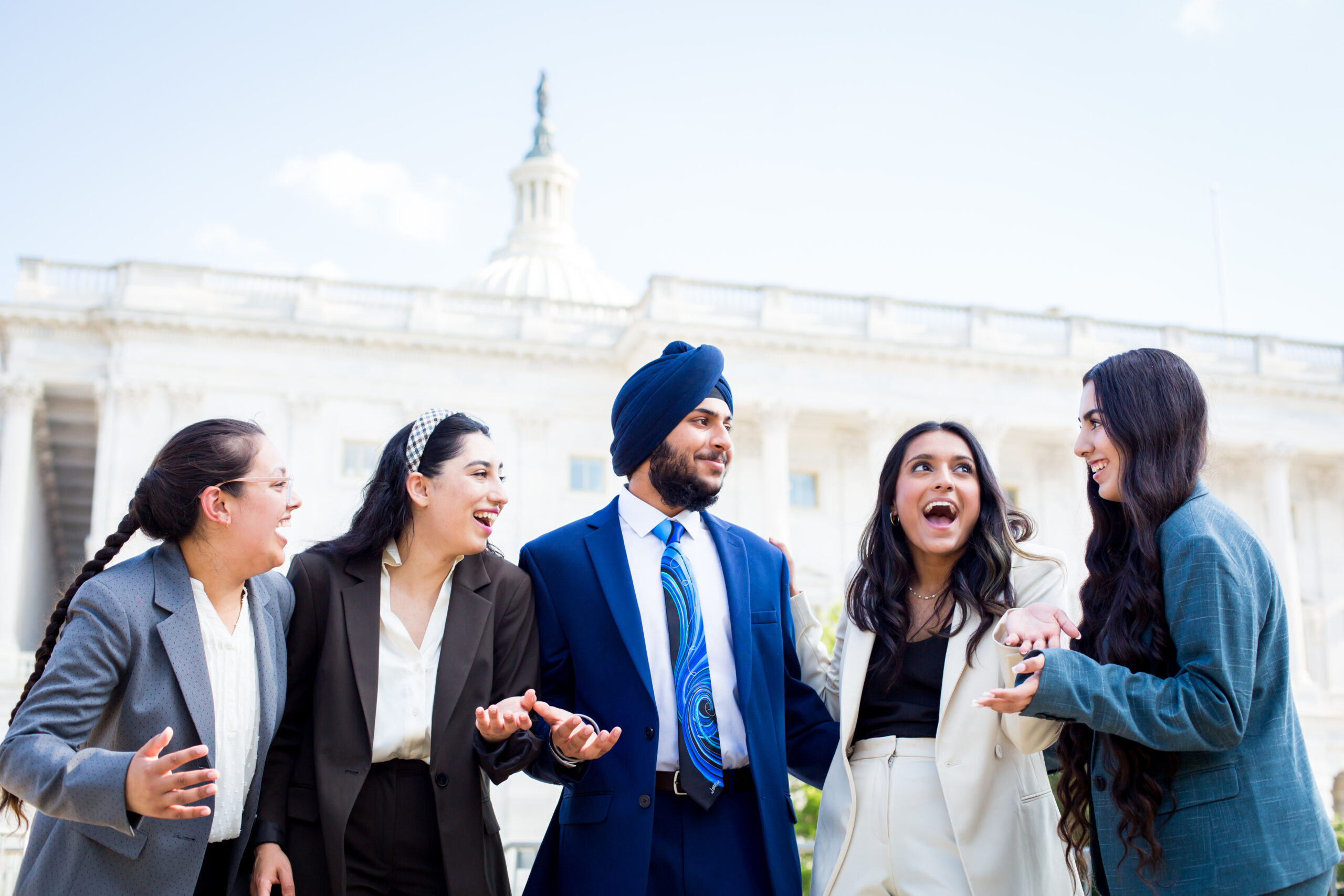
On Common Ground: Training Video for Law Enforcement

Department of Justice Adds SALDEF Sikh Cultural Awareness Training to Community Relations Service (CRS) Website

SALDEF has played a leading role in improving the understanding of Sikh American religious and cultural practices among law enforcement and government agencies nationwide.

In partnership with the U.S. Department of Justice (DOJ), SALDEF developed On Common Ground: Sikh American Cultural Competency Training for Law Enforcement, a training video designed to reduce bias, prevent misunderstandings, and strengthen relationships between Sikh communities and public institutions.

Launched: January 2007

Reach: Viewed by more than 65,000 law enforcement officials in the United States

Adoption: Used by all TSA screeners at U.S. airports

Global Impact: Requested by law enforcement agencies in Ireland, the United Kingdom, Germany, Australia, India, and Brazil

Federal Recognition: Hosted by the DOJ’s Community Relations Service (CRS)

This work builds on SALDEF’s broader Educational Outreach efforts with federal agencies, including:

  • DOJ Collaboration (2004): Common Sikh American Head Coverings — a poster educating local, state, and federal officials on Sikh articles of faith, including the dastaar (turban), and best practices for respectful engagement.
  • DHS Collaboration (2006): Sikh Americans and the Kirpan — guidance developed with the Department of Homeland Security to promote awareness and ensure appropriate interactions between Sikh Americans and federal law enforcement.

Director of DOJ-CRS, Ondray T Harris remarked, “On Common Ground serves as a valuable tool in educating law enforcement officials, airport personnel, and various communities across the United States on the cultural and religious practices associated with Sikhism. Awareness of cultural and religious observations can help avoid misunderstanding and tension. Towards this goal, On Common Ground can assist the public in understanding the challenges and realizing the contributions of the Sikh community in the United States. Former CRS Director Sharee Freeman, the Sikh American Legal Defense and Education Fund (SALDEF), and other local, state, and federal agencies are to be commended for their extraordinary efforts in making On Common Ground possible.”

Together, these initiatives demonstrate SALDEF’s long-standing commitment to proactive education, institutional accountability, and protecting the civil rights and dignity of Sikh Americans through partnership and policy-informed outreach.

Washington, DC— A poster explaining Sikh head-coverings was recently produced in partnership with the U.S. Department of Justice (DOJ) and the Sikh American Legal Defense and Education Fund (SALDEF).  The poster is entitled Common Sikh American Head Coverings and provides a brief introduction to the Sikh religion and protocol to follow security screening by law enforcement officials. “[The posters] represent the Department of Justice’s continued efforts to educate government officials about the practices and beliefs of vulnerable minorities,” wrote Assistant Attorney General for Civil Rights, R. Alexander Acosta, in a letter to SALDEF.  “Not only does this lead to greater understanding, but it also helps our officers do their jobs better.  Thank you for your assistance in developing these posters and bringing this project to fruition.” The full-color, glossy posters are 24 inches long and 18 inches wide.  They were produced following SALDEF’s regular participation in meetings with Assistant Attorney General Acosta’s working group about post-9/11 issues.  The DOJ has produced 10,000 copies of the posters, which will be distributed to local, state and federal law enforcement officials. “We are extremely pleased that the DOJ not only took the initiative to produce these posters but will be distributing them to law enforcement officials across the country,” said SALDEF National Director Preetmohan Singh. “Our Law Enforcement Partnership Program has trained thousands of first-responders and this will reinforce information for some and provide a straight-forward introduction for others.” To view a copy of the poster, please click here.

The U.S. State Department recently invited SMART President Manjit Singh to address participants of their International Visitor Program. The program entitled, “Managing Diversity in a Multi-Ethnic Society,” was designed to expose participants to the contributions and challenges of immigrants in the U.S. by examining policies on immigration, refugees and citizenship, and America’s cultural diversity. This year, several government officials, academics, and journalists from Europe were invited to tour the United States. Mr. Singh spoke about SMART’s efforts in the areas of protecting civil rights, encouraging political involvement, and participating in legislative efforts affecting the Sikh American Community. He was joined by panelists from the Arab American Institute (AAI) and the National Association for the Advancement of Colored People (NAACP), who also discussed political empowerment of minorities. The International Visitor Program is administered by the State Department’s Bureau of Educational and Cultural Affairs. The emphasis of the program is to increase mutual understanding through communication at the personal and professional levels. Participants are established or potential foreign leaders in government, politics, media, education, science, labor relations, and other key fields. Over the years, hundreds of former participants under the International Visitor Program have risen to important positions in their countries. Among the alumni are over 160 current and former chiefs of state or heads of government and more than 600 are cabinet-level ministers.

On June 6th, SMART’s Western Regional Director delivered its Sikhism 101: An Introduction to Sikh Beliefs and Culture presentation to members of the Our Brother Congregational Church in Fremont, CA. Members of the congregation attended the presentation which was followed by over one hour of questions and discussion. Tentative plans were also made to take the congregants to a local Gurdwara to show a standard Sikh divaan (congregation). If you, or someone you now would like to conduct a similar presentation in your neighborhood, please contact SMART.

Before the end of the school year, SMART’s National Director Preetmohan Singh addressed the Sikh Studies class at Stanford University in Palo Alto, CA. Organizers of the class, which consists of Sikh and non-Sikh students and as well as community members, invited Mr. Singh to provide an overview of the Sikh faith and discuss current issues within the Sikh Diaspora. SMART also held workshops with college students at the East Coast Asian American Students Union (ECAASU) annual conference at the University of Virginia in Charlottesville, VA. The workshops included information on critical issues facing the Asian American community, including hate crimes legislation, racial profiling, and immigration. If you would like to host a similar event on your college campus, please email SMART at info@sikhmediwatch.org.

SMART Representative Tejinder Singh recently conducted the Sikhism 101: An Introduction to Sikh Culture, Practices and Beliefs for a dozen members of the Tri City Ministerial Association at its monthly meeting in Fremont, CA. The TCMA is a group of ministers casino online real money and religious leaders in the San Francisco Bay Area that work together to carry out interfaith events and support each other”s religious centers. SMART also talked with the TCMA members about possible in-house workshops at their respective houses of worship.

The Applied Research Center recently released the report of their third “The Public’s Truth” event held in Santa Clara, CA. SMART co-sponsored and presented at the event, which was a forum for community members of different races, colors and religions to communicate with legislators and civic officials about the ill-effects they have endured since 9/11. Speakers at the event shared their personal experiences of direct harassment and discrimination they faced from law enforcement, airport security, workplace supervisors and immigration officials. SMART’s representative, who is featured in the report, discussed the Sikh community’s response to hate crimes. The Applied Research Center is a public policy, educational and research institute whose work emphasizes issues of race and social change. The report is titled “Stories of Racial Profiling & The Attack on Civil Liberties.”

Students at Bowdoin College in Brunswick, Maine recently invited SMART to present about the prevalence of hate crimes and strategies to prevent these incidents. National Director Preetmohan Singh addressed the issue of post-9/11 hate crimes targeting those were who are or appeared to be from the Middle East.

The National Council of Jewish Women recently invited SMART to speak at its annual Washington Institute. SMART’s National Director, Preetmohan Singh, addressed conference attendees about effectively lobbying members of Congress to pass pending federal legislation designed to combat hate crimes. Mr. Singh was joined by Michael Lieberman, Washington Counsel for the Anti-Defamation League and Julie Fernandes, Senior Policy Analyst for the Leadership Conference on Civil Rights. Mr. Singh also represented SMART at the Mid-Atlantic Asian Pacific American Law Students Association (APALSA) conference at the University of Pennsylvania. He addressed the audience about pre- and post-9/11 racial profiling and SMART’s efforts within a broad civil rights coalition to pass the End Racial Profiling Act of 2004. Other presenters included Thomas Joo, a law professor at the University of California, Davis; Alberta Lee, a law student and daughter of Wen Ho Lee; and Jan Ting, a law professor at Temple University.

Panelist Discusses Recent Incidents, Community Outreach and Prevention Washington, DC – Earlier this week, the Sikh Mediawatch and Resource Task Force (SMART), a national Sikh civil rights organization, conducted a congressional briefing about hate crime and effective strategies for outreach and prevention. The briefing, entitled “Violence Against South Asians since 9/11”, took place on Capitol Hill August 23 and was sponsored by the offices of Representatives Joseph Crowley (D-NY) and Joe Wilson (R-SC). Preetmohan Singh, SMART’s National Director, stated that since 9/11 the Sikh American community has experienced over 400 hate crimes, including verbal and physical threats, aggravated assaults, and shootings. Amnesty International recently reported that only one of nine hate crimes is reported in the United States. Experts state that reporting in the South Asian community is even lower primarily due to the lack of access, language barriers and immigration status issues. As recently as July 5, Gurpreet Singh, a Sikh cab driver in Richmond, CA, was shot and killed when attempting to pick his fare. Although local law enforcement officials have yet to determine if race bias was a motive, Mr. Singh stated that in the absence of such a declaration, many in the Sikh community assume a hate crime, as on May 19, when Avtar Singh Chiera was shot in Phoenix, AZ, by assailants who shouted “Go back to were you belong.” Mr. Singh stressed that in addition to affecting the family and the individual, these incidents generate fear and anxiety in the Sikh community because these incidents are based on real or perceived religion or national origin. Mr. Singh shared SMART’s community education and outreach efforts to stress the importance of reporting bias and hate motivated incidents, and to take active measures in prevention. Some of the steps SMART and the Sikh American community have taken in the post-9/11 period include encouraging the community to increase its civic participation, increasing awareness about themselves among their neighbors, co-workers and collaborating with law enforcement to disseminate information about Sikh Americans. SMART also discussed the Local Law Enforcement Enhancement Act (S. 966), legislation that further empowers law enforcement to investigate and prosecute hate crimes. A representative of the South Asian American Leaders of Tomorrow (SAALT) also made comments and engaged in discussion with House Staff.