A Day in the Life of…

Welcome to part two of my day at Becket Fund’s Freedom Summit. After a fancy lunch consisting of mostly finger foods, and some serious religious liberty talk, it was time for our tour of the Library of Congress. All I knew about the Library was that parts of National Treasure 2 were filmed there. Little did I know, the Library has a long history in America’s past and that every single painting, mural, wood carving, and cherub has a metaphorical meaning. Several paintings stood out to me – one was about how Greeks played their sports and another depicted modern day athletics. A different set of paintings displayed this idea: if government remains uncorrupted and fair, then prosperity and peace would transpire; if not, then decay would take over. A general theme running through all décor is progress and how our society has advanced since ancient past.

And because the core of the Library is formed by Thomas Jefferson’s personal collection (which we all were able to see, behind a thick glass protection), which included books from all languages and on all subjects, the Library has made it a point to collect any and every book that this country produces. In fact, by law it is required that two copies of any publication, be it in book, DVD or CD form, or any other media form, be sent to the Library of Congress. The genres range from religion, warfare, and music to games, philosophy, art, and science and everything in between.

This flood of knowledge was soon followed by a short reception with the Becket Fund and finally with an after-hours tour of the U.S. Capitol Building. I had been inside the Capitol once, but that was to a directed area for the CAPAL Washington Leadership Program. This time, the SALDEF team and I were given a grand tour, including the Old Senate Chamber, which actually used to house the Supreme Court, Emancipation Hall, and the old House of Representatives. But perhaps the most notable part of our tour was the privilege of stepping into the House Chamber, just 15 minutes after our Congressmen had stepped out. This is the location of all State of the Union addresses; where everyday Congress was legislating the next path of American history. It is a room, much smaller than I expected, that is filled with big decisions, big speeches, and big history.

The Crypt

The First Statue of Liberty

Old Senate Chamber

The Capitol tour, only expected to last 1 hour, had lasted 3 hours. This made us late to our ‘welcome to DC’ dinner with some local Sikhs but the wait was worth it. We had 20+ Sikh interns, students, and professionals attend the dinner. Later we all watched Game 7 of the finals I was able to show some Los Angeles Laker pride to a room full of Laker-haters.

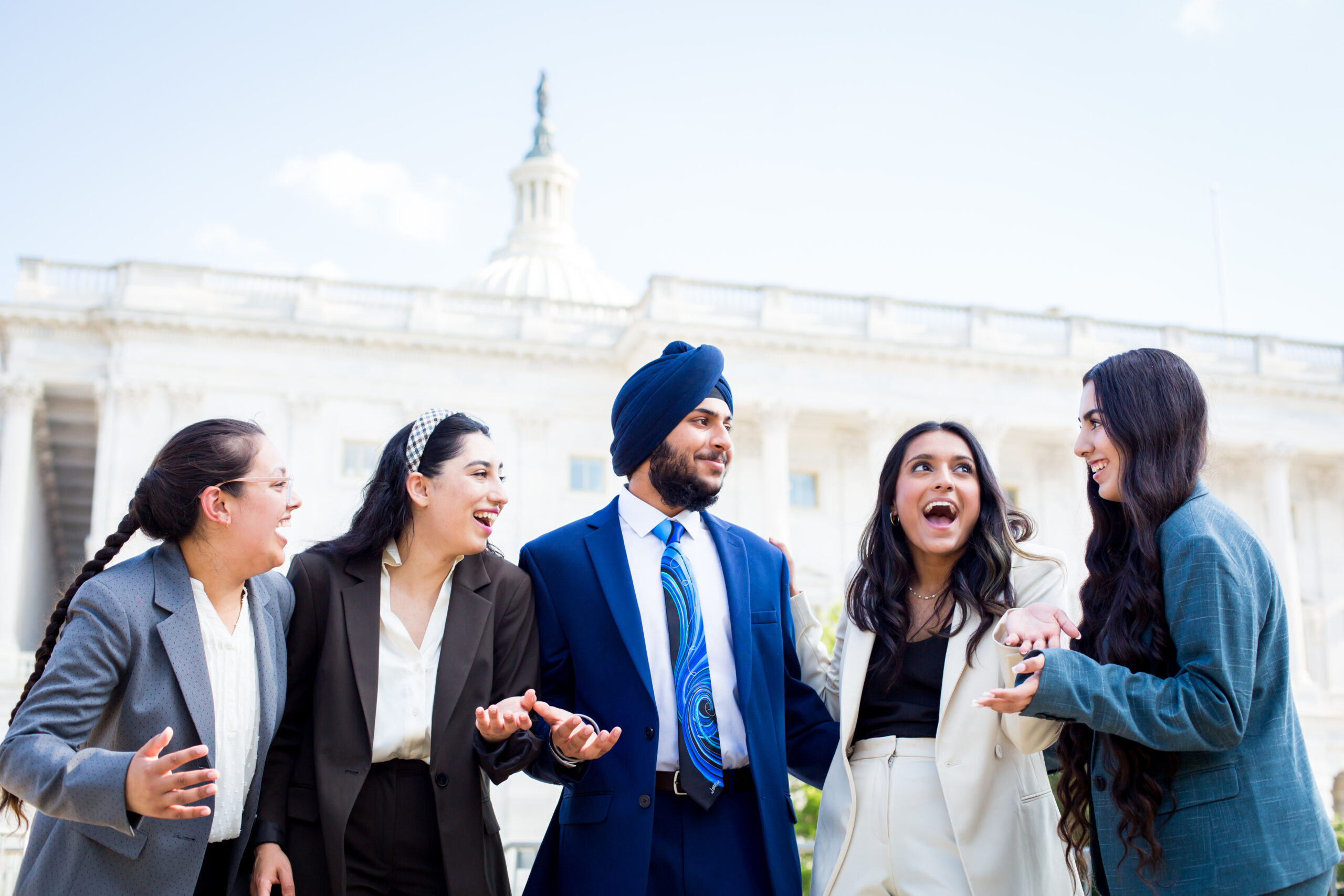
The SALDEF Team

Overall, it was a thoroughly informative day, filled with plenty of laughs and food and painful heels. Just another day in life of a SALDEF intern. Coming to you from 1413 K Street, Jasleen Kaur Singh For Part 1 of this blog, click here.

The Becket Fund is a non-profit law firm as well as a think-tank that defends the religious liberties of any and all faiths, domestically and internationally. Last Thursday, the Washington DC SALDEF team attended the Becket Fund’s Freedom Summit. When Navdeep Singh, a former SALDEF intern-turned-volunteer, forwarded me an e-mail about the Summit, I immediately RSVP-ed for the slightly selfish reason that it was being held at the Library of Congress, a DC landmark I had been waiting to visit. Also promised was an “after-hours tour” of the Capitol Building, but that part of the day is for another time. The Summit was held in the “Member’s Room” of the Library. This room, purposely designed to look like the most prestigious English library, was where members of our Congress would come to read and study the thousands (now turned millions) of books. I already felt cool. Representatives of the Becket Fund discussed three major topics that day: Religion in the Public Sphere, Conscience and Healthcare, and Religious Liberty and the Growth of a Regulatory State. Perhaps the most compelling discussion focused on the Pledge of Allegiance, under “Religion in the Public Sphere.” A prelude to the not-so-old Pledge debate is an overall consensus that the government should remain neutral in matters of the religion, as established by Thomas Jefferson’s separation between church and state. The definition of neutral, however, becomes the first point of argument. Becket Fund identifies two views: first, that neutral implies that government should remain completely absent from religion and second, that excluding all religion would in fact indicate a governmental bias, not neutrality. I personally believe the latter. “God” is mentioned four times in the Declaration of Independence; even if some argue that these mentions are not necessarily religious, they are inspired by some degree of spirituality. Thus, from the very beginning, spirituality, often embodied by religion, has been a part of the “state” aspect of society. Now back to the Pledge. Opponents to the phrase “under God” claim that it is a purely religious phrase that indirectly coerces children, who repeat it in schools, to repeat words that their family might not necessarily believe in or they themselves do not believe in. It predisposes them to believe in God. Proponents of “under God,” such as the Department of Justice, have justified the phrase by the idea of ceremonial deism. Basically, because it has been repeated so much, the phrase has lost all religious meaning, if it ever had any, and is said for merely ceremonial purposes. Becket Fund takes a different approach. The firm is defending the right to say “under God” by arguing that government is supposed to be defending pre-existing rights; it cannot create rights. Jefferson wrote that it is God that has bestowed us with inalienable rights, one of which is liberty. We should thus have the liberty to say “under God” on an individual basis. Because no child, no adult is required to say the Pledge of Allegiance, I believe they should have the right to say it the way they believe is correct, whether that includes “under God” or not.” With a rise in American diversity, and consequently religious diversity, there has been a simultaneous rise in the hostility to public expression of religion. What role will government take? Will it start banning religious headgear in DMV photographs, or will “freedom and liberty for all” actually be respected? And how far will people of religious persuasions go to protect our first amendment right to practice our faiths, whatever they may be? Coming to you from 1413 K Street, Jasleen Kaur Singh For Part 2 of this blog, click here.

SMART Encourages Turn-out at Interfaith Demonstrations in Washington DC, Los Angeles and San Francisco Washington, DC— Following French President Jacques Chirac’s support of legislation banning religious insignia from public venues, the Sikh Mediawatch and Resource Task Force (SMART), the nation’s oldest Sikh American civil rights organization, will join other organizations to demonstrate against this proposal on Saturday, January 17, 2004 in Washington, DC, Los Angeles and San Francisco. Sikh Americans will join Muslim Americans and other concerned citizens outside the French consulates in these cities (details below). Simultaneous protests will be held in France and the United Kingdom. “The turban is a mandatory and integral part of Sikh’s identity and faith as laid down by its founders, the Sikh Gurus,” said SMART President Manjit Singh. “Thousands of Sikh soldiers, including those in the French armed forces, fought with turbans in both of the World Wars. To force Sikhs to remove their turbans and adherents of other faiths to shed religious insignia that have no correlation with state functions will solely serve to exacerbate religious bigotry in France.” The ban on religious wear, which is due to be debated in the French Parliament next month, would ban articles of faith such as the Sikh turban, Muslim hijab, Jewish yarmulke, and all other religious items in courts, schools, and the public administration. SMART is particularly concerned about news reports that the French commission which recommended this policy failed to interview any Sikhs during its investigation. Singh also stated, “The adoption of this law would needlessly limit the display of mandatory articles of faith in a way that is contrary to the spirit of all international documents upholding religious freedom to which France is a signatory.” SMART encourages all Sikhs to come out in large numbers to these demonstrations and support the rights of French citizens. The events will take place on Saturday, January 17 at the following locations: Washington, DC: French Embassy in Georgetown 4101 Reservoir Road, NW Washington DC 20007 11 am – 2 pm San Francisco: San Francisco City Hall 1 Dr. Carlton B. Goodlett Place San Francisco, CA 94102-4683 11 am – 2 pm NOTE: Demonstrators will march from City Hall to the French Consulate Building Los Angeles: Westwood Federal Building 11000 Wilshire Blvd Los Angeles, CA 90095 Noon – 3 pm