I was very fortunate to be able to attend and participate in this year’s US Social Forum Conference hosted in Detroit, MI. SALDEF was invited as one of the participating organizations for a panel titled “The 9/11 Movement: Intersections and Movement Building Strategies.” The panel also included Adhikaar, DRUM (Desis Rising Up and Moving), Sikh Coalition, and SAALT (South Asian Americans Leading Together) and focused on the post 9/11 climate and the intersection of perception and outcomes for minority communities. Being in an environment where there were over 10,000 activists was a refreshing change of atmosphere. Imagine walking into a building where thousands of people have gathered with one mission: to promote a national agenda of inclusive change. The USSF provides an opportunity for activists working on a range of social justice issues to network and find ways to collaborate. It was a unique experience to be sitting in a room with so many progressive South Asian voices, discussing issues that have been plaguing our individual communities in the post-9/11 era. Inclusiveness was the name of the game for this panel, as we spent time identifying the backlash felt in terms of physical hate crimes, as well as the mental and social abuses that have increased dramatically since the attacks. One of the key discussion points SALDEF highlighted was the unfair media coverage Sikhs faced in the days after 9/11. On the one hand, the simple case of misidentification of Sher Singh in Rhode Island as a terrorist made immediate news on outlets across the country – images of an innocent Sikh being taken off a train in handcuffs because he ‘looked suspicious’. On the other hand, Balbir Singh Sodhi’s tragic murder, the first post 9/11 hate-crime, did not gain the national coverage it warranted. These instances underscore the Media’s attitudes and lack of journalistic responsibility in the days after the attacks. In addition to speaking about imbalances in the media, we had the opportunity to talk about SALDEF’s continued strategies to address racial and religious profiling via the Law Enforcement Partnership Program (LEPP). We concluded the panel by discussing the need to create a “Pan-Asian” voice on hate crimes and discrimination. Essentially, we cannot just look at the affect of 9/11 separately, but also show how it escalated and built upon many existing tensions of racial equality with minority communities and the sociopolitical contexts of these problems.
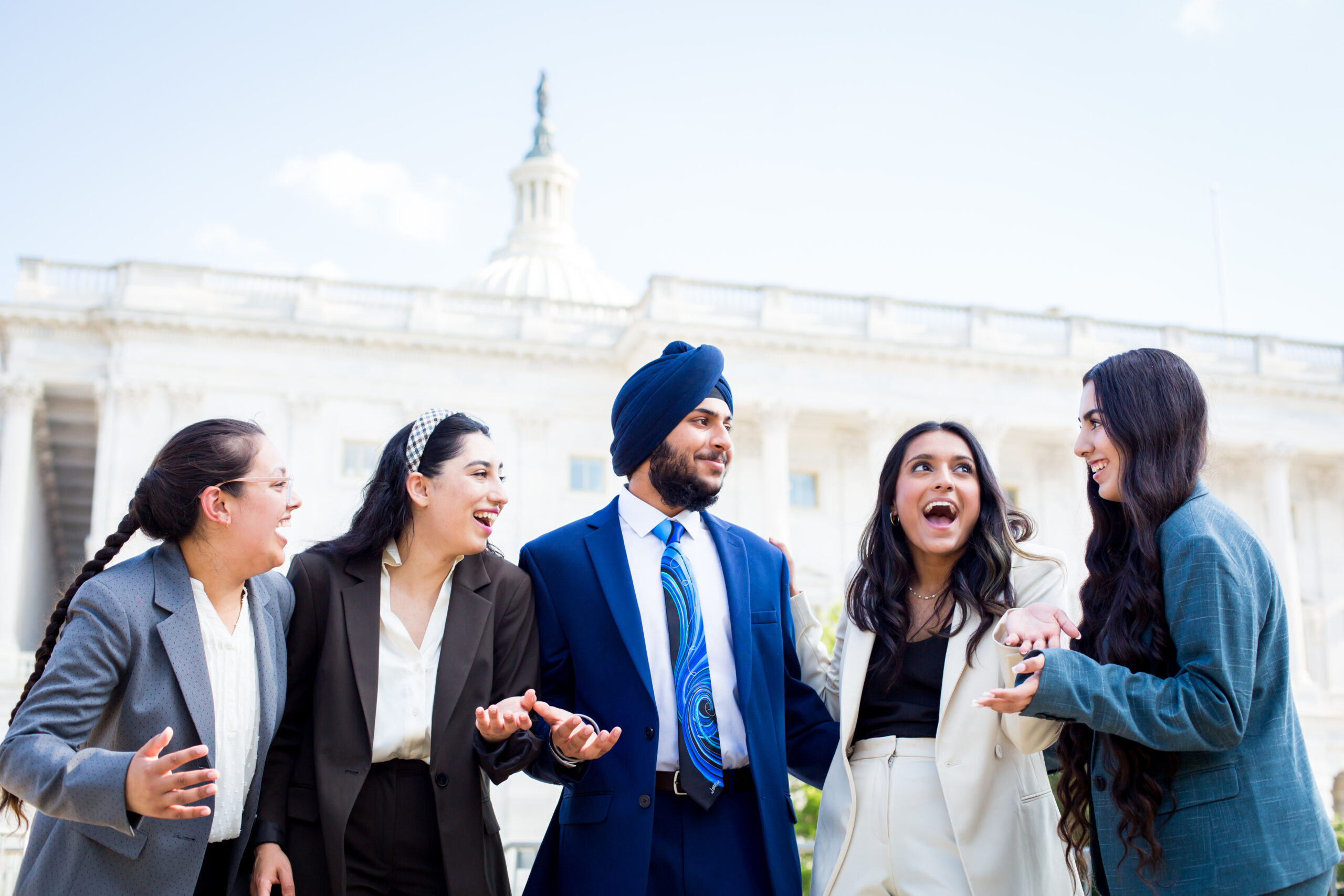
US Social Forum
ANDREA RANE/Missourian Cody Abram, of the Department of Justice in Kansas City, has a Sikh turban wrapped around his head. He attended a cultural training session for public safety officers at MU on Thursday. By UTHAYLA ABDULLAH June 1, 2007 | 12:00 a.m. CST It was a consciousness-raising game of free association. The question: “What do you think when you see a Muslim?” Among the answers by a group of mostly police, airport security and corrections officers: “terrorist,” “prayer,” “monotheism,” “mystique” and “unknown.” The exercise was part of a cultural training session Thursday morning at MU for local and state public safety officials to help increase awareness and understanding of Arab, Muslim and Sikh cultures. The objective of the training, organized by the Department of Justice, was to “dispel misconceptions, to build relationships with the community,” said Aftab Ahmad, a trainer from St. Louis who talked about Arab and Muslim cultures. How should law enforcement respond to a complaint about a Muslim praying in public? Most practicing Muslims pray five times a day, so public prayer happens. Law enforcement officers should just wait for the prayer to be over. Then, if a question is necessary, ask away, Ahmad told the group. The group of about 70 people learned the basic tenets of Muslim and Sikh faiths and how to approach Muslims and Sikhs in non-crisis situations. Presentations included sensitivity videos about Arab-Americans and Sikhs, a clip from the Canadian sitcom, “Little Mosque on the Prairie” and role-playing exercises. Ahmad and Maysa Al-Barcha, another presenter from St. Louis, talked about the importance of understanding differences, like the significance of eye contact. During a role-playing exercise with a Kansas City detective, Al-Barcha showed how Arabs, Muslims and Sikhs avoid prolonged eye contact, especially with authority figures, because it is seen as disrespectful and confrontational. “We tend to think that people who avoid eye contact have something to hide,” Columbia Police Chief Randy Boehm said. About 12 Columbia police officers attended the training. Rajbir Datta, the Pittsburgh-born director of the Sikh American Legal Defense and Education Fund, talked about how Sikh men are easily identified by the turban their faith requires them to wear. “The turban now signifies terrorism or Muslim or Arab or worse,” Datta said. Cody Abram, from the Department of Justice in Kansas City, got to experience part of Datta’s morning routine: wrapping an 18-foot to 24-foot piece of cotton around his head. A slightly reluctant volunteer, Abram held the end of the cloth while Datta wrapped and the class snapped pictures. “This isn’t something you can take off and put on easily”, said Datta, as he lifted the turban off Abram’s head in front of the group, an action no Sikh would ever perform in front of anyone except close family members. Hence, the need for privacy when searching a Sikh. For Datta, it boils down to this: “Law enforcement can do their job better by knowing the community they serve.” The training, which was sponsored by a coalition that included the Department of Justice, MU Chancellor’s Diversity Initiative, MU Extension, Missouri Police Chiefs Association and the Columbia Police Department, was held at the Reynold’s Alumni Center at MU. Columbia Missourian
ACLU Considering Legal Action Against Sheriff’s Office Sikh groups are decrying the treatment of a Florida inmate who was forced into the cutting of his hair, a revered symbol of piety. The Sikh community is protesting the forced haircut and shave of Jacksonville, Fla. inmateJagmahon… The Sikh community is protesting the forced haircut and shave of Jacksonville, Fla. inmate Jagmahon Ahuja, a Sikh who had not cut his hair since birth. The Sikhs view uncut hair as a religious article and say cutting of the hair is akin to religious persecution. (Courtesy United Sikhs/Jacksonville Sheriff’s Office) The Florida chapter of the American Civil Liberties Union is considering legal action against the Jacksonville Sheriff’s Office, saying that cutting Jagmahon Ahuja’s hair after he entered the jail system violated the state’s statute on religious freedom. And for devout Sikhs, Ahuja’s haircut represents hundreds of years of persecution. “It’s essentially like saying, ‘I don’t care about your religion. I don’t care about who you are,'” said Rajbir Datta, national director of the Sikh American Legal Defense and Education Fund, which has been following Ahuja’s case. Ahuja, 36, was jailed April 29, charged with a probation violation and an order of protection related to a domestic violence case. He was convicted, sentenced to 714 days in jail and is expected to be released in May 2010, according to the Jacksonville Sheriff’s Office’s Department of Corrections Web site. Court documents show Ahuja has filed an appeal. His hair was cut and his face shaved in July. Jacksonville Sheriff John Rutherford declined to comment to ABCNews.com, with a spokeswoman in his office citing possible litigation. And the Department of Corrections did not respond to a request for a telephone interview with Ahuja. Datta hasn’t spoken to Ahuja directly, but said the effect of such an event for a Sikh would be devastating. “For a lot of people, it is essentially akin to death,” Datta said today, noting that his own hair falls to his waist. Sikhs do not cut their hair, including facial hair, for the duration of their lives, a tradition stemming from the early 18th century guru Gobind Singh. Hair, Datta said, is “given by God.” Back in the days of Gobind Singh, turbans were worn by men of wealth and status, and the Sikhs adopted the turban for all men, poor and rich alike, to reject the idea of a caste system. The long hair, he said, also signifies Sikhs’ not being focused on their outward appearance. Historically, Datta said, opposing religious groups and governments persecuted Sikhs by cutting off their hair. The United Sikhs New York-based U.S. division, which is spearheading the protest on Ahuja’s behalf, staged a peaceful demonstration in Jacksonville Sunday with about 80 protestors, most of them Sikhs. Jaspreet Singh, the group’s lawyer, said he has met with Ahuja, who he said is divorced with two young daughters, twice, and described him as being “very distressed,” even more so after his second haircut and shave Sept. 28. “He was very happy to hear the people were taking concern over this issue,” Singh said today. Singh noted that to Sikhs, the hair is like a limb. Uncut hair is one of Sikhism’s five articles of faith, along with a small wooden comb, an iron bracelet, a short steel or iron blade and an article of clothing similar to boxer shorts. “Their reasoning for cutting the hair in the jail is you can hide contraband … or if you were to escape, you could shave yourself and alter your appearance quickly,” Singh said. The state of Florida — whose policy is closely adhered to by the Jacksonville Sheriff’s, Singh and Datta said — states that the government shall not “substantially burden” a person’s right to religious exercise and must find the least restrictive means of accomplishing the government’s interest — the safety and security of the jail in Ahuja’s case. Glenn Katon, an ACLU lawyer in Florida and director of the Religious Freedom Project, today said that cutting Ahuja’s hair as a security issue is hard to justify when the Federal Bureau of Prisons and several state corrections departments have already adopted policies allowing inmates to keep certain grooming practices for religious reasons. “I think we have a pretty good case,” Katon said today, adding, however, that the ACLU has not yet committed to legal action. There are several inmate grooming cases involving hair on the law books across the country, involving Hasidic Jews, American Indians and Rastafarians, but not Sikhs, Katon said. The outcomes of the cases were fairly mixed between rulings in favor of the inmates and the prison systems, he said. Singh noted the 2006 case of Satnam Singh, a Florida state inmate who was moved to Vermont after the Sikh community protested the impending cutting of his hair while in prison. That, Jaspreet Singh said, was a reasonable accommodation. But United Sikhs didn’t hear about Ahuja’s case until three weeks after his hair had been removed. His mother, who lives in the United Kingdom, contacted the group after getting a letter from her son saying that he was depressed and didn’t recognize himself in the mirror. Datta noted that Ahuja had been imprisoned in Jacksonville in 2006 and his hair was not cut then because of the short duration of his stay in the jail. Datta said there are about 500,000 Sikhs living in the United States. He estimated there are fewer than two dozen Sikhs imprisoned across the country. Worldwide, Sikhs number about 25 million, Singh said, with the biggest population in India, followed by the United Kingdom, Canada and the United States. http://www.abcnews.go.com/US/Story?id=5966130&page=1 ABC News
Richmond (CA) Police Department Welcomes Sikh American Police Officers; SALDEF Hopeful that Other Police Departments Will Follow Suit June 17, 2009 (Washington, DC) – Following the announcement last week that observant Sikh Americans are welcome to join the Yuba City Police Department with their articles of faith intact, Richmond (CA) Police Chief Chris Magnus issued written confirmation yesterday that observant Sikh Americans are also welcome to join the Richmond Police Department in Richmond, California. Located in the San Francisco Bay Area, the Richmond Police Department serves a community of more than 102,000 residents of diverse religious and ethnic backgrounds. Responding to an email dated June 16, 2009 from local Sikh American community leader Dr. J.P. Singh — an email which contained SALDEF’s recent Press Release regarding the Yuba City Police Department’s acceptance of the Sikh identity — Chief Chris Magnus confirmed that observant Sikh Americans are welcome to apply for jobs at his agency.

Chief Chris Magnus, Richmond (CA) Police Department
The Sikh American Legal Defense and Education Fund (SALDEF) is proud to announce that three more California police chiefs and one county sheriff have issued written confirmation that observant Sikh Americans are welcome to join their respective departments. (more…)
June 15, 2009 (Washington, DC) – Late last week, the Sikh American Legal Defense and Education Fund (SALDEF) received confirmation that observant Sikhs are still welcome to join the Yuba City Police Department in Yuba City, California. On January 23, 2007, former Yuba City Police Chief Richard Doscher corresponded with SALDEF in the context of an employment matter and wrote: “We have no policy which precludes an employee of the Sikh faith from wearing a turban or beard (or possession of a kirpan) during their employment with us.” According to current Yuba City Police Chief Robert D. Landon, “[o]ur policy has not changed and we continue to respect the customs of the Sikh faith[.]” SALDEF is grateful to Chief Landon and the Yuba City Police Department for their leadership in the cause of promoting equal employment opportunities for observant Sikh Americans who aspire to serve as law enforcement officers. SALDEF will continue to work with police departments nationwide to strengthen relations between law enforcement agencies and the Sikh American community under the auspices of SALDEF’s Law Enforcement Partnership Program.
June 10, 2009 (Washington, DC) – Yesterday, the Sikh American Legal Defense and Education Fund (SALDEF) called upon Maryland Attorney General Douglas F. Gansler to modify a legal opinion that endangers the religious freedom of observant Sikh Americans and members of other religious groups. The legal opinion in question—94 OAG 81—was issued on May 27, 2009 in response to a law enforcement officer’s inquiry about the right of individuals to remain “veiled or masked” for religious reasons upon entering a courthouse. Notwithstanding the narrow focus of the officer’s inquiry, 94 OAG 81 makes conspicuous reference to religious “headgear” in its title; is laced with overbroad references to “head” coverings; and can be misinterpreted to mean that deputy sheriffs can require individuals entering a courthouse to remove religious headgear for security purposes. In a letter to Mr. Gansler, SALDEF expressed concern that 94 OAG 81 would create needless confusion among security officers at courthouses throughout Maryland and potential legal liability for the State of Maryland. For these reasons, SALDEF has urged the Maryland Attorney General to modify the opinion and collaborate with SALDEF on Sikh American cultural awareness trainings for security officers through SALDEF’s Law Enforcement Partnership Program. LEARN MORE Read more about SALDEF’s work on religious accommodation issues at courthouses: Dallas County Agrees to Adopt SALDEF Guidelines in Settlement of Lawsuit (Link no longer available) Georgia Court Apologizes to Sikh American Denied Entry Into Court House Due to His Turban (Link no longer available) Georgia Court Apologizes for Denying Sikh American Man Entrance to Court (Link no longer available) SALDEF is grateful to volunteer attorney Dawinder Singh Sidhu for bringing this matter to its attention. If you or your children ever experience discrimination, threats, or violence because of your Sikh identity, please contact SALDEF by email at legal@saldef.org or by phone at (202) 393-2700 Ext 131.
By BRIAN STANLEY bstanley@scn1.com JOLIET — The trial of a Sikh who claims he was beaten by a Joliet police officer during an arrest two years ago began Monday. Kuldip Nag, 51, is facing charges of aggravated battery to a police officer and obstructing a police officer in a bench trial before Judge Edward Burmila. On March 30, 2007, Joliet officer Ben Grant was sent to 3574 Buck Ave. to place a tow notice sticker on a derelict van parked on Nag’s driveway. Police said Nag became upset and pushed Grant. The Sikh American Legal Defense and Education Fund (SALDEF) alleged the officer used his baton to strike Nag’s head while he yelled racist comments and threats. An internal investigation later cleared Grant, who was the first witness to testify Monday. “I walked up to the van and saw the registration sticker was expired and the license plate did not match (police records),” he told Assistant Will County State’s Attorney Sara Shutts. Grant said he explained why he was there when Vera Nag came out of the house and again when her husband came out a short time later. “He appeared to be angry and said I didn’t have the right to be on his property,” he said. Grant testified when he walked back to the van after getting a sticker from his squad car, Nag pushed his arm away. “I went to get his hand behind his back and told him he was under arrest. He was pulling his arm in the opposite direction,” Grant said. Grant said Nag resisted when he tried to both push him to the ground and swing his knee into Nag’s leg as they struggled onto the front lawn. Grant sprayed Nag with pepper spray and attempted another takedown maneuver. Once the combatants were on the ground, Grant used his baton to strike Nag’s right bicep two times, he said. “I still couldn’t get his arms (pinned), so I stayed on top of him until he was tired and put him in handcuffs,” Grant said. SALDEF contends Grant was yelling “You (expletive) Arab! You (expletive) immigrant. Go back to your (expletive) country before I kill you.” Shutts played a recording from the dispatch center that seems to corroborate Grant’s testimony. He was using his radio to call for backup during the struggle. Nag’s attorney Eric Mitchell did not refer to SALDEF’s allegations during his cross-examination. In his opening statement, Mitchell said Nag wasn’t resisting arrest but was trying to cover his head as Grant struck him with the baton. “He suffered serious head injuries and spent three days in the hospital … (Nag) was keeping his arms up out of necessity,” Mitchell said. Suspects condition Officer Amy Chochola brought Nag to the police station for booking. She testified the suspect walked to the squad car and into the holding area of the station without difficulty, but he complained during the ride that he couldn’t sit comfortably and didn’t understand why he had been arrested. Nag also reportedly refused to allow Chochola to wash the remaining pepper spray from his face. “He said he was ‘schizophrenic and afraid of water,'” she said. Nag became ill while he sat in the booking area and was later taken to Silver Cross Hospital. Mitchell noted Chochola’s police report does not mention Nag seemed agitated during the ride in her squad car. Neighbors testify The other two witnesses who testified Monday were Matt Jurewicz and Terry Ogenae, who both reside on Buck Avenue. Jurewicz said he was driving past when he saw Nag struggling with a police officer. “The officer was trying to take him down to the ground with (his) hands and Mr. Nag was trying to get up and move away,” he said. Ongenae said he’d been in his garage when he heard “hollering” and looked over his fence to see a police officer helping a handcuffed Nag to his feet. Neither man was cross-examined. The trial will continue Thursday.
By SHAWN R. BEALS | The Hartford Courant NAVJEET SINGH of Shrewsbury, Mass., a Sikh, talks Wednesday to a group of federal Transportation Security Administration workers at the Sheraton Hotel at Bradley International Airport in Windsor Locks. Singh was a speaker at sensitivity training sessions for security and law enforcement personnel at the airport that focused on the Muslim and Sikh cultures. (CLOE POISSON / HARTFORD COURANT / January 21, 2009) WINDSOR LOCKS — – Seeking to bridge barriers and avoid unnecessary alarm, federal security officials at Bradley International Airport hosted sensitivity training focused on Muslim and Sikh cultures Wednesday. “By informing our officers of some of the cultural aspects of diversity, we can avoid being distracted unnecessarily by some of those differences,” said Peter Boynton, Bradley’s federal security director. “The training helps us understand the differences so we can focus on what we’re really looking for, which is an indication of a risk. We’re not looking for turbans.” The group of speakers, working under the umbrella of the U.S. Department of Justice, held two sessions for security and law enforcement personnel and others to educate them on cultural practices they may encounter at the airport. The federal Transportation Security Administration, state police and airlines were represented at the training session in the Sheraton Hotel at Bradley. The importance of the training was underscored by an incident in a Washington, D.C., airport Jan. 1. Nine Muslims were taken off an airplane after passengers overheard a conversation that was misconstrued as a threat. The airline subsequently apologized. TSA was not involved in that incident, but Boynton said the airline’s action reinforces the fact that risk assessment cannot be based on cultural differences. Noting the worldwide population of approximately 1 billion Muslims, presenter Elizabeth Dann instructed the group Wednesday about Muslim customs and clothing. Dann, herself a Muslim, said she speaks to groups in the security and education fields to raise awareness of Muslim culture, trying to eliminate stereotypes and cultural conflicts. She also said she tries to make TSA officers aware that Muslims going through security checkpoints are just as worried as other travelers about passing through quickly to catch their flights. “We’re probably more scared of you than you are of us,” Dann told the officers. The TSA last held similar training three years ago at Bradley, and Boynton said he was hoping to schedule such sessions more frequently. Navjeet Singh, a Sikh and featured presenter, said TSA officers, state police and airline workers can benefit from cultural awareness. “We want to make you aware of the Sikh religion, and we hope that will make your job a little bit easier,” Singh said. [http://www.courant.com/news/local/hc-arabsens0122.artjan22,0,309410.story] Hartford Courant
Sheriff-Elect Adrian Garcia commits to a detailed investigation of police misconduct and cultural awareness training for all the deputies Houston, Texas: December 22, 2008 – On Sunday, December 14 2008 at the request of SALDEF Regional Director and long-time friend, Bobby Singh, Harris County Texas Sheriff-elect Adrian Garcia met with the Sikh American community at the Sikh Center of Houston, in the aftermath of a recent incident where a Sikh family was allegedly harassed by Harris County officers after calling in a burglary. Presentation of Posters The meeting allowed the Sikh American community to voice their concerns directly to the Sheriff-elect and was also an opportunity for the community to hear from local officials at a time when concerns and fear of the local police are high. At the meeting, Sheriff-elect Garcia remarked that the behavior of the Sheriff Deputies in this incident would not be tolerated under his administration, which takes effect on January 2, 2009. At the meeting, the Sheriff-elect was presented with framed copies of SALDEF’s Sikh Americans and the Kirpan, and Common Sikh American Head Covering posters by the congregation, to be displayed in his office as a reminder of the diversity within his community. Adrian Garcia During his comments to the over 200 Sikhs, in attendance Sheriff-elect Garcia committed to instituting “high quality diversity training” for all of his officers – the third largest police force in the United States. “These meetings are part of SALDEF’s continued efforts to provide long-term and meaningful engagement with government officials in cities across the nation,” said SALDEF Regional Director Bobby Singh. “Both the community and government, must take concrete steps to understand one another, and make sure that incidents like this do not happen again. These meetings are just the beginning of a long-term partnership that SALDEF and the Sikh American community will have with the local officials to ensure open communication and to prevent misunderstandings in the future.” Judge Ed Emmett Through SALDEF’s Law Enforcement Partnership Program, SALDEF previously provided law enforcement training to the City of Houston police department. In the new year, SALDEF plans to work with the Harris County Sheriff’s Office to provide a year-long training program to educate the entire force about Sikhs and Sikh Americans. BACKGROUND Earlier this month, in the course of investigating the burglary of a Sikh American home, Harris County police officials made suggestive remarks to the family about Muslims, terrorism and the Mumbai terrorist attacks. When one the officers noticed a family member wearing a kirpan, they pointed a taser gun at her head, and handcuffed multiple family members, including a sixty-year-old grandmother. The only reason for this action was the Sikh family practicing their faith freely in their home. To read media reports about this incident, click below: * Sikh family accuses deputies of abuse, taunts – Houston Chronicle 12/5/08 * Sheriff-elect reaches out to Harris County Sikhs – Houston Chronicle 12/14/08 * Garcia, Sikhs to meet – Houston Chronicle 12/12/08 * Interview with Tagore Family – Sach Productions 11/27/08