Sikh American Community Encouraged to Contact Local Legislators to Support Important Bill Washington D.C. – March 21, 2007: The Sikh American Legal Defense and Education Fund (SALDEF), the nation’s oldest Sikh American civil rights advocacy organization, today applauds Congress for taking the first step in passing a new piece of legislation aimed at protecting the nation’s communities from hate violence. Late yesterday, U.S. House of Representative Judiciary Committee Chairman John Conyers (D-MI), introduced H.R. 1592, the Local Law Enforcement Hate Crime’s Prevention Act of 2007. The legislation, which has enjoyed bipartisan support from this Congress, and has 137 co-sponsors already, will provide assistance to state and local law enforcement agencies and amend federal law to facilitate with the investigation and prosecution of violent, bias-motivated crimes. “By introducing this legislation, the House has sent a clear message that hate crimes will be investigated and prosecuted to the fullest extent of the law,” said SALDEF Managing Director Kavneet Singh. “Even before the flurry of post-9/11 hate crimes affecting the Sikh American and other communities, we were working with a broad coalition to pass this legislation. We applaud the House for introducing this important piece of legislation.” Bias crimes are increasingly a cause for concern specifically within the Sikh American community. The FBI Hate Crime Report, although voluntary, has documented over 115,000 hate crimes since 1991. In 2005, 7,183 hate crimes were reported, of which, 17.1 percent were perpetrated against individuals of faith and 14.2 percent against ethnic minorities. The legislation has a broad range of support of over 200 civil rights, advocacy and law enforcement organizations including: Leadership Conference on Civil Rights, Anti-Defamation League, Human Rights Campaign, the National Sheriffs’ Association, the International Association of Chiefs of Police and the Federal Law Enforcement Officers Association, among many others. For more information about our work, visit www.saldef.org or contact us at 202-393-2700 or info@saldef.org
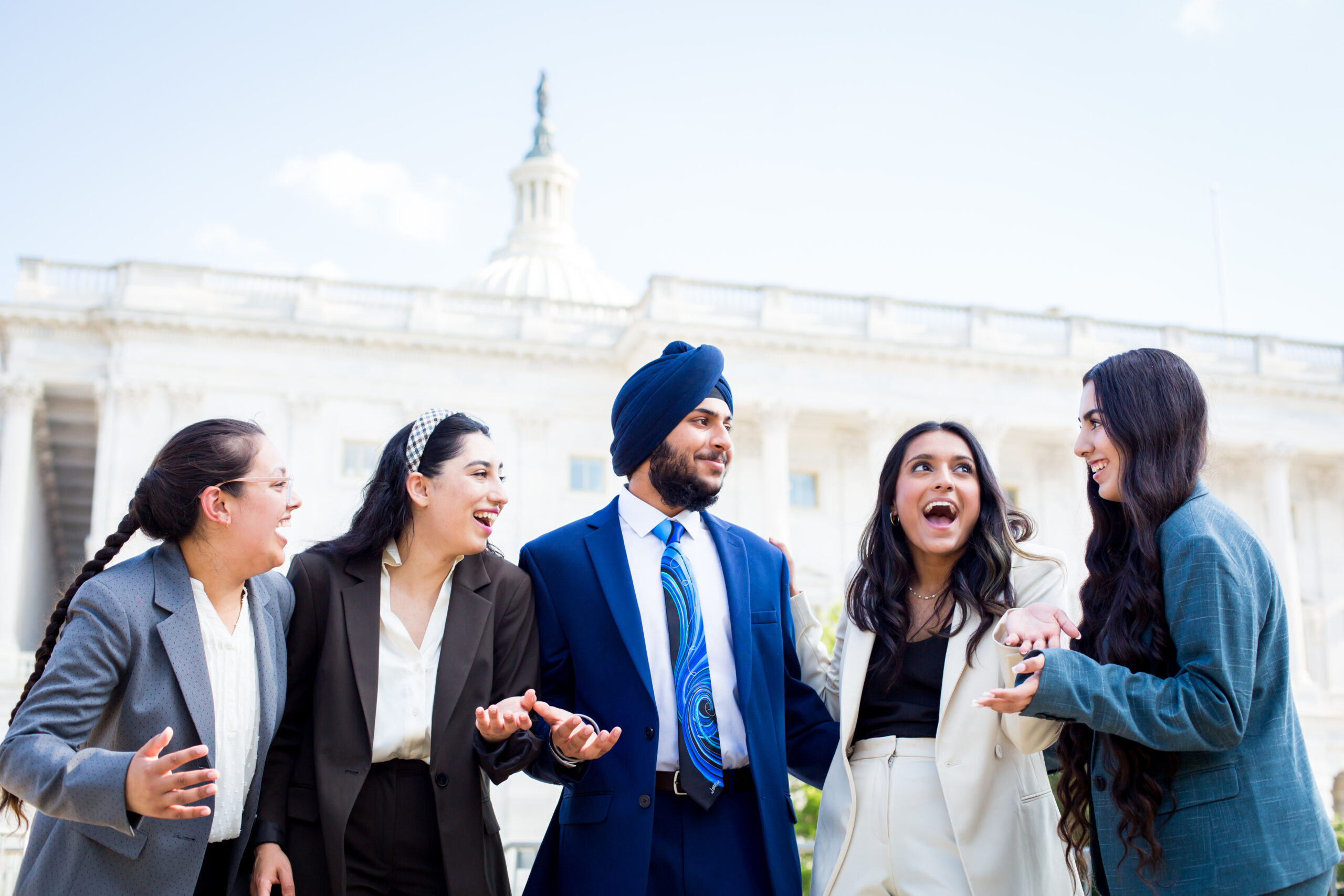
SALDEF Welcomes Congressional Legislation on Hate Crimes
SALDEF Contacts Law Enforcement Officials Demanding Swift and Thorough Action Washington, DC – On December 22, 2005, the members of Guru Angad Darbar Gurdwara (place of congregational worship), located in Bakersfield, CA, awoke to find two pig heads thrown in front of the Gurdwara. Additionally, a week and a half prior to this incident, eggs were thrown at the Gurdwara building as well. These unfortunate incidents are not an uncommon experience for Sikhs across the country. Three days later on Christmas morning, a Sikh American cab driver, Gurpartap Singh of El Sobrante, was fatally shot as he dropped off his fare in Richmond, CA. The tragic shooting of this innocent Sikh is unfortunately not the first incident of its kind in the East Bay. On July 2, 2003 a 23 year old gentleman, Gurpreet Singh, was also murdered as he drove his taxicab. Additionally, on July 5, 2003 another Sikh man, Inderjit Singh was shot at point blank range while picking up a fare in a similar location to the shooting of Gupreet Singh just three days earlier. Following those incidents in 2003, The Sikh American Legal Defense and Education Fund (SALDEF), worked with local law enforcement and civic officials to address the concerns of the Sikh community and the cab drivers. On December 30, 2005, SALDEF spoke with Bakersfield Police Chief Bill Rector about the case and received a progress update on the investigation. The Bakersfield PD has taken this case very seriously, and besides having some strong leads in the case, they also are ensuring that they investigate thoroughly to determine a motive. Additionally, SALDEF has contacted the Police Chief, Mayor and City Attorney of Richmond to express our outrage at the incident and to insure that a full investigation is conducted to ensure what if motive of the crime was indeed bias related. These incidents, along with many other violent crimes against Sikhs in the Bay Area, have caused significant distress and increased a sense of concern among the Sikh community in regards to the safety of themselves and their families. Since the September 11, 2001 attacks, Sikh Americans have a tremendous increase in hate crimes. FBI statistics show that the number of post-9/11 hate crimes increased three fold from 2001 to 2004. Sikh American Cab drivers and convenience store clerks are particularly vulnerable due to their heightened exposure and high-risk employment. SALDEF offers our condolences to the family of Gurpartap Singh and ask that the entire Sikh American community keep them in your prayers, especially during the holiday season. Additionally, a trust is being set up for Sukhvinder Kaur – Gurpratap Singhs’ widow. While specifics are not yet available, anyone interested in donating to this fund should contact SALDEF at: info@saldef.org to do so. If you or anyone you know becomes the victim of a hate incident, please report it immediately to SALDEF at: info@saldef.org or by reporting it on our website. SALDEF has strong working relationships with law enforcement agencies across the nation and will ensure that the appropriate agency is notified of the incident. You can also contact SALDEF at 202-393-2700. To help the community better respond to an incident, SALDEF has developed the Know What To Do Guide; a handy pocket guide that details the steps that should be taken in the event of a hate crime, discrimination in the workplace, or racial profiling, and states your rights as an airline passenger. Please print and distribute the pocket guide at your local Gurdwara, as well as to your local community, family and friends. To order the pocket guides from SALDEF, please send an email to: education@saldef.org.
Washington, DC – The Sikh American Legal Defense and Education Fund, the nation’s oldest Sikh American civil rights and advocacy organization, applauds members of the U.S. House of Representatives for passing the Local Law Enforcement Enhancement Hate Crimes Prevention Act (LLEEA). The bill was approved, with 223 votes for and 199 against, as an amendment to the Children’s Safety Act of 2005. The legislation, which still must pass through the Senate and be signed by the President, is critical to the Sikh American Community. The LLEEA is intended to strengthen the ability of federal, state, and local governments to investigate and prosecute hate crimes based on race, ethnic background, religion, gender, sexual orientation, and disability. The bill helps state and local anti-bias efforts by enabling the Justice Department to assist them in the investigation and prosecution of hate crimes. “Hate violence is rooted in prejudice and is meant to intimidate entire communities,” said Mirin Kaur Phool, SALDEF President. “Sikh Americans have long suffered from violence based on discrimination, and although legislation cannot expunge hate from our society, this bill sends a clear message that these insidious acts of violence run counter to America’s promise of freedom and tolerance.” The bill will also allow the federal government greater ability to aid local and state agency efforts in prosecuting, investigating, and preventing hate crimes. The House bill had strong bipartisan support and was endorsed by more than 175 law enforcement, civil rights, civic, and religious organizations, including SALDEF. The similar bill currently pending in the Senate has 44 co-sponsors, and SALDEF strongly supports this bill as well.
Calisha Myers, Cavalier Daily Associate Editor The South Asian Leadership Society, the NAACP Student Chapter and the Sikh Students Association co-sponsored a forum yesterday evening entitled “AMERICAN HATRED: are YOU part of it?” reflecting on recent University concerns of minority animosity. The forum began with attendees sharing their experiences of hatred at the University with each other and the event drew undergraduate and graduate students as well as administrators from many different backgrounds. Aleea Maye, a fourth-year College student and president of the NAACP chapter at the University and Neela Pal, a third-year College student and president of the South Asian Leadership Society, opened the forum by discussing the importance of finding common ground for dialogue and change. The forum was led by Preetmohan Singh, director of the Sikh American Legal Defense and Education fund, and M. Rick Turner, dean of the Office of African-American Affairs and president of the Charlottesville/Albemarle NAACP. Singh spoke mainly about hate crimes and racial profiling as a larger national problem, as well as the importance of everyone’s involvement in making changes. “What you’re doing here today is proactive, so I implore you to think about the big picture, to think about how we build a more inclusive community,” Singh said. “It’s our responsibility to be at the table.” Turner discussed incidents at the University, initiatives the University has taken and the importance of students holding the administration responsible for change. “What happens oftentimes in the history of higher education is that people fall asleep,” Turner said. “You guys are asleep. You sleep too long. All I’m asking is that you ask questions.” Turner also emphasized the importance of willingness by University administrators to be the leaders of change. “I haven’t seen any major changes,” Turner said of his 17 years at the University. “I think incidents are probably more reported, but I haven’t seen any progress. When we see leaders, students will rally behind that. But I haven’t seen that and unless that happens, I don’t think we’re going to see much change.” After hearing Singh speak about civil rights and discrimination in Washington, D.C. this summer, Pal came up with the idea of holding a forum concerning hatred both in America and at the University. Pal consulted Sikh Student Association President Jasjeev Sawhney, a third-year Engineering student, who worked with Singh over the summer. The two collaborated with the NAACP Student Chapter and under the advisement of Singh. “We wanted to put something together that bridged these distant communities,” Sawhney said of the African-American and Asian communities at the University. The collaboration between Sawhney and Pal and the African-American and Asian student groups is unique, according to Pal. “We don’t have intersections like this often at U.Va.,” she said. “That’s kind of what appealed to me. We have to think about these issues more creatively. We have to bring together individual groups and do things collectively.” This forum was one of the first events the newly reestablished NAACP Student Chapter sponsored. Maye said she was disappointed with African-American student turnout but that she was pleased with the forum overall. “All things considered, the turnout was great,” Maye said.
By Scott Wong, STAFF WRITER, The Daily Review FREMONT — Almost no one had heard of Afghanistan before the Sept. 11 terrorist attacks, said Homaira Hosseini, an Irvington High School senior whose family emigrated from the war-torn country when she was only 2. Afterward, no one could ignore it. “A tragic event on Sept. 11 changed my future, my present, my identity,” Hosseini, 17, told a stunningly quiet room of more than 200 community members at “Our Community: Who Belongs?” an anti-hate forum at the high school Thursday night. “After Sept. 11, I got a lot of looks and experienced biases and prejudices.” Hosseini, whose family is Muslim, was one of a handful of speakers who shared personal testimony about how local Muslims, Sikhs and other “vulnerable and victimized” minorities have been subjected to things such as name-calling, eggings and other abuse in the wake of the 9/11 attacks and the wars in Iraq and Afghanistan. “I am an Afghan and a Muslim and an American,” said Hosseini, who noted that Fremont is home to the largest number of Afghans living outside Afghanistan. “It’s not a paradox, but it’s sometimes treated as such.” Among those who joined in self-affirming chants of “We all belong” were City Council members, police chiefs, county supervisors, state Assembly members past and present, school board members, educators and other civic, ethnic and religious leaders from throughout the area. Most came to hear the keynote speaker, state Attorney General Bill Lockyer, who as a state senator 15 years ago wrote the first felony hate crime law in the nation. But Debbi Pearson, a 44-year Mission San Jose resident, might have said it best: “The people who needed to hear the message most weren’t here.” Lockyer, a Democrat and a possible 2006 gubernatorial candidate, warned the audience about misdirected hostility. “It’s OK to be angry about the attacks on the World Trade Center and the Pentagon,” he said. “But direct that at the people who carried it out, not the people who are here to enjoy these freedoms.” Kavneet Singh, Western regional director for the Sikh American Legal Defense and Education Fund, the nation’s oldest Sikh civil rights and education advocacy group, said it is critical that Americans take the next step in the war on racial and religious bigotry. “As a community, we need to continue to fight to move beyond tolerance,” said Singh, who added that there are about a half-million Sikhs living in the United States today. “It’s not just our responsibility to tolerate but to accept.” From physical attacks and racial slurs to less subtle prejudices, such as compliments on their English, all burn themselves into the minds of victims, one speaker shared. “Such comments may seem rare,” said Owais Mahesri, 17, an Irvington senior who was born in the United States and is Muslim. “But they happen, they exist and they hurt.” Despite the fact that about six hate crimes still occur in the state each day, Lockyer said he is optimistic about the future. “It’s important that we be mindful that we virtually all are immigrants here,” Lockyer said. “For three centuries, we skimmed the planet and brought its risk-takers to this place. “This is the first place on the planet where the fundamental policy has been, ‘Everybody counts, every voice matters.'”
Bay Area Residents Encouraged to Attend Next Week Concord, CA—A candlelight vigil will be held to show support for the Anands, a Sikh American family residing in Concord, who had their home robbed and burned down in a confirmed act of arson in September. Community members are encouraged to sign a petition and attend the vigil, which will be held on the evening of Wednesday, November 17 (details below). This vigil is being organized by “The Justice for the Anand Family Coalition,” a coalition of legal and civil rights organizations comprised of the Sikh American Legal Defense and Education Fund (SALDEF), the Asian Law Caucus, the South Asian Bar Association (SABA) and Narika. The Anand family and this coalition believes these crimes were motivated by hate. While the events have been investigated and the suspect identified, the Contra Costa District Attorney’s Office has not yet filed any charges. The vigil also presents the coalition an opportunity to update the community and the media about the status is this case. The coalition urges all concerned community members to attend this event and show support for the Anand family. SALDEF, the oldest national Sikh American civil rights organization (formerly known as SMART), has been working with the Anand family since learning about these crimes. If you have any questions about this vigil, please email SALDEF at info@saldef.org or call 202-393-2700 Ext. 29. WHEN: Wednesday, November 17, 2004 TIME: 7:30 – 830 p.m. WHERE: 1356 Babel Lane (the site of the Anand Family’s burned home) Concord, California
SALDEF Joins Other Community Organizations to Show Support Concord, CA — Over 150 Bay Area community members came together Wednesday night for a candlelight vigil held to support the Anands, a Sikh American family residing in Concord, who had their home robbed and burned down in a confirmed act of arson on September 5, 2004. The Sikh American Legal Defense and Education Fund (SALDEF), the oldest national Sikh American civil rights organization formerly known as SMART, has been working with the Anand family and other groups since learning about these crimes. “Thank you all for coming tonight to this vigil,” said Jasleen Anand, one of five children in the Anand Family. “Your being here goes a long way in helping us heal and move on with our lives knowing that this community is a safe community and neighbors support each other.” This vigil was being organized by “The Justice for the Anand Family Coalition,” a coalition of legal and civil rights organizations comprised of SALDEF, the Asian Law Caucus, API Legal Outreach, the South Asian Bar Association (SABA) and Narika. The Anand family and this coalition believes these crimes were motivated by hate. While the events have been fully investigated and the suspect identified, the Contra Costa District Attorney’s Office has not yet filed any charges. “The Anand family has lost everything in this tragedy”, stated Malcolm Yueng an attorney with the Asian Law Caucus. “We must support the Anands by demanding that the Contra Costa County District Attorney move forward with the arson charges. The Justice for the Anand Family Coalition is working with the community to ensure that this happens. SALDEF has played an instrumental role in connecting our coalition with the Sikh and South Asian community in the East Bay.” SALDEF urges all concerned community members to support the Anand Family by signing an online petition urging District Attorney Robert Kochly to file charges against the suspect. If you have any questions about this vigil, please email SALDEF at info@saldef.org or call 202-393-2700, Ext. 29.
Recently, SALDEF participated at the Applied Research Center’s (ARC) Race and Public Policy Conference entitled: A Proactive Agenda for 2005 and Beyond. SALDEF’s Western Regional Director Kavneet Singh addressed conference attendees at the University of California, Berkeley about the effects that Hate Crimes and racial profiling have had on the Sikh community as well as the struggle within the Sikh community in ensuring one’s right to practice their faith in a post 9/11 world. Joining Mr. Singh on the panel were Camilo Perez-Bustillo, American Friends Service Committee/Project Voice; Ban Al-Wardi, Arab-American Anti-Discrimination Committee, Los Angeles/Orange County Chapter; Esmeralda Simmons, Applied Research Center Board member and Director of the Medgar Evers Center for Law & Social Justice.
CONCORD – A network of legal advocacy groups launched a public-pressure campaign this week urging prosecutors to charge a man with the September arson of a Sikh family’s home. “We believe race was a motivating factor. To what degree, it’s hard to say,” said attorney Edwin Prather, who represents the Anand family. “I think it’s safe to say his anger toward the Anands was a primary motivating factor.” Mark Peterson, a deputy Contra Costa district attorney and also a Concord City Council member, said Tuesday that investigators could not prove that 39-year-old Gregg Ogan set the fire on Babel Lane on Sept. 5 or that he committed a hate crime. “There was not sufficient evidence to file criminal charges. That was the conclusion after we reviewed the case initially,” Peterson said. “Now we’re investigating some evidence that (the Anand family’s attorney) has submitted.” Prather agreed that the case does not meet the legal definition of a hate crime, but a coalition including the South Asian Bar Association, Asian Law Caucus, Asian Pacific Islander Legal Outreach, and the Sikh American Legal Defense and Education Fund wants prosecutors to file arson and burglary charges. The advocacy groups have organized a candlelight vigil in front of the Anands’ house, at 1356 Babel Lane, at 7:30 p.m. today, as well as a letter-writing campaign that so far has generated about 100 letters urging the District Attorney’s Office to file charges against Ogan, Prather said. Ogan appeared in court in an unrelated criminal case Tuesday. He could not be reached at County Jail in Richmond to answer an interview request. The Anands say Ogan appeared on their doorstep Sept. 3. He said he was helping a neighbor move but that utilities to the neighbor’s home were cut off, they say. The Anands cooked for him and offered him use of their phone for the next two days, but they soon became wary of his loitering around and some of his comments that they felt were racially offensive, Prather said. When he showed up Sept. 5, Gurcharanjeet Singh Anand told Ogan that the family had no time to help that morning because they were going to temple. Ogan appeared angry, Prather said. Half an hour later, someone called Anand to tell him his house was on fire. Police and fire investigators found that the house had been burglarized and a fire deliberately set in more than one place. An enclosed shrine in the back yard was also burglarized and vandalized, Prather said. “We lost everything. Everything we’ve had since we came to this country 22 years ago burned. It shattered our life,” Anand said Tuesday. “I am not still young any more. I have a heart condition. … It’s not so easy to start over.” Concord police arrested Ogan on Sept. 6 a few blocks from the arson scene. Officers responding to a report of a suspicious person hanging around the neighborhood stopped him, according to police reports. Police found methamphetamine on Ogan and, on the side of a nearby house, spotted a plastic trash bag containing items reported missing from the Anand house, according to the reports. The Anands and their five children now live in temporary housing while they wait for repairs to their home of 14 years. Peterson said his office would probably make a decision about whether to file related charges against Ogan in the next two weeks.
Students at Bowdoin College in Brunswick, Maine recently invited SMART to present about the prevalence of hate crimes and strategies to prevent these incidents. National Director Preetmohan Singh addressed the issue of post-9/11 hate crimes targeting those were who are or appeared to be from the Middle East.