India Currents – SALDEF Releases Groundbreaking Report

SALDEF Releases Groundbreaking Report on Transnational Repression and Minority Censorship

Read the full article on India Currents
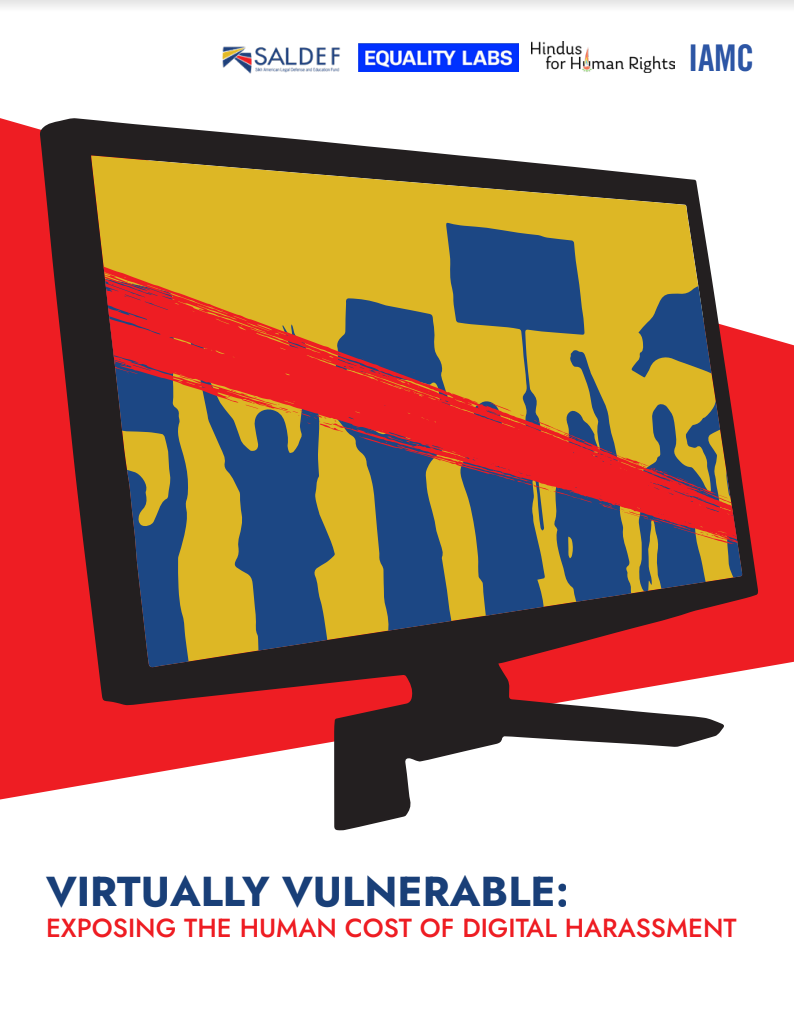
A pioneering report titled Virtually Vulnerable: Exposing the Human Cost of Digital Harassment was released on February 20 by the Sikh American Legal Defense and Education Fund ( SALDEF ). This in-depth study examines the escalating problem of online harassment and censorship, specifically targeting the Sikh diaspora and allied communities like secular Hindus, Indian Muslims, and Dalits.

“’Virtually Vulnerable’ sheds crucial light on the insidious ways digital harassment is employed against minority voices, including those in the Hindu community who stand for secular and democratic values, said Sunita Viswanath, Executive Director, Hindus for Human Rights (HHR). “This report not only exposes these harmful practices but also provides vital policy recommendations. It’s essential that we come together to ensure that digital platforms are spaces of free expression and not tools of oppression.”

The report offers a detailed analysis of the sophisticated methods used to silence minority voices online. It highlights the troubling practices of Big Tech, specifically social media firms, in censoring content under the guise of preserving national integrity, often resulting in the shadow banning and deletion of community-based social media accounts.

It includes a series of policy recommendations aimed at promoting transparency, accountability, and collaboration between tech companies and democracy-oriented nonprofits. These recommendations are geared towards mitigating international censorship and supporting the rights of free speech for diasporic communities.

This report serves as a clear call to action, said Kavneet Singh, SALDEF Acting Executive Director. “We must urgently address the lack of transparency and accountability in the digital realm to safeguard the fundamental human and civil rights of all communities.”

Thenmozhi Soundararajan, Executive Director of Equality Labs, the nation’s leading Dalit civil rights organization, added, “We are currently witnessing the digitization of caste apartheid, violent disinformation campaigns, and an era of surveillance capitalism exacerbated by right-wing authoritarianism. Caste-oppressed people have a right to advocate for their communities without the fear of being attacked and targeted by foreign state actors. This report is a critical look into the correlations between Big Tech, civil rights advocacy, and repression of dissent, and anyone concerned with free and ethical digital spaces should pay attention to it.”

Some of the critical issues addressed in the report include documenting trends in misinformation and suppression of Sikh voices on significant dates and events, examining the strategic misinformation campaign against various minority groups, including Indian Muslim and progressive Hindu communities–by the Indian-American Muslim Council (IAMC) and Hindus for Human Rights (HHR), and Big Tech’s failure to protect caste equity.

The report is available for download on the SALDEF website.

Sikhs in Storytelling

Join SALDEF for Sikhs in Storytelling – a night full of engaging discussions, thoughtful panels, and captivating performances all challenging the one-dimensional Sikh American narratives in the mainstream media.

To Purchase Tickets, Please Click Here

FOR IMMEDIATE RELEASE   

February 20, 2024

Contact: Amrita Kular, SALDEF Director of Communications

media@saldef.org | (202) 332-6700


SALDEF Releases Groundbreaking Report on Transnational Repression and Minority Censorship

WASHINGTON D.C. — This World Social Justice Day, the Sikh American Legal Defense and Education Fund (SALDEF) unveiled a pioneering  report titled, Virtually Vulnerable: Exposing the Human Cost of Digital Harassment. This in-depth study examines the escalating problem of online harassment and censorship, specifically targeting the Sikh diaspora and allied communities like secular Hindus, Indian Muslims, and Dalits.

The report traces the evolution of digital censorship against all non-Hindu supremacist advocates and leaders in the 2020s, offering a detailed analysis of the sophisticated methods used to silence minority voices online. It highlights the troubling practices of Big Tech, specifically social media firms in censoring content under the guise of preserving national integrity, often resulting in the shadow banning and deletion of community-based social media accounts.

Key sections of the report include:

  • Online Harassment and the BJP IT Cell: Analyzing the role of the Bharatiya Janata Party in controlling online narratives.
  • Censorship of the Sikh Diaspora: Documenting the trends in misinformation and suppression of Sikh voices on significant dates and events–by SALDEF .
  • Silencing Dissent: Examining the strategic misinformation campaign against various minority groups, including Indian Muslim and progressive Hindu communities–by the Indian-American Muslim Council (IAMC) and Hindus for Human Rights (HHR).
  • Big Tech’s Failure to Protect Caste Equity: Discussing the manipulation of technology by nationalist groups and the implications for caste equity–by Equality Labs.

In addition to detailing these critical issues, SALDEF and our co-authors of “Virtually Vulnerable” present a series of policy recommendations aimed at promoting transparency, accountability, and collaboration between tech companies and democracy-oriented nonprofits. These recommendations are geared towards mitigating international censorship and supporting the rights of free speech for diasporic communities.

“This report goes beyond simply highlighting the challenges faced by the Sikh diaspora; it serves as a clear call to action,” said Kavneet Singh, SALDEF Acting Executive Director. “We must urgently address the lack of transparency and accountability in the digital realm to safeguard the fundamental human and civil rights of all communities.”

“As the US government grows increasingly concerned about India’s escalating transnational repression, it is important to understand that this issue has roots in India’s ongoing abuse of online platforms against religious minorities and dissenters,” said Safa Ahmed, Associate Director of Media and Communications for IAMC. “This report offers critical recommendations to the US government on how to better protect Indian Americans from being targeted by the Modi regime online.”

“’Virtually Vulnerable’ sheds crucial light on the insidious ways digital harassment is employed against minority voices, including those in the Hindu community who stand for secular and democratic values. This report not only exposes these harmful practices but also provides vital policy recommendations. It’s essential that we come together to ensure that digital platforms are spaces of free expression and not tools of oppression.” said Sunita Viswanath, Executive Director, HHR.

“We are currently witnessing the digitization of caste apartheid, violent disinformation campaigns, and an era of surveillance capitalism exacerbated by right-wing authoritarianism. Caste-oppressed people have a right to advocate for their communities without the fear of being attacked and targeted by foreign state actors. This report is a critical look into the correlations between Big Tech, civil rights advocacy, and repression of dissent, and anyone concerned with free and ethical digital spaces should pay attention to it,” said Thenmozhi Soundararajan, Executive Director of Equality Labs, the nation’s leading Dalit civil rights organization.

The report is available for download on the SALDEF website, as well as those of our partners, and is a must-read for policymakers, human rights activists, and anyone interested in the intersection of technology, human rights, and minority representation.

For more information or to request an interview with the authors of the report, please contact Amrita Kular, Communications Director.

About SALDEF:

SALDEF is the nation’s oldest Sikh civil rights and community impact organization.

www.saldef.org

SALDEF Submits Letter to Senate Foreign Relations Committee Hearing on Transnational Repression

Along with other leading civil rights organizations, SALDEF submitted a statement urging the U.S. Senate Foreign Relations Committee to engage the Biden Administration on meaningfully confronting the Indian Government on the issue of transnational repression.

SB403 is a crucial piece of legislation that will protect vulnerable communities from discrimination and foster a more equitable California. We are proud to stand alongside our coalition partners in advocating for the passage of this historic bill. Caste-based discrimination is especially prevalent in South Asian communities in America, but this bill sets a national example for expanding civil rights and the American values of liberty and justice for all.”

Kiran Kaur Gill, SALDEF Executive Director

Uniting Against Caste Discrimination

SALDEF joins the Californians for Caste Equity Coalition of civil rights organizations, state legislators, and community advocates to celebrate the rapid passage of California State Bill SB403. The anti-caste discrimination bill just passed its final procedural step, with the California Senate casting a successful final concurrence vote. Now, the coalition calls on Governor Newsom to swiftly sign the bill.


SB403 seeks to combat caste discrimination and strengthen protections for marginalized communities across the state. State Senator Wahab, the lead author of the bill, joined caste equity civil rights activists and organizations from across the country—including the Sikh American Legal Defense and Education Fund (SALDEF) and Equality Labs—in their united effort to promote equality and justice for California’s caste-oppressed community.


Stay Up to Date on How We Are Making Civil Rights History:

Countering Mis- and Dis- Information

SALDEF ran digital ads (below) to counteract mis- and dis- information being spread about SB403 in the Yuba City region of California. Over the course of 2 weeks, the ad was viewed about 15,000 times with a 60% completion rate. Versions of the ad included both English and Punjabi to be more accessible to sangat members who were most vulnerable to disinformation.