Know Your Rights Webinar: Immigration & Travel for Sikh Americans

Traveling this Summer? Join Our FREE Know Your Rights Webinar!

SALDEF is hosting a FREE Know Your Rights webinar on Wednesday, June 18th at 6PM EST. Learn how to protect yourself and your family during travel during this uncertain time.

From encountering immigration enforcement at home to border patrol after traveling abroad, SALDEF is here to help you learn your rights. 

Here’s What You’ll Learn:

  • Your rights during travel, regardless of immigration status
  • What to do if you’re stopped or questioned by TSA or border patrol agents
  • How to prepare before leaving and returning to the U.S.
  • How different immigration statuses may impact your travel
  • Practical tips to stay safe and confident while traveling

This webinar will be conducted in English and Punjabi featuring:

  • Anas J. Ahmed, Attorney (New York)
  • Manjit Singh, SALDEF Co-Founder

Register now: www.tinyurl.com/kyrsikhtravel

Disclaimer: This webinar is for informational purposes only. SALDEF and its speakers cannot provide legal advice about your specific case.

FOR IMMEDIATE RELEASE

Contacts: media@saldef.org, media@sikhcoalition.org


Sikh Organizations Release Joint Statement on Closure of U.S. Department of Homeland Security Watchdog Agencies

March 26, 2025 (Washington, DC) — Today, SALDEF (Sikh American Legal Defense and Education Fund) and the Sikh Coalition released the following joint statement on last week’s reports that the Department of Homeland Security is closing three key “watchdog” agencies.

“As longtime advocates for Sikh civil rights, we are disturbed that the Department of Homeland Security (DHS) has announced a ‘reduction in force’ that all but eliminates the Office for Civil Rights and Civil Liberties, the Office of the Immigration Detention Ombudsman, and the Office of the Citizenship and Immigration Services Ombudsman. While we are clear-eyed about the enforcement capabilities of these offices, we know firsthand that a legal venue for challenging abuses against migrants is important.” 

“For years, our organizations have been working collaboratively with allies to stop the mistreatment of Sikhs and their articles of faith. As recently as February, in fact, individuals in DHS custody have alleged that their turbans were seized and destroyed (among other mistreatments) in the course of their detention and deportation. Each of our organizations have sought answers and accountability from the Trump Administration on this matter, and neither has received a response. The closure of these offices will only make it harder to protect Sikh detainees’ religious rights—and the human rights and basic dignity to which all detainees, regardless of their background, are entitled to under the Constitution.” 

“It is additionally chilling to see these closures against the backdrop of the Trump Administration’s escalating battle with the judiciary regarding their invocation of the Alien Enemies Act and subsequent rendition, without due process, of individuals alleged to be Venezuelan gang members to third-party countries. We call on leaders within DHS, the Department of Justice, and elsewhere in the federal government to commit to respecting the religious and civil rights of all people—even in the course of immigration enforcement.”

###

For Immediate Release

January 26th, 2025

Contact: media@saldef.org

SALDEF Condemns DHS Rescission of “Sensitive Areas” Guidelines Removing Protections for Gurdwaras

WASHINGTON D.C. — SALDEF (Sikh American Legal Defense and Education Fund) expresses grave concern over the Department of Homeland Security’s (DHS) recent directive rescinding the guidelines that designated “sensitive areas,” such as houses of worship, where immigration enforcement actions were previously restricted. This troubling shift in policy comes in tandem with community reports of DHS agents visiting gurdwaras in the New York and New Jersey areas just days after the directive was issued.

“We are deeply alarmed by the Department of Homeland Security’s decision to eliminate protections for sensitive areas and then target places of worship like gurdwaras,” said Kiran Kaur Gill, Executive Director of SALDEF. “Gurdwaras are not just places of worship; they are vital community centers that provide support, nourishment, and spiritual solace to Sikhs and the broader community. Targeting these spaces for enforcement actions threatens the sanctity of our faith and sends a chilling message to immigrant communities nationwide.”

The rescinded guidelines recognized the critical need to protect spaces like gurdwaras, churches, mosques, and schools from enforcement operations to uphold trust between immigrant communities and law enforcement. SALDEF strongly opposes any policies or actions that undermine these principles and violate the sanctity of places of worship.

SALDEF urges DHS to immediately reconsider this directive and calls on the broader community to report any additional incidents of enforcement actions at gurdwaras or other places of worship. The organization remains steadfast in its commitment to holding DHS accountable to conduct its operations in a manner consistent with existing laws and the fundamental rights of all Americans.

“We encourage members of the Sikh community to remain vigilant and report any DHS activity at gurdwaras to SALDEF,” added Gill. “We are committed to advocating for policies that respect the civil rights and religious freedoms of all communities, and we will continue to push DHS to act in alignment with these values.”


SALDEF at the Forefront of Protecting Sikh Americans

Faith-based communities in America have repeatedly come under attack.

These attacks not only threaten individual faith groups, such as Sikh Americans, but they also threaten the idea of religious freedom, one of the core principles under which our nation was founded. 

At SALDEF, the safety and security of the Sikh American community is our top priority.

We’re proud to share a significant step forward achieved through SALDEF’s leadership.

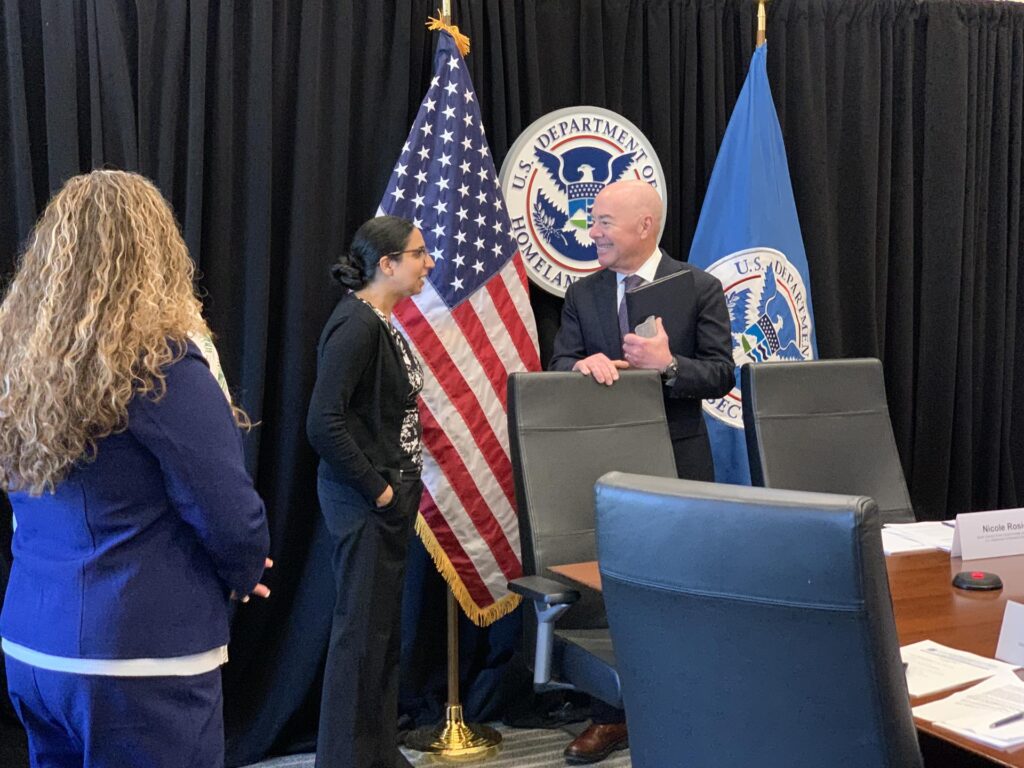
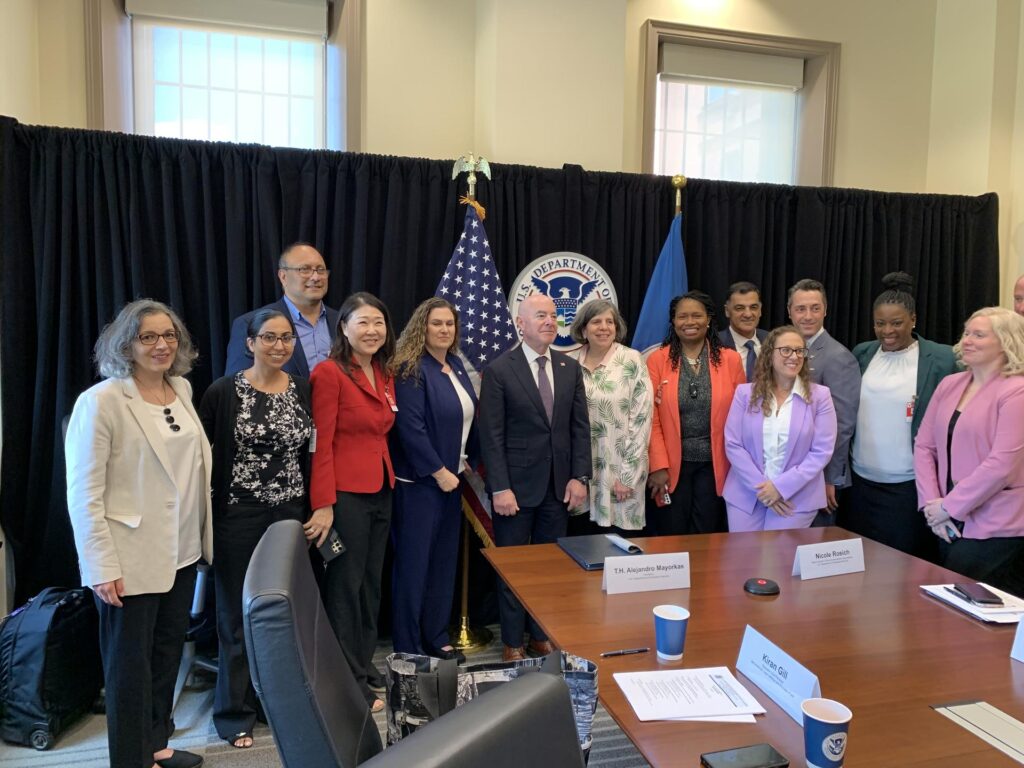
Since 2022, SALDEF Executive Director Kiran Kaur Gill has served as Chair of the Department of Homeland Security’s (DHS) Faith-Based Security Advisory Council (FBSAC). This council plays a vital role in ensuring houses of worship, faith communities, and faith-based organizations have the resources and support they need to stay safe.

Leadership Leads to Action

Under Kiran’s leadership and based on SALDEF research and analysis, the committee has worked to identify substantive and meaningful recommendations to support and enhance faith-based communities’ ability to be able to prevent, respond to, and recover from acts of targeted violence.

In an effort to protect Sikh Americans and others from incidents of transnational repression, the subcommittee has published recommendations that the government should enact.

Not only does the report heighten domestic awareness of this threat, but it also includes recommendations for prosecuting perpetrators of transnational repression, increased victim support services for targeted communities and language-accessible resources and outreach.

The DHS also announced an increase of $390 million in grant funding for faith-based institutions and nonprofit organizations, bringing the total FY2024 total to over $664 million.

Earlier this year, SALDEF engaged in successful advocacy to get Congressional funding for our sangats through this program.

The Committee reports and recommendations are on the FBSAC page, and you can find them here: Faith-Based Security Advisory Council | Homeland Security (dhs.gov).

Stay Informed, Stay Safe

We encourage you to visit https://saldef.org/transnationalrepression and https://saldef.org/nonprofit-security-grant-program-nsgp-application/ for the latest updates on security resources and initiatives.

SALDEF’s leadership role in this DHS committee demonstrates our ongoing commitment to the safety and security of all faith-based communities. SALDEF’s work in protecting the Sikh American community never stops. We will continue to advocate for your safety and security at every level.

  • SALDEF Previews New NBC Show ‘Outsourced’
  • SALDEF National Gala – October 16 in DC
  • Department of Homeland Security Annual Roundtable
  • FBI training on Sikh Americans
  • Connecting with Sikh American Youth at Local Camps
  • Lobbying for WRFA
  • Apply to be a Fall Intern

SALDEF Previews New NBC Show ‘Outsourced’ On August 16, SALDEF met with NBC executives to preview the pilot episode of the network’s new comedy ‘Outsourced’.  The show, which features a Sikh American as a cast member, is about a manager in the United States whose call center has been outsourced and follows him as he moves to India and manage the operation. After the showing, SALDEF commended NBC for promoting diversity through its programming but also cautioned the network to remain sensitive to the Sikh American community’s perception of the character and the show.  The show will air on Thursdays at 9:30 / 8:30c starting September 23rd. SALDEF National Gala – October 16 in DC Join us for an evening of celebration, culture and achievement in the Nation’s Capital on October 16.  We will recognize individuals who have contributed to the advancement and protection of religious liberty and civil rights in this country.  The event will feature cultural performances and live entertainment.  More information coming soon to saldef.org Department of Homeland Security Roundtable in Los Angeles Last month, SALDEF participated in an annual Roundtable hosted by the Department of Homeland Security in Los Angeles, CA.  The event included an introduction to the Officer for Civil Rights and Civil Liberties, Margo Schlanger, as well as presentations from Arif Alikhan, DHS Assistant Secretary for Policy Development and Michael Downing, Deputy Chief, Los Angeles Police Department.  Other agencies which were represented included the FBI, TSA, U.S. Attorney’s Office-Civil Rights Division, LA County Sheriffs, and ICE. Topics of discussion included partnership with Law Enforcement, community policing initiatives, and cultural competency trainings with other community and agency representatives.  SALDEF raised the issue of increased racial profiling under new community policing and anti-terrorism projects programs such as I-Watch and Counter Violent Extremism (CVE). SALDEF will continue to work with DHS to ensure that community concerns are closely monitored. FBI Training on Sikh Americans On July 29, SALDEF provided cultural sensitivity training to approximately 50 FBI agents and staff members at the FBI’s Washington Field Office.  Participants watched On Common Ground, a DVD training video produced by SALDEF in collaboration with the Department of Justice, and received a presentation about the Sikh articles of faith, religious practices, and appropriate protocol when interacting with Sikh Americans. The presentation was well received and SALDEF has been requested to hold a similar presentation in the near future. Connecting with Sikh American Youth at Local Camps This summer, SALDEF presented Anti-Bullying and ‘Getting Involved’ workshops at three Sikh Youth Camps.  At Guru Harkrishan Institute of Sikh Studies in Maryland, 50 children learned how to more effectively handle situations when they feel bullied at school.  At Guru Gobind Singh Foundation Camp, also in Maryland, approximately 80 campers learned how to more effectively communicate about their faith and identity to non-Sikhs.  At Camp Gian near Los Angeles, SALDEF discussed how young Sikhs can be involved in the community and develop leadership skills for the future.   Through the workshops, presentations and group discussions SALDEF seeks to provide support and guidance for the Sikh American youth across the country.  If we can support your child or local school, please contact us. Lobbying for Religious Freedom in the Workplace — WRFA Over the past month, SALDEF has continued to engage with the offices of several members of Congress to support the Workplace Religious Freedom Act (WRFA).  If passed, WRFA will positively impact the Sikh American community by strengthening the laws which allow for religious expression in the workplace. To read about past engagement with this bill please click below:

Apply to be a Fall Intern The SALDEF Internship Program offers Sikh American youth rare opportunities for political advocacy and leadership development. The program educates students on issues of civil rights, public policy, and the legislative process. Students will gain practical experience in community organizing, research and writing, legal issues, political action, and educational outreach. SALDEF is seeking interns to assist in the following areas: Legislation, Communication, Development and Technology/Media. The deadline to apply for the Fall is September 16. For more information, click here.

A recent initiative by the Department of Homeland Security would expand communication between its agencies and Arab, South Asian and Muslim youth in America. A conference on the issue, called “Roundtable on Security and Liberty: Perspectives of Young Leaders Post 9-11,” is being hailed by participants as a positive first step in repairing years of mutual mistrust.

“We’re dealing with profiling within our communities, and this provides us with a voice to change these problems,” said Rajbir Singh Datta, 25, of the Sikh American Legal Defence & Education Fund (SALDEF) of Washington, D.C., who participated in the conference. “When you’re a high school or college student, you are always dealing with these problems, but not sure how to solve them.” Datta, who lives in Washington, was one of 30 or so young leaders from a wide range of backgrounds who met with several government and law enforcement agencies at the conference, held at George Washington University in Washington in late July. “The youth want — and got access to — government people,” Datta said. Panel discussions ranged from “The State of Arab, Muslim, South Asian, Sikh, and Middle Eastern American Young People Today,” to how to get a job with the federal government. Datta said the best part of the conference was the frank discussions that took place between government officials — including Homeland Security Director Michael Chertoff — and participants. “These are youth leaders within communities that are not already integrated with organizations that have a national voice,” Datta said. “You got an un-political response to questions from the government such as ‘How are we doing?’ ‘You’re doing horrible’; they knew they’d get a straight answer.” Datta’s group conducts educational outreach and sensitivity training about Sikhs — a group of non-Muslim South Asians that suffered intense post-Sept. 11 backlash as visible targets because of their traditional turbans. He said there are many positive steps the government has taken to improve community relations, but young people don’t seem to be aware of them. Hesham Mahmoud, of the New Jersey chapter of the American-Arab Anti Discrimination Committee, said his group regularly meets with law enforcement and government officials to try to improve relations. “We try to do as much as we can on the local level,” he said. “We meet to communicate our concerns when specific issues occur, and to keep lines of communication open.” Mahmoud said such relationships can benefit both groups — law enforcement feels they can build trust in more insular communities, and members of those communities feel their concerns are being heard. “It’s more a two-way communication,” Mahmoud said. “We always make it clear we are not spies in the community, but if we see something in the community of concern, we’ll definitely enforce the law.” Brett Hovington, chief of community relations for the FBI in Washington, one of the agencies that participated in the recent youth roundtable, said the agency is paying more attention to young people, especially in light of increasing radicalism among young immigrant groups throughout Europe. “For the FBI, it was an overall change in our mission, where we started to realize the importance of having a better understanding of the demographics in this country as they started to change,” Hovington said in a telephone interview from Washington Friday. “The community definitely wanted more communication with government, and at the FBI, we realized we had to make inroads into those communities — it was on both fronts.” Shaarik Zafar, of the Homeland Security’s Office for Civil Rights and Civil Liberties, which organized the conference, said it was refreshing to hear new perspectives on what it’s like to grow up as a Muslim, Arab-American or South Asian in a post-Sept. 11 world. “It was a very frank and constructive conversation with young people about the issues they face,” he said. “And we look forward to continuing the discussion.” Reach Samantha Henry at 973-569-7172 or henrys@northjersey.com [http://www.northjersey.com/]

Secretary Chertoff Engages with Arab, Muslim and Sikh American Youth Leaders Washington D.C. – August 2, 2007: Last week, the Sikh American Legal Defense and Education Fund (SALDEF) participated in a roundtable discussion, Security and Liberty: Perspective of Young Leaders Post-9/11, hosted by the Office for Civil Rights and Civil Liberties of the Department of Homeland Security (DHS) and the George Washington University Homeland Security Policy Institute. The roundtable presented an opportunity for thirty Arab, Muslim, South Asian, and Sikh American youth leaders to interface and engage with high level government officials, policy experts, and national community leaders including DHS Secretary Michael Chertoff. They primarily discussed issues of civil rights and how they relate to homeland security. “The roundtable presented us with an opportunity to explain the effects government security policies and initiatives have on our respective communities,” said SALDEF Legal Fellow Nitoj Singh. SALDEF Associate Director Rajbir Singh Datta served on a series of panels, highlighting both the challenges the Sikh American community has faced since 9/11 and the increased opportunities for positive community-government relationships. “The two-day roundtable was another step in creating a lasting dialogue between Arab, Muslim, and Sikh American youth and federal policymakers so that we may work together to jointly face the challenges of protecting the nation and its citizen’s civil rights,” said Mr. Datta. “The event highlighted the importance of engaging young leaders in the discussion and the contributions they can make.” SALDEF thanks DHS Secretary Michael Chertoff, Daniel Sutherland, Officer for Civil Rights and Civil Liberties of the DHS, and Frank J. Cilluffo, Associate Vice President for Homeland Security at The George Washington University, for organizing and hosting the July 24-25 roundtable at the George Washington University School of Law.

Poster to reach over 40,000 federal law enforcement officials; will significantly increase awareness of Kirpan, a Sikh article of faith Washington, D.C., November 15, 2006 – Next Monday, the Sikh American Legal Defense and Education Fund (SALDEF) will be unveiling a a poster explaining the Sikh Kirpan produced in partnership with the U.S. Department of Homeland Security (DHS).  The poster is entitled Sikh Americans and the Kirpan and provides a brief introduction to the Sikh faith, the Sikh article of faith the Kirpan, and security recommendations for law enforcement officials when they come in contact with a Kirpan. The Kirpan, a religious sword, which serves as a constant reminder to a Sikh’s duty to uphold justice, has often caused law enforcement officials much confusion across the country. This poster, a product of an extensive collaboration between DHS and SALDEF, will be used to inform thousands of federal law enforcement officers and security screeners about the religious significance of the Kirpan to Sikhs. The poster will be sent to hundreds of offices under DHS including, the Federal Protective Services (FPS), Transportation Security Agency (TSA), Immigration and Custom’s Enforcement (ICE) and the Secret Service to name a few. “This venture is one part of an ongoing effort by SALDEF to change the way individuals in the United States view the Kirpan.” said SALDEF co-founder and Board Chairman Manjit Singh. “We must continue partnering with law enforcement and government officials at all levels to ensure their further understanding of our Sikh practices.” SALDEF similarly collaborated with the U.S. Department of Justice in 2004 on a project to produce a poster entitled Common Sikh American Head Coverings. The purpose of that poster was to provide local, state and federal law enforcement officials with basic information about the Sikh faith, the significance of the Daastar (turban), and provide recommendations on handling the Daastar when interacting with Sikh Americans. The Kirpan poster will be a formally unveiled in a joint SALDEF – DHS Press Conference on November 20, 2006 at the National Gurdwara (details below). Individuals scheduled to speak include: Dean Hunter, Acting Director of the Federal Protective Services Daniel Sutherland, Officer for Civil Rights and Civil Liberties, Department of Homeland Security Satwant Kaur Bell, President, National Gurdwara Manjit Singh, Chairman, SALDEF Unveiling of Kirpan Poster National Gurdwara 3801 Massachusetts Avenue, NW Washington, DC Monday November 20, 2006 4:00 pm – 5:00 pm Members of the mainstream and ethnic media will be in attendance. SALDEF encourages the Washington, DC-area Sikh American community to attend and show their support for continued collaboration and partnership between the Sikh American community and the Federal Government.  The poster will be available at www.saldef.org for review and download after the unveiling.

Washington, DC – On April 28th, the Sikh American Legal Defense and Education Fund (SALDEF) met with the head of the Department of Homeland Security (DHS) Secretary Michael Chertoff.  At the meeting SALDEF National Director Preetmohan Singh expressed the need for consistent cultural competency training for DHS’ 179,000 employees who are responsible for security at America’s airports and borders, coordinating immigration enforcement, and administering refugee agencies. “Secretary Chertoff has the tremendous task of optimizing DHS and we want to make sure that the civil rights and civil liberties we are trying to protect are held in the highest regard during this process,” said Mr. Singh.  “This is a continuation of SALDEF’s effort to ensure that top government officials prioritize the notion that all Americans should be treated respectfully when interacting with federal agencies.” Mr. Singh informed Secretary Chertoff that SALDEF has trained over 6,500 local, state, and federal law enforcement officials through its Law Enforcement Partnership Program. These trainings have also included a recent presentation to instructors at the Federal Law Enforcement Training Center (FLETC) in Glynco, GA. SALDEF is the only Sikh American organization to offer trainings at FLETC, where approximately 40,000 federal law enforcement officers are required to attend annual training. The meeting was facilitated by Dan Sutherland, DHS Officer for Civil Rights and Civil Liberties, and included representatives from several other leading national civil rights organizations including the Leadership Conference on Civil Rights (LCCR), Human Rights First, the National Immigration Forum, the Open Society Institute, the Muslim Public Affairs Council (MPAC), the Arab American Institute (AAI), the Chicago Bar Foundation, and the American-Arab Anti-Discrimination Committee (ADC). In addition to training, participants at the meeting also discussed racial profiling, post-9/11 detentions, access to legal representation, and issues pertaining to asylum-seekers.