Tremendous Gathering Features SALDEF Awardees and Commemorates 10 years of Service to Sikh Americans Washington, D.C. – On June 19, 2006 Sikhs from across the country along with elected officials and honored guests, gathered to commemorate the 10th Anniversary of the Sikh American Legal Defense and Education Fund (SALDEF) as well as recognize individuals who have helped in the empowerment and development of the Sikh American Community. The Honorable Navdeep Singh Bains, a Sikh Canadian Member of Parliament provided the evening’s Keynote address. In his address, Mr. Bains spoke about the strength of character and Sikh tenets that led him to dedicate his life to public service. “SALDEF is an organization that I have a great amount of respect and admiration for,” said MP Bains. “There is no parallel institution of this caliber that does this kind of work for the Sikh community and all communities.” Additionally, SALDEF was honored to award Canadian MP Bains with its inaugural SALDEF Youth Leadership Award for his extraordinary achievement of being elected to the Canadian Parliament and for embracing his role as an inspiration to Sikh youth worldwide. Congressman Michael Honda (D-CA) was recognized as this year’s recipient of the Dalip Singh Saund Legislative Leadership Award. The award is named after Dr. Saund, a Sikh American who became the first Asian American ever elected to the United States Congress in 1956. When introducing Congressman Honda, SALDEF co-founder and Acting Chair Manjit Singh remarked, “very rarely have we had such a close friend for the Sikh Community in Congress. [Congressman Honda] has been the most steadfast friend and it gives us special honor and privilege to recognize him for his dedication and public service.” Congressman Honda, chair of the Congressional Asian Pacific American Caucus, noted that, “Congressman Dalip Singh Saund had fought for his position. I also know that he could not become a Congressman when he wanted to be because of the discriminatory laws that were existing at that time that did not allow people like him nor people like me to become citizens.” He added, “SALDEF is an organization that not only stands up for all people’s rights, Sikhs specifically, but they also make sure the contract of our country, the Constitution is fulfilled, that the Bill of Rights are fulfilled. It is to those ends that I dedicate my life to public service.” This year’s SALDEF Public Service Award recognized Ms. Sharee Freeman, Director of the United States Department of Justice’s Community Relations Service. Since September 11, 2001 Ms. Freeman has led CRS by vigilantly addressing issues that directly affect the Sikh American Community. In conjunction with SALDEF, CRS has helped educate thousands of law enforcement, airport screeners and security personnel across the country about the Sikh faith. In her acceptance speech, Director Freeman said, “In my mind, an award like this is for those who toil long and hard in communities across the country and who are rarely recognized for their hard work. Those are the people this award is for, not me.” This year’s Dorothy Height Coalition Building Award was presented to the American Arab Anti-Discrimination Committee (ADC) for their efforts to build and sustain coalitions within the civil rights community. Ms. Height’s tireless efforts in struggling for equal rights included building bridges among a range of different communities. Accepting the award on behalf of ADC, the Honorable Mary Rose Oakar noted, “The great thing about our country is its diversity, it’s cultural and religious diversity. I thank SALDEF for this award and for its tremendous work on behalf of the Sikh American community.” Recognizing the achievements of a member of the Sikh American community, the Bhagat Singh Thind Community Empowerment Award was presented to Ratanjit Singh Sondhe of Ohio. An internationally renowned chemist, entrepreneur, stress-free expert, author, speaker and consultant, Dr. Sondhe has been an active voice on behalf of the Sikh community through lobbying for legislation and interfaith outreach. Among the guests attending the Banquet was Congresswoman Sheila Jackson-Lee (D-TX). In her remarks to the congregation the Congresswoman commented, “What an honor to be able to say a decade of service in fighting for equality, respect and dignity that comes when we eliminate discrimination amongst us. I congratulate SALDEF for its special leadership and acknowledge the many honorees that are here today.” Also highlighted during the event was the case of Mr. Jaswant Singh who contacted SALDEF to help resolve a case of employment discrimination with Domino’s Pizza. The statement that was delivered on Mr. Singh’s behalf read, “Soon after I started working [for Domino’s], I was told by the owner of the local franchise that I would not be allowed to wear my turban while working. I was absolutely humiliated by this request and felt that it was a violation of my religious beliefs as a Sikh American.” Thanking SALDEF for addressing this issue, Mr. Singh added, “I am now free to practice my religion openly at work, and I am grateful to SALDEF for working so quickly and diligently on this issue. To read more about Mr. Singh’s case, please click here. Additionally, SALDEF was fortunate to have Mr. Harry Kao and Mr. Paramjitinder Singh Dhillon, of the Pennsylvania Governor’s Advisory Commission on Asian American Affairs attend and present SALDEF with a citation of commendation from Pennsylvania Governor Edward G. Rendell. The citation partially reads, “The growing Sikh American community is part of this vibrant diversity, which is maintained and glorified through our freedom of association and expression and the sense of pride we all hold for our individual heritage. As Governor of the Commonwealth of Pennsylvania, I commend [SALDEF] for everything they have done over the years for the Commonwealth and its citizens.” At the end of the night, SALDEF Interim Managing Director Kavneet Singh specifically highlighted the hard work, dedication and passion of SALDEF’s co-founders Manjit Singh and Jaideep Singh. Kavneet addressed the audience noting that, “It would be a tragedy to not recognize the contributions that [Manjit Singh and Jaideep Singh] have had over the past 10 years as true sevaks (selfless servants).” He went on to thank Manjit Singh and recognize him as one “who has given of his life, his time, and of his whole-being, dedicated solely to the service and the betterment of the Sikh community.” SALDEF would like to thank Congressman Michael Honda, Congresswoman Sheila Jackson-Lee, Canadian Member of Parliament Navdeep Singh Bains, Ms. Sharee Freeman, Ratanjit Singh Sondhe, and the staff of the American-Arab Anti-Discrimination Committee (ADC) for their work and support. SALDEF would also like to thank our many sponsors including Sevatec Inc, the Chardhi Kaala Sikh Community Center, Galaxy Home Furnishings, and the Sikh Education and Charitable Trust for their support, as well as Camille’s Restaurant for catering the affair, our coalition partners and of course the Sikh American community who attended from all across the country.
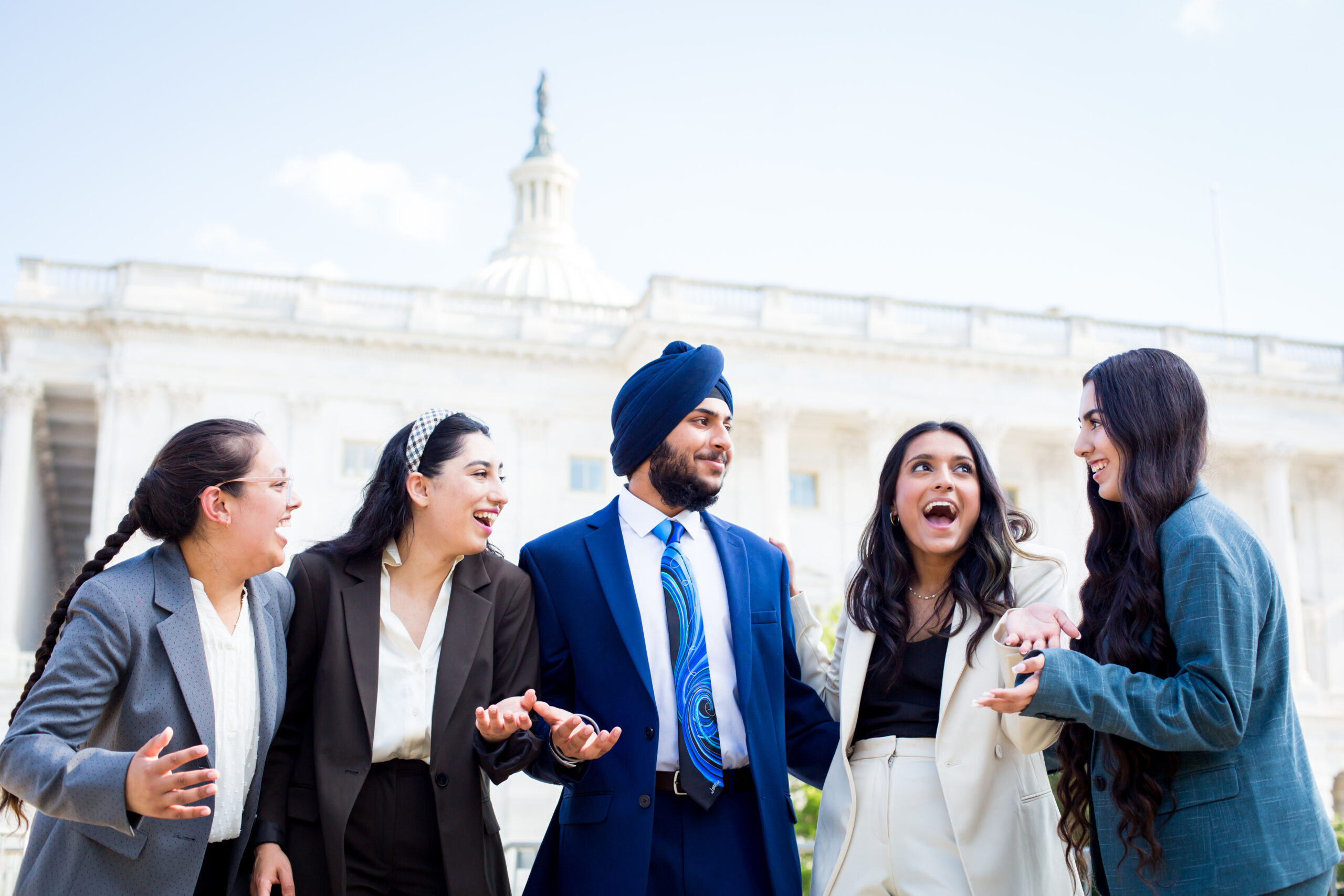
SALDEF Celebrates a Decade of Advocacy, Empowerment and Outreach on Capitol Hill
Sangat members are encouraged to contact their Representatives and Senators. Washington D.C. – The Sikh American Legal Defense and Education Fund (SALDEF) urge national leaders to support the reauthorization of the Voting Rights Act of 1964. Key provisions of the VRA, a historical piece of civil rights legislation, are set to expire on August 6, 2007 Despite the Fifteenth and Nineteenth Amendments to the U.S. Constitution, southern voter registration boards used poll taxes, literacy tests, and other bureaucratic impediments to deny minorities their legal voting rights. President Lyndon B. Johnson made civil rights one of his administration’s top priorities, using his skill to pass the Twenty-Fourth Amendment to the U.S. Constitution, which outlawed poll taxes, in 1964. By the late 1960’s the effects of the Voting Rights Act could be seen; 60% of eligible African Americans registered to vote in Mississippi, and other states showed similar improvement. Some of the provisions being threatened include; Section 203 of the VRA requires that certain states and local jurisdictions provide language assistance in languages other than English to voters who are not literate or fluent in English. Also Section 5, which requires certain states and local governments to “preclear” proposed changes in voting or election procedures with the U.S. Department of Justice or U.S. District Court for the District of Columbia. Voting is a hallmark of a true democracy and we must not let this legislation fall through the cracks. The VRA implemented the safeguards necessary for all minorities and low-income individuals to possess the right to have their vote count as equally as their wealthy counterparts. This is the true nature of America, and we must protect it. SALDEF urges members of the Sikh American community to contact their representatives in the United States Congress to support this vital piece of legislation. To find your U.S. Representatives Click here. To find your U.S. Senator Click Here.
Washington, DC – The Sikh American Legal Defense and Education Fund (SALDEF) and the American-Arab Anti-Discrimination Committee (ADC) alarmed by the current campaign associating the wearing of a turban and Senator Richard Durbin (D-IL) with terrorism. SALDEF, ADC and over 100 national and local organizations (see full list below) are strongly opposed to a recent flyer campaign launched by the Nutritional Health Alliance (NHA) depicting Senator Durbin wearing a turban with the words, “Keep Congressional Terrorism at Bay.” “ While we are aware of legitimate political differences in the debate on supplement regulation, the flyer produced by the NHA transgresses the boundaries of both legitimate and civil political discourse. The flyer serves as nothing more than hatemongering and uses stereotypes to support its point of view. We are disappointed that NHA would be engaged in the production of such a racist flyer that serves to perpetuate an increased environment of prejudice and hate against the Sikh, Muslim and Arab American communities . The flyer, which can be viewed here, makes an explicitly false correlation between individuals who wear turbans and terrorism or terrorist activities. It also attacks Senator Durbin and associates him with terrorism. The turban is a mandatory article of faith for the Sikh community. Adherents of the Sikh faith are required by their religion to keep uncut hair and cover their head with a turban. Additionally, many Muslims and Arabs wear turbans for cultural reasons. The turban is a sign of respect, dignity and humility and should not be associated with terrorism or terrorist activity. SALDEF, ADC and the other cosponsors urge the NHA to remove the flyer from any further distribution immediately. We further ask that a public apology be made and posted on the NHA’s website. Legitimate public debate must not be tainted with images that continue to create a dangerous environment of xenophobia and hate against innocent Sikh, Muslim, Arab and South Asian Americans. Click here to read the letter to the Nutritional Health Alliance Click here to read the letter to Senator Durbin
For Immediate Release December 6, 2005 Contact: Kavneet Singh info@saldef.org 202-393-2700 SALDEF Urges Passage of Religious Freedom Legislation Washington, DC – Last month the House Subcommittee on Employer-Employee Relations held a briefing on the Workplace Religious Freedom Act of 2005 (WRFA). This piece of legislation would provide greater protection against discrimination for people of faith. WRFA will require employers to reasonably accommodate the religious needs of their employees in the workplace. Typical examples covered by WRFA include allowing for religious clothing (such as turbans, yarmulkes, and head-scarves) and for flexible scheduling arrangements to facilitate holiday observances (such as agreeing to work on another holiday in order to observe Vaisakhi, the Sikh New Year). “Sikh men are already being discriminated against due to the American public not knowing who they are,” stated Congressman Mark E. Souder (R-IN), co-sponsor of the bill, in a statement proclaiming the need for such legislation to be passed. The hearing was preceded by a Press Conference organized by the Work Place Religious Freedom Coalition, of which SALDEF is an active member. “Since September 11, 2001 Sikh Americans have been mistakenly associated with terrorism and criminal activity,” stated SALDEF Associate Director Rajbir Singh Datta. “Unfortunately this perception has made its way into our nation’s places of employment and the threat of increased discrimination continues to persist.” Mr. Datta added, “Sikhs have been terminated from their jobs due to their turbans, beards, and/or articles of faith. As Americans, we all must advocate for religious freedom everywhere, because people of faith must never be told to check their religion at the door.” Testifying at the briefing were; House co-sponsors Congressman Souder (R-IN) and Congresswoman Carolyn McCarthy (D-NY); along with a second panel including, Richard Foltin, Esq., Legislative Director and Counsel, American Jewish Committee; Dr. Richard Land, President, Ethics and Religious Liberty Commission, Southern Baptist Convention; Samuel A. Marcosson, Associate Dean and Professor of Law, Louis D. Brandeis School of Law; and Camille A. Olson, Esq., Partner, Seyfarth Shaw LLP. If you would like to learn more about this bill or SALDEF’s efforts in protection religious liberties for all Americans, please, contact us at info@saldef.org. To view a partial list of SALDEF’s past legislative efforts, please see below: SALDEF Conducts Congressional Visits on Religious Freedoms Legislation SALDEF Congratulates House for Passing Hate Crimes Bill SALDEF Testifies at California Assembly Hearings about Sikh Americans SALDEF Welcomes Senate Approval of Strengthened Hate Crimes Legislation
Washington, DC – The Sikh American Legal Defense and Education Fund, the nation’s oldest Sikh American civil rights and advocacy organization, applauds members of the U.S. House of Representatives for passing the Local Law Enforcement Enhancement Hate Crimes Prevention Act (LLEEA). The bill was approved, with 223 votes for and 199 against, as an amendment to the Children’s Safety Act of 2005. The legislation, which still must pass through the Senate and be signed by the President, is critical to the Sikh American Community. The LLEEA is intended to strengthen the ability of federal, state, and local governments to investigate and prosecute hate crimes based on race, ethnic background, religion, gender, sexual orientation, and disability. The bill helps state and local anti-bias efforts by enabling the Justice Department to assist them in the investigation and prosecution of hate crimes. “Hate violence is rooted in prejudice and is meant to intimidate entire communities,” said Mirin Kaur Phool, SALDEF President. “Sikh Americans have long suffered from violence based on discrimination, and although legislation cannot expunge hate from our society, this bill sends a clear message that these insidious acts of violence run counter to America’s promise of freedom and tolerance.” The bill will also allow the federal government greater ability to aid local and state agency efforts in prosecuting, investigating, and preventing hate crimes. The House bill had strong bipartisan support and was endorsed by more than 175 law enforcement, civil rights, civic, and religious organizations, including SALDEF. The similar bill currently pending in the Senate has 44 co-sponsors, and SALDEF strongly supports this bill as well.
Over the past several months, representatives of the Work Place Religious Freedom Coalition, of which SALDEF is an active participant, have met with numerous Congressional representatives on the importance of religious freedom in the workplace. The meetings were held to encourage House members to support the Workplace Religious Freedom Act (WRFA) of 2005 (Senate Bill 677/House Bill 1445. This legislation is designed to reinstate protections in America’s civil rights laws which encourage employers to reasonably accommodate the religious needs of their employees in the workplace. The meetings were held with Rep. Phil Gingrey (GA-11), Rep. Marilyn Musgrave (CO-4), Rep. Jon Doolittle (CA-4), Rep. Ron Lewis (KY-2), Rep. Tom Delay (TX-22), Rep Wally Herger (CA-2), Rep. W. Todd Akin (MI-2), Rep. Marsha Blackburn (TN-7) as well a personal meeting with Rep. Tom Tancredo (CO-6), among others. At present, Title VII of the Civil Rights Act of 1964 (amended 1972) allows employers to fire employees if they can prove that they bear an “undue hardship” for providing accommodation for an employees religious practices. This term has come to mean any minimal discomfort; a very low test. As any attorney knows, this amendment has shifted protection away from people of faith. The Workplace Religious Freedom Act, would amend Title VII to say that employers must accommodate an employees’ religious practices so long as it does not produce, “significant difficulty or expense.” This legislation is vital to Sikhs since there have been numerous cases of employment discrimination due to wearing a turban and beard. It will force employers to accommodate and work with people of all faiths whom are being discriminated against simply for their religion. With the help of SALDEF and the WRFA Coalition, we hope to gain more protections for people of all faiths.
On April 28, representatives of Asian Pacific American organizations, including SALDEF, met with the Senate Democratic Steering and Outreach Committee to discuss issues affecting the APA community. The meeting was chaired by Senator Hillary Clinton (NY) and attended by Senate Minority Leader Harry Reid (NV), was also attended by Senators Daniel Akaka (HI) and Byron Dorgan (ND). Also in attendance were Congressmen Xavier Becerra (D-CA) and Mike Honda (D-CA). The meeting was organized by the National Council of Asian Pacific Americans (NCAPA), of which SALDEF is a member. In light of pending legislation, the group discussed issues related to social security, immigration, civil rights, health care, and education. SALDEF National Director Preetmohan Singh highlighted legislation called the REAL ID Act which would place restrictions on drivers licenses and change asylum laws. SALDEF appreciates the Senate Democrats recognition of these important issues to the Sikh and broader Asian American community and hopes to meet with Republican leaders in the near future.
SALDEF Conducts Congressional Briefing, Urges Sikh Americans to Contact Congress about Religious Freedom April 8, 2005–A critical piece of legislation for the Sikh American community, the Workplace Religious Freedom Act (WRFA) of 2005 (Senate Bill 677/House Bill 1445), is again being considered in Congress. This legislation is designed to reinstate protections in America’s civil rights laws which encourage employers to reasonably accommodate the religious needs of their employees in the workplace. Today, SALDEF’s National Director, Preetmohan Singh, conducted his third briefing in six months for congressional staff along with leaders from other civil rights and religious liberties organizations. SALDEF is encouraging the community to immediately contact their representatives in Congress and urge them to support this bill (see sample letter below). Typical issues that would be affected by this legislation include allowing for religious attire (such as turbans, yarmulkes, and head-scarves) and for flexible scheduling arrangements to facilitate holiday observances (such as agreeing to work on an Easter holiday in order to observe Vaisakhi). The legislation is bipartisan in support with Senators Rick Santorum (R-PA) and John Kerry (D-MA) serving as its lead sponsors in the Senate, along with 13 other Senators. The House currently has six co-sponsors, with Representatives Mark Souder (R-IN) and Carolyn McCarthy (D-NY) leading the way. WRFA is also supported by a diverse coalition of more than 45 religious and civil rights organizations, including the Anti-Defamation League, American Jewish Committee, National Council of Churches, Southern Baptist Convention, National Council of Muslim Women, Seventh Day Adventist Church and many others. We urge you to contact your members of the House and Senate today and relay to them the importance of supporting the Workplace Religious Freedom Act. Please telephone, fax, and/or e-mail (listed in the order or importance) your representatives about WRFA, especially if they have not cosponsored this legislation already. You can contact your representatives in the House and Senate by calling the Capitol switchboard at 202-224-3121. The names and contact information for elected representatives can be found at www.senate.gov and www.house.gov. Regular mail is still being diverted for screening before it can be delivered to Capitol Hill, so do not use this method. Please inform SALDEF at legislation@saldef.org with your name, state, and the representative(s) you contact. To learn more about this bill and its cosponsors, please click here http://thomas.loc.gov and type in “Workplace Religious Freedom Act.” SAMPLE Message to Members of Congress: My name is [_____] and I reside at [home address, city, state, zip]. As my elected representative, I would like to urge you to cosponsor the Workplace Religious Freedom Act (H.R.1445/S.677.) As a Sikh American, I believe WRFA provides a solution to two of the most important issues for members of our community in the workplace: religious dress and flexible scheduling. With WRFA intact, we can avoid repeating situations where Sikh Americans have had to engage in expensive litigation to receive reasonable accommodation at minimal or no cost to employers. WRFA also provides that accommodation needed only be provided to an employee who is able to perform the essential functions of the job. As you may know, according the U.S. Equal Employment Opportunity Commission (EEOC), charges relating to race, gender, and national origin grew by 15 percent in the past decade, while those involving religion increased by over 80 percent. This spike in religious claims was particularly severe after the 9/11 terrorist attacks, when Sikh Americans and others faced greater hostility at the workplace. The bill is a fundamental step toward protecting religious liberty and I hope you will support it. Sincerely, [Your Name]
SMART’s National Director Preetmohan Singh recently conducted two congressional briefings to discuss the impact of the pending Workplace Religious Freedom Act (WRFA) on the Sikh American community. This legislation (Senate Bill 893) will require employers to reasonably accommodate the religious needs of their employees in the workplace. Typical examples covered by WRFA include allowing for religious clothing (such as turbans, yarmulkes, and head-scarves) and for flexible scheduling arrangements to facilitate holiday observances (such as agreeing to work on another holiday in order to observe Vaisakhi, the Sikh New Year). Mr. Singh conducted the briefings on Capitol Hill with leaders from the Christian, Jewish, and other civil rights organizations. If you would like to learn more about this bill, please see SMART’s Action Alert. If you would like to become more active with SMART’s legislative efforts, please email us at legislation@sikhmediwatch.org.
SMART representatives recently attended meetings to discuss legislative priorities with members of the Congressional Asian Pacific American Caucus (CAPAC). SMART met with Congressman Mike Honda (D-CA), the newly-elected chair of CAPAC, and Rob Leonard, Legislative Aide for Congressman Robert Matsui (D-CA). Attendees at both meetings referred to the 2004 National Council of Asian Pacific Americans’ (NCAPA) Call to Action platform. SMART discussed issues such as hate crimes, racial profiling, and workplace religious freedom issues. Others attending the meeting included representatives of the National Asian Pacific American Legal Consortium, and representatives from Japanese American Citizens League, Asian Pacific American Labor Alliance, AFL-CIO and Hmong National Development. SMART has participated in multiple Congressional hearings and town hall meetings sponsored by CAPAC members last year and looks forward to continuing that relationship in the future.