Religion News – Sikh Americans, citing ‘Transnational Repression,’ vote for an independent homeland

Sikh Americans, citing ‘Transnational Repression,’ vote for an independent homeland

Read the Full Article from Religion News

(RNS) — More and more Sikh Americans are fearful about an ‘alarming rise’ in transnational repression, according to several Sikh advocacy organizations.

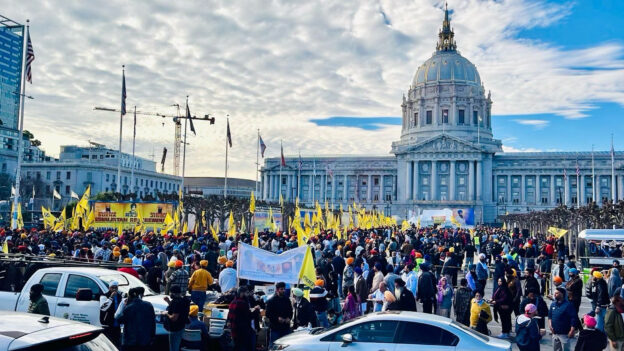
Last Sunday (Jan. 28), more than 120,000 Sikhs of all ages and occupations took part in a historic referendum in San Francisco on the creation of an autonomous homeland in northwestern India. They braved hourslong lines after already long commutes, in many cases from neighboring states, to reach the polling place in the City by the Bay. 

These Sikhs, almost all of them U.S. citizens and residents, were voting aspirationally for the creation of Khalistan — a hoped-for but nonexistent “land of the pure” that would stand separate from the nation of India.

Organized by Sikhs for Justice, an activist group that is banned in India, the vote was aimed at raising the profile of Sikh efforts to convince the government of India to allow Punjab, the state where the Sikhi faith was born, to secede.

Though only symbolic, the vote for self-determination, said Harjeet Singh, a Seattle resident who voted in the referendum, was taken to “shake up and wake up” the Indian government to take accountability for their “historical oppression” and hold a binding referendum in Punjab.

“There are people who are proposing a solution to a problem. Now they have launched a peaceful, democratic expression of their will through a referendum,” said Singh. “This is a beautiful way to show that Sikhs as a community, we are not happy with the system, and we want change.”

The vote is especially timely, say Sikh advocates, after recent incidents outside of India of surveillance, intimidation and censorship of dissidents, or what several Sikh advocacy organizations refer to as “transnational repression.”

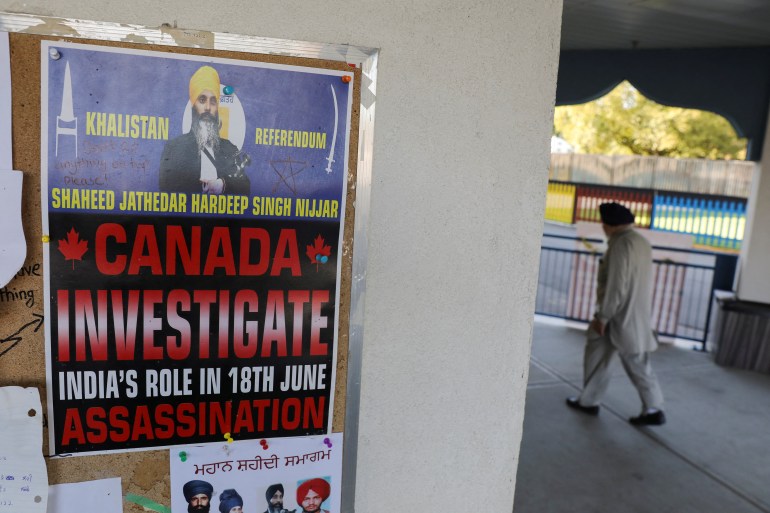
In June of last year, Canadian Prime Minister Justin Trudeau accused the Indian government of involvement in the assassination of Sikh activist Hardeep Singh Nijjar in a Surrey gurdwara parking lot. In November, the U.S. Department of Justice unsealed a document revealing an attempted assassination of a Sikh separatist leader in New York — this time the legal adviser of Sikhs for Justice, Gurpatwant Singh Pannun, who was present at the referendum.

More and more Sikh Americans are fearful about an “alarming rise” in such incidents, which Kavneet Singh of the Sikh American Legal Defense and Education Fund said are “indicative of a broader, more systematic threat to the basic human rights of American citizens and residents.”

Bobby Singh, a member of Sikhs for Justice, was reportedly warned by the FBI for his own safety after the organization was informed of a credible threat to his life. 

On Tuesday, SALDEF announced that four U.S. House members — including Illinois Rep. Raja Krishnamoorthi and Washington Rep. Pramila Jayapal, both Indian-American — are co-sponsoring a bill that would offer greater resources and expanded protections for the minority community.

The United States Commission on International Religious Freedom published a statement in December denouncing the “severe escalation of India’s efforts to silence religious minorities and human rights defenders both within its country and abroad.”

On Friday, the FBI released a public service announcement in the Punjabi language, warning citizens of the increase in threats.

The FBI “is reaching our community particularly in the language they speak, getting to them at their very core and heart,” said Kavneet Singh. “This is very clearly showing that they see our community, and that this is a legitimate issue.”

While the referendum organizers expected tens of thousands to come out for the vote, the massive turnout in San Francisco meant that some 30,000 voters were turned away. A second vote will occur on March 31.

Karam Singh, a board member for the California Sikh Youth Alliance, says the turnout  ”unequivocally” demonstrated where Sikhs in America stand on the Khalistan issue. 

“At the end of the day, this is a political grievance,” he said. “It’s a matter of persecution. It’s a matter of a community feeling neglected. Even if it was an advisory vote, even if it was non-binding, it was still a statement that Sikhs are not safe in India, and they firmly believe in independence.”

The 26-year-old graduate student drove two hours to cast his ballot, feeling a responsibility as a Sikh raised in the U.S. to “share the stories of pain and violence” that older generations, many of whom fled political persecution for supporting Khalistan, “didn’t have the tools to tell.”

“Sikhs from a very young age are taught a history of valor and honor,” he said. “That history is always a part of us. Although we are victims of genocide, at the same time, we’re also survivors. Sikhs see this as continuing that lineage of resistance. That history has a big part of Sikh psyche in America and even among young people.”

Tensions between Sikhs and the Indian government can be dated back to Indian independence in 1947, when support for the Khalistan movement gained traction against the backdrop of a division of Punjab into two parts — one in predominantly Muslim Pakistan and one in Hindu-majority India. In the resulting unrest, scholars estimate, 200,000 to 2 million people died, and up to 20 million were displaced. 

In the 1980s, India’s then-Prime Minister Indira Gandhi ordered an army operation called Operation Blue Star that was meant to silence prominent Khalistani leader Jarnail Singh Bhindranwale and his militants in the holy Golden Temple in Amritsar, in Punjab. In retaliation for Bhindranwale’s death and the killing of many innocent civilians at the temple, Gandhi was assassinated by her two Sikh nationalist bodyguards. 

In October of 1984, an anti-Sikh pogrom in New Delhi took the lives of more than 3,000 Sikh Indians. A year later, Khalistani separatists based in Canada bombed an Air India flight en route from Toronto to New Delhi, killing all 329 people on board in the deadliest aviation attack before 9/11.

But activists such as Harjeet Singh and Karam Singh stress mutual Sikh and Hindu tolerance. The strife of the past was never a Hindu-Sikh religious battle, they say, but instead one about political representation. They point to the unity shown in 2020-2021, when hundreds of thousands of farmers, most of them Punjabis of both faiths, demonstrated peacefully against Indian Prime Minister Narendra Modi’s agricultural reforms that they claimed would worsen ecological and economic conditions. After months of sit-ins and rallies, Modi agreed to repeal the laws.

Harjeet Singh, an Indian army veteran who moved to the U.S. in 2013, said the general public is flooded with misinformation about the Khalistan movement, including that it is a “terrorist,” “fringe” or “militant” movement that supports a “theocracy.” He calls this propaganda from Indian media and government officials.

“Sikhs have a saying that when good Sikhs sit together, then the Guru himself sits there,” he said, referring to Guru Nanak, the founder of Sikhi. 

“We Sikhs, we act almost as a nation. Whether it is a gathering for a political purpose or a gathering for a spiritual purpose, you always have a feeling of being with your family,” he added.

For Kavneet Singh, this fight also boils down to the aspects of the Sikhi faith that drive each Sikh’s pursuit of social justice.

“Our tradition has always had a concept of vigilance for justice for all,” he said. “That is a cornerstone of our faith. It is embedded in our DNA that we are to endeavor to stand up for what is right. If we see something unjust, or if we see someone who is being denied justice, it is our job to stand up and stand with them.”

SALDEF Responds to 2023 Hate Crime Statistics Release

The U.S. Department of Justice (DOJ) and the Federal Bureau of Investigation (FBI) released their national report on hate crimes earlier this week. There were 156 anti-Sikh hate crimes documented in 2023.

“We continue to see Sikhs as one of the top three most targeted religious groups in the country,” said Kiran Kaur Gill, SALDEF Executive Director. “We are proud that the Sikh American community is willing to come forward with these incidents and to advocate for constructive change. Unfortunately, we know these numbers do not account for the true scope of hate around the country. Law enforcement agencies continue to under- and not- report the number of hate crimes in their regions.”

Documented hate crimes against the Sikh American community continue to be among the most reported categories since 2015, when the anti-Sikh category was first included in the FBI’s hate crimes report. The number of anti-Sikh hate crimes reported decreased from 2022, while the overall number of hate crimes increased.

SALDEF continues to urge Congress, policymakers, and law enforcement agencies around the country to take specific action to combat hate and increase resources for victims and community. The organization submitted recommendations to the Senate Judiciary Committee as a part of their hearing, “A Threat to Justice Everywhere: Stemming the Tide of Hate Crimes in America”.

If you are a victim of an act of hate or bias, after you have reached out to law enforcement and are in a safe place, we encourage you to share your experience with SALDEF. You can find more resources on how to respond to acts of hate, including from a community health perspective, on our Resources page.

FOR IMMEDIATE RELEASE

September 19, 2024

Contact: Amrita Kular, SALDEF Director of Communications

(202) 393-2700 | media@saldef.org

Schiff Introduces the Transnational Repression Reporting Act to Track Cases of Foreign Repression in the U.S.

Washington, D.C.— Today, Representative Adam Schiff (D-Calif.) introduced the Transnational Repression Reporting Act of 2024 which would require the Attorney General, in coordination with other relevant federal agencies, to submit a report of cases of transnational repression against U.S. citizens or people in the United States. Schiff’s bill comes after the 2023 attempted assassination against prominent Sikh activist, Gurpatwant Singh Pannun.

“With transnational repression on the rise, the American people deserve to know if foreign governments are working to intimidate, harass, harm or kill individuals within the United States whom they view as hostile to their regimes,” said Rep. Schiff. “My bill will require a comprehensive report on cases of foreign governments targeting individuals here at home and American citizens abroad. I will continue to work with my colleagues to safeguard fundamental rights and freedoms, both domestically and around the world.”

Transnational repression violates the fundamental rights to free speech and privacy granted to all individuals in the United States – including foreign citizens, U.S. residents, and naturalized and U.S.-born citizens. According to the FBI, the most common targets of transnational repression are political and human rights activists, dissidents, journalists, political opponents, and members of religious or ethnic minority groups. Methods of transnational repression may include physical and digital stalking, harassment, computer hacking, criminal threats, assaults, attempted kidnappings, coerced repatriation, and detaining family members in the home country.

“The Transnational Repression Reporting Act is a major step forward in protecting the freedom of speech and civil rights of Americans,” said Kiran Kaur Gill, Executive Director of the Sikh American Legal Defense and Education Fund (SALDEF). “When foreign governments infringe upon American sovereignty, there must be full transparency around the violation for the safety of our communities. Through this bill, Congress sends a strong message to both allies and adversaries that violating the constitutional rights of Americans will not be tolerated. SALDEF and the Sikh American community thank Congressman Schiff for his leadership in protecting the rights of all Americans.”

“We are deeply grateful to Congressman Schiff for proposing this legislation and taking the continuing threat of all transnational repression, including India’s recent targeting of Sikhs, seriously. It is essential for our national security that the United States is not seen abiding such egregious violations of democratic values or international norms–including India’s harassing, harming, and plotting to kill U.S.-based Sikhs–without consequence. We hope that others in congress will join Congressman Schiff to support this significant step forward,” said Harman Singh, Executive Director of the Sikh Coalition.

“India must be made accountable for transnational repression on Sikhs and this bill helps combat the oppression and intimidation Sikhs are facing in America,” said Swaranjit Singh Khalsa, City Council Member from Norwich, Connecticut and one of the Directors of Sikh Assembly of America.

The Transnational Repression Reporting Act of 2024 is cosponsored by Representatives Daniel S. Goldman (D-N.Y), Ilhan Omar (D-Minn.), Barbara Lee (D-Calif.), James McGovern (D-Mass.), Eleanor Holmes Norton (D-D.C.), and Eric Swalwell (D-Calif.).

Schiff’s bill is also supported by Human Rights Watch, Sikh American Legal Defense and Education Fund, Sikh Coalition, Sikh Assembly of America, American Sikh Caucus Committee, International Defenders Council, Public Affairs Alliance of Iranian Americans, Middle East Democracy Center, Hong Kong Democracy Council, Committee for Freedom in Hong Kong Foundation, and Falun Dafa Association.

Schiff has been a consistent leader in protecting Americans from transnational repression. He introduced the Stop Transnational Repression Act which would bolster the prosecution and oversight of transnational repression in 2022 and reintroduced the bill in December of 2023.

Read the full text of the bill HERE.

FOR IMMEDIATE RELEASE

Friday, July 12, 2024

Contact:

Amrita Kular, (202) 393-2700, media@saldef.org

LOCAL AND NATIONAL SIKH ORGANIZATIONS CELEBRATE THE APPOINTMENT OF RAJ SINGH BADHESHA TO THE FRESNO COUNTY SUPERIOR COURT BENCH

Judge Raj Singh Badhesha Represents a Historic First for the Sikh Community in the United States

FRESNO, CA — In a momentous occasion for the Sikh community in the United States, the Jakara Movement, the Sikh American Legal Defense and Education Fund (SALDEF), and the Sikh Coalition, are proud to celebrate the historic appointment of Raj Singh Badhesha to the Fresno County Superior Court Bench.

An enrobing ceremony was held Thursday, July 11, 2024, at Fresno City Hall.

Raj Singh Badhesha’s appointment is not just a professional achievement; it represents the culmination of decades of perseverance and dedication by Sikhs in America. He is the first ever Sikh to wear a judge’s robe in Fresno County; he is also the first Amritdhari (fully initiated) Sikh Judge in the United States that wears the Dastar (Sikh turban) or Pagri, per reporting.  Badhesha’s presence on the bench symbolizes the rich cultural heritage and the enduring spirit of the Sikh community.

In response to his appointment, Badhesha remarked, “It is my hope moving forward, that the Sikh youth present here today know that they can use this example and aspire to serve this county, this state, and this nation, in any position they wish to pursue.”  He added, “As I step into this new phase of service, I am aware of the great weight of the responsibilities bestowed upon me…I will strive to do my best each and every day, act impartially, honorably, and with the utmost integrity.”

The Sikh community has deep roots in California’s Central Valley, with Sikh farmers and laborers having settled in the region over a century ago. Their contributions to agriculture and local industry have been invaluable, and their cultural influence is woven into the fabric of the region. Today, Sikhism is the fifth-largest religion in the world, with millions of adherents who follow its teachings of equality, justice, and selfless service.

Immediately before his appointment, Badhesha served as Chief Assistant City Attorney in the Fresno City Attorney’s Office since 2022 and served in several roles in that office since 2012. He was an Associate at the law firm of Baker Manock & Jensen, PC from 2008 to 2012.  Badhesha earned a Juris Doctor degree from the University of California College of the Law, San Francisco (formerly UC Hastings).

Naindeep Singh, Executive Director of the Jakara Movement, expressed his excitement, stating, “Raj Singh Badhesha’s appointment is a groundbreaking moment for Sikhs in America. It reflects our community’s resilience and our contributions to the broader society. We are incredibly proud of Raj for breaking this glass ceiling and confident that he will bring his unwavering commitment to justice and equality to the bench.”

“Raj Singh Badhesha’s appointment is a proud moment for the Sikh community in the Central Valley, throughout California and across the Country. He has displayed decades of dedication to justice and community advocacy, and serves as an inspiration to all those looking to serve and make change,” added SALDEF Executive Director Kiran Kaur Gill.

Harman Singh, Executive Director of the Sikh Coalition also commented on this milestone: “This appointment is a significant step towards greater representation and diversity within our judicial system. Raj Singh Badhesha’s journey and achievements inspire us all and highlight the importance of inclusion and equality in all spheres of public service.”

The Jakara Movement, SALDEF and the Sikh Coalition, will continue to support and advocate for the Sikh community, celebrating milestones like this that pave the way for future generations.

Pictures of Judge Badhesha’s Enrobing Ceremony are available here.

SALDEF at the Forefront of Protecting Sikh Americans

Faith-based communities in America have repeatedly come under attack.

These attacks not only threaten individual faith groups, such as Sikh Americans, but they also threaten the idea of religious freedom, one of the core principles under which our nation was founded. 

At SALDEF, the safety and security of the Sikh American community is our top priority.

We’re proud to share a significant step forward achieved through SALDEF’s leadership.

Since 2022, SALDEF Executive Director Kiran Kaur Gill has served as Chair of the Department of Homeland Security’s (DHS) Faith-Based Security Advisory Council (FBSAC). This council plays a vital role in ensuring houses of worship, faith communities, and faith-based organizations have the resources and support they need to stay safe.

Leadership Leads to Action

Under Kiran’s leadership and based on SALDEF research and analysis, the committee has worked to identify substantive and meaningful recommendations to support and enhance faith-based communities’ ability to be able to prevent, respond to, and recover from acts of targeted violence.

In an effort to protect Sikh Americans and others from incidents of transnational repression, the subcommittee has published recommendations that the government should enact.

Not only does the report heighten domestic awareness of this threat, but it also includes recommendations for prosecuting perpetrators of transnational repression, increased victim support services for targeted communities and language-accessible resources and outreach.

The DHS also announced an increase of $390 million in grant funding for faith-based institutions and nonprofit organizations, bringing the total FY2024 total to over $664 million.

Earlier this year, SALDEF engaged in successful advocacy to get Congressional funding for our sangats through this program.

The Committee reports and recommendations are on the FBSAC page, and you can find them here: Faith-Based Security Advisory Council | Homeland Security (dhs.gov).

Stay Informed, Stay Safe

We encourage you to visit https://saldef.org/transnationalrepression and https://saldef.org/nonprofit-security-grant-program-nsgp-application/ for the latest updates on security resources and initiatives.

SALDEF’s leadership role in this DHS committee demonstrates our ongoing commitment to the safety and security of all faith-based communities. SALDEF’s work in protecting the Sikh American community never stops. We will continue to advocate for your safety and security at every level.

WELCOME 2024 SikhLEAD DC INTERNS!

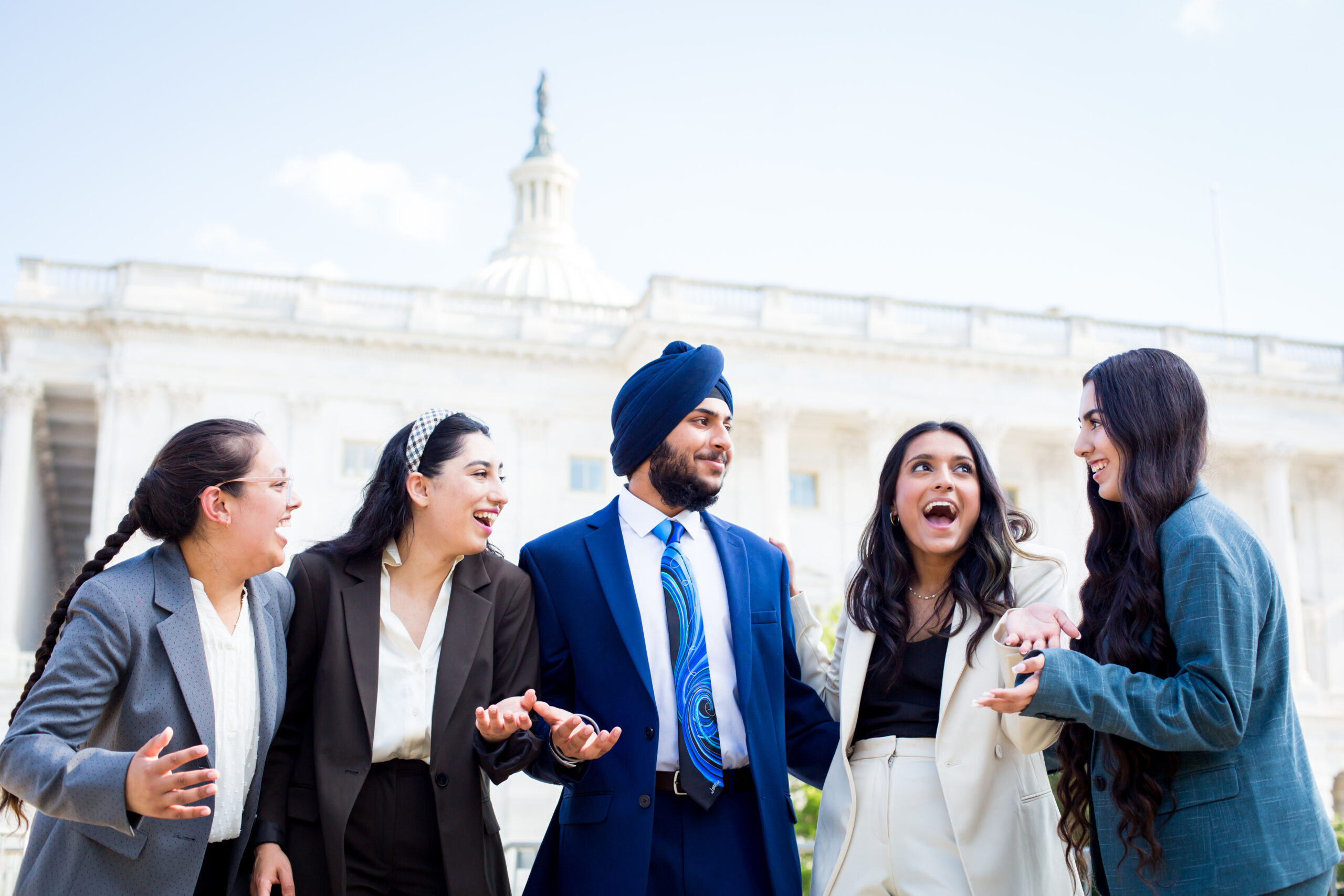
We are thrilled to announce the arrival of our exceptional Washington DC SikhLEAD Summer Internship participants at SALDEF!

This year’s cohort brings together eight talented young Sikh professionals from diverse communities across the nation:

  • Salonee Raheja | Becket Law Firm
  • Karamjot Singh | Senator Chuch Schumer
  • Komal Samrow | United States Government Accountability Office
  • Harbani Kohli | Asian Americans Advancing Justice (AAJC)
  • Shaan Dhaliwal | New Heights Communication
  • Noorkaran Chima  | United States Commission on Civil Rights
  • Sareena Datta  | Congressman Andy Kim
  • Harman Singh Kohli  | APIAVOTE

Throughout the summer, they will have a unique opportunity to engage with influential leaders in Washington, D.C., including those on Capitol Hill, at key federal agencies, and at esteemed organizations like Becket Law Firm and the United States Government Accountability Office.

Through their participation in the SikhLEAD Internship Program, these interns will not only cultivate relationships with our nation’s leaders but also learn how to align their Sikh values with their chosen careers. Additionally, they will gain valuable professional experience that will equip them to serve the Sikh community effectively.

As a reminder, we have a summer fundraising goal of $75,000 to support the SikhLEAD Internship Program. Your contribution to this campaign will help us empower these and future aspiring leaders.

On behalf of these inspiring young leaders and the entire SALDEF team, thank you for your continued support!

Sikhs in Storytelling – A Smash Hit!

Our Sikhs in Storytelling event in New York City was an unforgettable evening with over 100 attendees in person and a whopping 500+ tuning in on the livestream!

The impact of your support was evident in the energy and enthusiasm that filled the room. Stories were shared, connections were made, and a powerful message of resilience and pride was amplified.

The evening unfolded as a vibrant tapestry of Sikh American experiences. A captivating panel discussion titled Storytelling for a New Era, delved into the heart of Sikh identity in the modern world.

Esteemed panelists Nardeep Khurmi, Nav the Poet, Ravjot Mehek Singh, Vishavjit Singh, and Anoopreet Kaur Rehncy shared their personal journeys and powerful voices, sparking thought-provoking discussions on representation, overcoming media stereotypes, and the vital role of storytelling in shaping a more inclusive future.

Next, the event took a powerful turn with From Margins to Mainstage: Sikh Women Reimagine Their Power, an interactive session that had the audience buzzing.

The brilliant writers behind the book Kaurs Reimagine: Meeta Kaur, Sonia Kaur, and Saranjit Banga took center stage, led by the ever-inspiring SALDEF Board Member, Juspreet Kaur.

Together, they wove a tapestry of captivating stories featuring Sikh women who shattered expectations and carved their own paths to strength and leadership. It was a session that left everyone feeling empowered and ready to embrace their own unique experiences.

Shattering the Glass Ceiling in Media and Journalism, brought together this a powerhouse group of women: Brahmjot Kaur, Harmeet Kaur, Asees K. Singh, and Sona Simran Kaur.

Their stories weren’t just about navigating a competitive field, they offered a refreshing perspective on how to tell Sikh stories in the media.

From personal anecdotes to practical advice on news cycles, this panel was a breath of fresh air, leaving the audience eager to see more diverse voices shaping the media landscape.

Weaving a fascinating thread through our Storytelling for Change panel was the unlikely historical figure, Bhagat Singh Thind.

Panelists Nardeep Khurmi, Anoopreet Kaur Rehncy, Harjus Singh, Vishavjit Singh, and Joy Kanwar, despite their diverse backgrounds and experiences, all connected to Thind’s legacy of resilience and fighting for justice.

This panel also sparked a powerful conversation about how storytelling can empower our community to advocate for a more just and equitable world, leaving a lasting impression on our engaged audience members.

Beyond Words: Performances that Stirred the Soul

From captivating musical performances to a thought-provoking spoken word session, the evening pulsed with the vibrant energy of Sikh American creativity.

Manav SinghUnnat Singh & Dashmesh Singh’s captivating rendition of Raag Gond (the 17th Raag in the sacred Sri Guru Granth Sahib Ji) set the perfect tone for an evening filled with unforgettable stories and vibrant culture.

Gurpreet Sarin‘s stirring vocals captivated the audience, while Nav the Poet‘s spoken word piece delivered a powerful message that resonated deeply with the attendees.

These diverse performances showcased the rich tapestry of Sikh American artistry and left a lasting impression on all who witnessed them.

Your continued support makes events like this possible.

The success of “Sikhs in Storytelling” wouldn’t have been possible without your support, and the support of our sponsors, The Asian American Foundation and Comcast.

Your contribution allows us to continue amplifying Sikh American voices and challenging the one-dimensional narratives prevalent in society.

Thank you once again for your unwavering support. Together, we are building a brighter future for the Sikh American community.

Sikhs in Storytelling Captures Hearts in NYC!

SALDEF’s groundbreaking Sikhs in Storytelling event in NYC was a resounding success! Over 100 attendees packed the Five Angels Theater for a night filled with captivating performances and insightful panels.

Sikh American creatives and local community members (the sangat) came together to share powerful stories and ignite a movement of cultural understanding. This event was a pivotal step in redefining the narrative of Sikh Americans through the power of storytelling.

Thank you to all who made this event a success!

Missed the event? Don’t worry! You can still experience the magic virtually! View the entire event via the recorded livestream below for FREE!