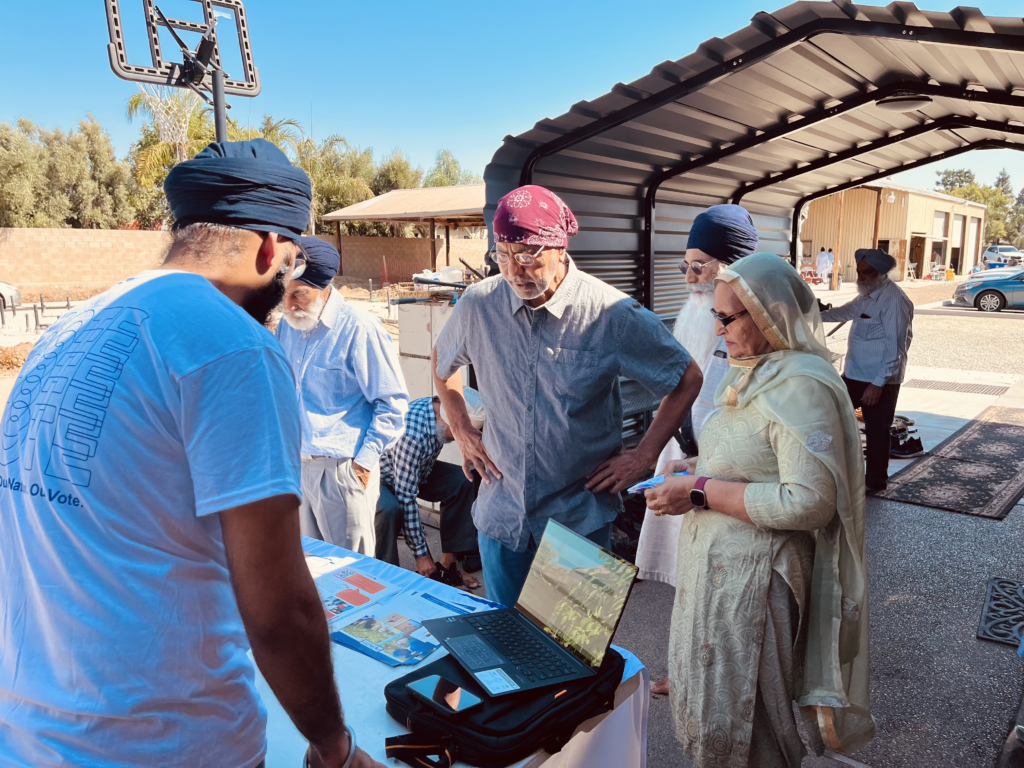
Keep the Momentum Going: Building on the Success of SikhVOTE

For Immediate Release

Date: October 25, 2024

Contact: media@saldef.org

Valadao introduces House Resolution recognizing the Sikh Genocide of 1984

WASHINGTON – Today, Congressman David G. Valadao (CA-22), co-chair of the Sikh American Congressional Caucus, and Congressman Jim Costa (CA-21) introduced a resolution to formally recognize and commemorate the Sikh Genocide of 1984. California is home to the largest Sikh population in the U.S., with the majority residing in the Central Valley.

“Sadly, many Sikhs have been targeted for their religious beliefs throughout history, including during the 1984 genocide,” said Congressman Valadao. “The Central Valley is home to a vibrant Sikh community and I’m proud to stand with them in demanding recognition and accountability for this horrific event in their history. This resolution is a small but important step to commemorate this tragedy and honor the innocent victims who lost their lives while practicing their faith.”

“As we mark the 40th anniversary of the Sikh Genocide, we remember a dark chapter in history that inflicted pain on Sikh families and communities. This is not just a distant tragedy—it hits home for us here in the San Joaquin Valley, where so many of our Sikh neighbors have shared their stories of loss, survival, and resilience. This resolution is more than a symbol — it’s a time to recognize this horrific time that our Sikh community experienced,” said Congressman Costa.

Reps. Valadao and Costa were joined in introduction by Reps. Josh Harder (CA-09), Vince Fong (CA-20), and John Duarte (CA-13).

The resolution is supported by the Sikh American Legal Defense and Education Fund (SALDEF), American Gurdwara Parbandhak Committee, American Sikh Caucus Committee, Ensaaf, Jakara Movement, Sikh Coalition, Sikh Coordination Committee East Coast (SCCEC), and the United Sikhs.

“This resolution is a historic acknowledgment of the deep scars the Sikh genocide of 1984 has left on our community. It not only honors the memory of those we lost but also empowers Sikh Americans and allies who have been fighting for decades to ensure that these atrocities are not forgotten. We are especially grateful to Congressman David Valadao for his unwavering support and for bringing this issue to the forefront of American consciousness. Today, we see a step toward justice and the validation of our truth,” said Kiran Kaur Gill, Executive Director, Sikh American Legal Defense and Education Fund (SALDEF)

“This resolution marks a pivotal moment in our ongoing quest for justice and truth. The American Gurdwara Parbandhak Committee, representing Sikh religious institutions across the nation, has long advocated for the recognition of the atrocities committed during the 1984 Sikh Genocide. We thank Congressman Valadao for his courageous leadership and reaffirm our commitment to ensuring that the stories of our martyrs are preserved, and that justice is pursued relentlessly,” said Gudev Singh, Acting President, American Gurdwara Parbandhak Committee (AGPC).

“This resolution is a turning point in our community’s decades-long pursuit of justice and recognition. For too long, the horrors of 1984 have been hidden from the global stage. Today, we honor the memory of those who suffered and ensure their voices will never be silenced. We extend our deepest gratitude to Congressman David Valadao for his leadership of the American Sikh Congressional Caucus, and in championing this cause, marking a momentous step toward accountability and healing for Sikh Americans and Sikhs worldwide,” said Dr. Pritpal Singh, Founder, American Sikh Caucus Committee.

“This resolution marks a crucial victory in the battle for truth and justice for the victims of the 1984 Sikh Genocide. It stands as a testament to the resilience of our community, which has sought justice for decades. While we still have a long road ahead in terms of accountability, this first step of recognition in the U.S. House of Representatives gives us hope that justice one day will prevail,” said Sukhman Dhami, Co-Director, Ensaaf

“The introduction of this resolution is not just about acknowledging the past but ensuring that future generations understand the truth about the 1984 Sikh Genocide. For Sikh youth and activists, this is more than a political milestone—it’s a validation of the pain our elders endured and a commitment to never allow history to forget. The Jakara Movement looks forward to working alongside Congressman Valadao to continue shining a light on this dark chapter and to ensure that justice for the victims remains a priority for all,” said Naindeep Singh, Executive Director, Jakara Movement.

“This is the first time a federal resolution has been introduced to recognize the 1984 Sikh Genocide, and it sends a powerful message: the world is watching, and the atrocities committed against Sikhs will not go unnoticed. We are deeply thankful to Congressman David Valadao for his leadership in this effort, and we look forward to building a broad coalition of support to ensure its ultimate passage. Today’s recognition fuels our resolve to continue advocating for justice and accountability,” said Harman Singh, Executive Director, Sikh Coalition.

“The introduction of this resolution is a significant step forward for Sikhs worldwide, especially for those of us who have been tirelessly advocating for the truth to be recognized. The Sikh Coordination Committee East Coast stands united with our brothers and sisters in the continued pursuit of justice for the victims of 1984. This resolution acknowledges not only our pain but our perseverance, and we are grateful to Congressman Valadao for standing with us in this cause,” said Himmat Singh, Sikh Coordination Committee East Coast (SCCEC).

“As a global humanitarian organization, United Sikhs has long championed the cause of justice and human rights for the Sikh community. The introduction of this resolution in the U.S. Congress is a watershed moment for our community’s struggle for truth and justice. It is an acknowledgment that the international community is listening, and it reinforces our collective resolve to ensure that the horrors of 1984 are neither ignored nor repeated. We extend our deepest gratitude to Congressman Valadao for his leadership and solidarity,” said Hardayal Singh, United Sikhs.

Background:

In June 1984, Indian Prime Minister Indira Gandhi ordered a military assault on Sri Darbar Sahib, a sacred place of worship more commonly known as The Golden Temple. During Operation Blue Star, the Indian Army used heavy artillery and tanks to lay siege on The Golden Temple complex, murdering thousands of civilians as an attempt to suppress Sikh religious rights and freedoms. This tragedy is considered by many as the beginning of the Sikh Genocide.

Following the death of Indian Prime Minister Indira Gandhi on October 31, 1984, the Indian government launched a multi-day campaign of state-sponsored violence and repression against Sikhs that included disappearances, targeted killings, and coordinated mass violence. Political unrest in India throughout 1984 resulted in the loss of thousands of Sikh lives. Today, transnational repression is still a widespread issue impacting the Sikh community.

Read the full text of the resolution here.
FOR IMMEDIATE RELEASE

October 23, 2024

Contact: (202) 393-2700 | media@saldef.org

Justice Department Announces Charges Against Indian Government Employee in Connection with Foiled Plot to Assassinate U.S. Citizen in New York City

ICYMI: U.S. Attorney General Slams Transnational Repression Efforts Against Sikhs

In case you missed it, United States Attorney General Merrick Garland put out a statement pledging to hold the responsible parties accountable for transnational repression and assassination attempts against Sikhs in America. SALDEF put out a statement as well emphasizing these points prior to the Department of Justice and Attorney General Garland doubling down on the United States’ commitment to protecting the pillars of American democracy—free speech and sovereignty.

Please see the full statement here and below:

“The Justice Department today announced the filing of murder-for-hire and money laundering charges against Indian government employee, Vikash Yadav, 39, also known as Vikas, and Amanat, in connection with his role in directing a foiled plot to assassinate a U.S. citizen in New York City. Yadav is charged in a second superseding indictment unsealed today in the U.S. District Court for the Southern District of New York. Yadav’s alleged co-conspirator, Nikhil Gupta, 53, was previously charged and extradited to the United States on the charges contained in the first superseding indictment. Yadav remains at large.

“The Justice Department will be relentless in holding accountable any person — regardless of their position or proximity to power — who seeks to harm and silence American citizens,” said Attorney General Merrick B. Garland. “As alleged, last year, we foiled an attempt by Vikash Yadav, an Indian government employee, and his co-conspirator, Nikhil Gupta, to assassinate an American citizen on U.S. soil. Today’s charges demonstrate that the Justice Department will not tolerate attempts to target and endanger Americans and to undermine the rights to which every U.S. citizen is entitled.”

“The defendant, an Indian government employee, allegedly conspired with a criminal associate and attempted to assassinate a U.S. citizen on American soil for exercising their First Amendment rights,” said FBI Director Christopher Wray. “The FBI will not tolerate acts of violence or other efforts to retaliate against those residing in the U.S. for exercising their constitutionally protected rights. We are committed to working with our partners to detect, disrupt, and hold accountable foreign nationals or others who seek to engage in such acts of transnational repression.”

“Today’s charges are a grave example of the increase in lethal plotting and other forms of violent transnational repression targeting diaspora communities in the United States,” said Assistant Attorney General Matthew G. Olsen of the Justice Department’s National Security Division. “To the governments around the world who may be considering such criminal activity and to the communities they would target, let there be no doubt that the Department of Justice is committed to disrupting and exposing these plots and to holding the wrongful actors accountable no matter who they are or where they reside.”

“DEA foiled this assassination attempt last year and has continued to trace this case back to an employee of the Indian government whom we charge was an orchestrator of this intricate murder-for-hire scheme. DEA did not relent, and today’s indictment names Vikash Yadav as an alleged mastermind,” said Administrator Anne Milgram of the Drug Enforcement Administration (DEA). “We charge that Yadav, an employee of the Indian government, used his position of authority and access to confidential information to direct the attempted assassination of an outspoken critic of the Indian government here on U.S. soil. This case was led by the DEA New York Division’s Drug Enforcement Task Force, which is comprised of DEA, the New York State Police, and the New York City Police Department, and is a true testament to the tenacity and determination of our team.”

“Last year, this office charged Nikhil Gupta for conspiring to assassinate a U.S. citizen of Indian origin on U.S. soil,” said U.S. Attorney Damian Williams. “But, as alleged, Gupta did not work alone. Today, we announce charges against an Indian government employee, Vikash Yadav, who orchestrated the plot from India and directed Gupta to hire a hitman to murder the victim. The right to exercise free speech is foundational to our democracy, and predicated on the notion that we can do so without fear of violence or reprisal, including from beyond our borders. Let this case be a warning to all those who would seek to harm and silence U.S. citizens: we will hold you accountable, no matter who and where you are.”

As alleged in the second superseding indictment and other public court documents, in 2023, Yadav, working together with others, including Gupta, in India, and elsewhere, directed a plot to assassinate on U.S. soil an attorney and political activist who is a U.S. citizen of Indian origin residing in New York City (the victim). The victim is a vocal critic of the Indian government and leads a U.S.-based organization that advocates for the secession of Punjab, a state in northern India that is home to a large population of Sikhs, an ethnoreligious minority group in India. The victim has publicly called for some or all of Punjab to secede from India and establish a Sikh sovereign state called Khalistan, and the Indian government has banned the victim and his separatist organization from India.

During times relevant to the second superseding indictment, Yadav was employed by the Government of India’s Cabinet Secretariat, which houses Indian’s foreign intelligence service, the Research and Analysis Wing. Yadav has described his position as a “senior field officer” with responsibilities in “security management” and “intelligence.” Yadav also has referenced previously serving in India’s Central Reserve Police Force and receiving “officer[] training” in “battle craft” and “weapons.” Yadav is a citizen and resident of India, and he directed the plot to assassinate the Victim from India.

In or about May 2023, Yadav recruited Gupta to orchestrate the assassination of the victim in the United States. Gupta is an Indian national who resided in India and has described his involvement in international narcotics and weapons trafficking in his communications with Yadav and others. At Yadav’s direction, Gupta contacted an individual whom Gupta believed to be a criminal associate, but who was in fact a confidential source (the CS) working with the DEA, for assistance in contracting a hitman to murder the victim in New York City. The CS introduced Gupta to a purported hitman, who was in fact a DEA undercover officer (the UC). Yadav subsequently agreed, in dealings brokered by Gupta, to pay the UC $100,000 to murder the victim. On or about June 9, 2023, Yadav and Gupta arranged for an associate to deliver $15,000 in cash to the UC as an advance payment for the murder. Yadav’s associate then delivered the $15,000 to the UC in Manhattan.

In or about June 2023, in furtherance of the assassination plot, Yadav provided Gupta with personal information about the victim, including the victim’s home address in New York City, phone numbers associated with the victim, and details about the victim’s day-to-day conduct, which Gupta then passed to the UC. Yadav directed Gupta to provide regular updates on the progress of the assassination plot, which Gupta accomplished by forwarding to Yadav, among other things, surveillance photographs of the victim. Gupta directed the UC to carry out the murder as soon as possible, but Gupta also specifically instructed the UC not to commit the murder around the time of the Indian Prime Minister’s official state visit to the United States, which was scheduled to begin on or about June 20, 2023.

On or about June 18, 2023, approximately two days before the Indian Prime Minister’s state visit to the United States, masked gunmen murdered Hardeep Singh Nijjar outside a Sikh temple in British Columbia, Canada. Nijjar was an associate of the victim, and, like the victim, was a leader of the Sikh separatist movement and an outspoken critic of the Indian government. On or about June 19, 2023, the day after the Nijjar murder, Gupta told the UC that Nijjar “was also the target” and “we have so many targets.” Gupta added that, in light of Nijjar’s murder, there was “now no need to wait” on killing the Victim. On or about June 20, 2023, Yadav sent Gupta a news article about the victim and messaged Gupta, “[i]t’s [a] priority now.”

Yadav and Gupta of India have been charged with murder-for-hire, which carries a maximum penalty of 10 years in prison; conspiracy to commit murder-for-hire, which carries a maximum penalty of 10 years in prison; and conspiracy to commit money laundering, which carries a maximum penalty of 20 years in prison. A federal district court judge will determine any sentence after considering the U.S. Sentencing Guidelines and other statutory factors.

The DEA New York Division and the FBI New York Field Office’s Counterintelligence Division are investigating the case, with valuable assistance provided by the DEA Special Operations Division, DEA Vienna Country Office, FBI Prague Country Office, Justice Department’s Office of International Affairs, and Czech Republic’s National Drug Headquarters.

Assistant U.S. Attorneys Camille L. Fletcher, Ashley C. Nicolas, and Alexander Li for the Southern District of New York are prosecuting the case with assistance from Trial Attorney Christopher Cook of the National Security Division’s Counterintelligence and Export Control Section and Trial Attorney A.J. Dixon of the National Security Division’s Counterterrorism Section.

An indictment is merely an allegation. All defendants are presumed innocent until proven guilty beyond a reasonable doubt in a court of law.”

SALDEF Commends the DOJ for New Charges Against Indian Government Employee Targeting Sikh Americans

SALDEF (Sikh American Legal Defense and Education Fund) is deeply alarmed by the Department of Justice’s announcement of charges against Vikash Yadav, an Indian government employee, in connection with a plot to assassinate a U.S. citizen and Sikh activist on American soil. This is a stark reminder of the escalating and dangerous reality of transnational repression targeting diaspora communities in the United States.

We commend the Department of Justice, FBI, and the federal government for their vigilance and commitment to protecting the safety and sovereignty of Americans. However, this incident highlights the urgent need for continued and comprehensive action to protect vulnerable communities in America, particularly the Sikh diaspora, who have been increasingly targeted for their activism and dissent against foreign governments.

The Sikh American community in the United States has a fundamental right to advocate for human rights and justice without fear of intimidation, violence, or retaliation from foreign actors. SALDEF urges the U.S. government to continue its efforts in holding foreign governments accountable for any attempt to silence or harm American citizens within our borders.

“We are outraged and deeply concerned by the attempted assassination of plot a Sikh American on U.S. soil, orchestrated by an Indian government employee,” said Kiran Kaur Gill, Executive Director of SALDEF. “This is a grave violation of our community’s rights and a threat to American democracy. We applaud the Department of Justice and federal law enforcement for their swift action, but we must do more. The United States must take concrete steps to protect all Americans from foreign repression, as seen with the charges filed today. We call on Congress to pass the Transnational Repression Reporting Act, championed by Representative Adam Schiff, to ensure transparency and accountability in addressing these threats. Sikh Americans, like all communities in the United States, have the right to live without fear of foreign intimidation or violence.”

SALDEF remains committed to advocating for the safety and rights of Sikh Americans and other diaspora communities affected by transnational repression. We urge the government to continue making strong public statements and enacting legislation that safeguards our constitutional rights and protects our communities from foreign interference.

Statement from SALDEF on Canada’s Stand Against Transnational Repression and the Need for U.S. Action

SALDEF (Sikh American Legal Defense and Education Fund) stands in solidarity with Canada as it continues to prioritize the protection of its citizens in the face of foreign repression. The recent developments highlighting Canada’s commitment to protecting its citizens’ rights, even in the face of foreign threats, underscore the urgent need for action here in the United States.

We commend Canada for taking a firm stand against transnational repression, recognizing the serious threat it poses not only to the targeted communities but to democratic values as a whole. This approach should serve as a model for how governments around the world can respond to the ongoing and increasingly aggressive attempts by foreign regimes to silence dissenting voices abroad, including Sikh activists.

In the United States, Sikh Americans and other diaspora communities continue to face the threat of transnational repression. Whether it be surveillance, intimidation, or targeted violence, foreign governments have sought to stifle free speech and political dissent within our borders. This is unacceptable in a country that stands for freedom and human rights.

SALDEF proudly supports Congressman Adam Schiff’s Transnational Repression Reporting Act, a crucial step in addressing these threats here at home. The bill would ensure greater accountability by requiring the U.S. Attorney General to report on cases of transnational repression and outline the actions taken by our government to protect American citizens. It is essential that the U.S. government continues to make public statements, as it did last year, condemning transnational repression and holding accountable those who seek to undermine the civil liberties of Americans.

We call on the U.S. government to remain steadfast in its commitment to protecting all Americans from foreign repression, especially as the threats against diaspora communities like Sikhs persist. The right to free speech and peaceful dissent must be protected at all costs. This includes standing against foreign governments that use intimidation, violence, and censorship to silence voices on U.S. soil.

As we continue to engage with our Congressional allies and federal partners, we urge the swift passage of the Transnational Repression Reporting Act to ensure that the U.S. government is doing everything in its power to protect its citizens from foreign repression.

SALDEF remains committed to defending the constitutional rights of the Sikh American community and all diaspora communities affected by these insidious acts. We urge the American government to stand firm, just as Canada has, in safeguarding the freedoms that define our democracy.

At ‘Kaur Power Hour,’ Sikh women get out the vote

Read the full article by Richa Karmarkar

(RNS) — On National Voter Registration Day, Sikh women leaders spoke at ‘Kaur Power Hour,’ a webinar dedicated to raising up ‘the minority within the minority’ to recognize their voting power in this upcoming election.

The Sikh faith has a long history of political activism in India. On National Voter Registration Day Tuesday (Sept. 17), Sikh women drew on that legacy to encourage their community in the U.S. to vote in the upcoming presidential election. 

Amrita Bamrah, executive director of Dasvandh Network, a nonprofit fundraising platform based in the Sikh value of giving, spoke to more than a hundred “Kaurs,” or Sikh women, for “Kaur Power Hour,” an online event hosted by the Sikh American Legal Defense and Education Fund.

“Our ancestors didn’t wait for change, they made it,” Bamrah told those gathered online. “And today, in that same spirit, our vote is one of the most powerful tools that we have to really continue that legacy.”

Kaur, the surname or middle name taken by many Sikh women as a symbol of equality and spiritual empowerment, was as much of a catchy webinar title as it was a call to action. Sikhism, also called Sikhi, is an Indic faith native to Punjab, India, that teaches scripture from the Guru Granth Sahib.

“We are a part of a history just woven with angles of those who stood up for justice, equality and the rights of individuals,” Bamrah said. “Our faith is built on these principles of courage and compassion and time and again, when we look at history, our community has risen to confront oppression, to uplift those who were silenced, and to create change where it was needed.”

The organizers of Kaur Power Hour said in the U.S. there is still work to be done to politically motivate the community. Though Sikhs can be found “truly everywhere,” reaching out to women is especially crucial, said Jaslin Kaur, Sikh organizer and former Queens City Council candidate.

Jaslin Kaur addresses the “Kaur Power Hour” virtual event, hosted by the Sikh American Legal Defense and Education Fund. (Video screen grab)
Jaslin Kaur addresses the Kaur Power Hour virtual event, hosted by the Sikh American Legal Defense and Education Fund. (Video screen grab)

“Unfortunately, campaigns already don’t reach out to Sikhs enough, but they sure don’t reach out to Sikh women,” she said to the audience. “I think it’s our job as fellow sisters to reach out behenji (sister) to behenji and ensure that our fellow Sikh women are registered and ready to vote.”

The Power Hour, said SALDEF’s executive director, Kiran Kaur Gill, had a twofold objective: getting as many Sikh Americans as possible registered to vote and emphasizing how important Sikh women are in the national conversation.

As the oldest Sikh advocacy organization in the nation, SALDEF has led a voter education program called SikhVote for over a decade. Directly after 9/11, many Sikhs — especially those wearing turbans and other outward signs of their faith — were racialized and attacked over their misperceived Muslim identity. That galvanized many Sikh Americans to get involved in the political sphere. Sikhs organized especially for issues of religious freedom, hate crimes and workplace discrimination, including the protected ability to carry a kirpan, or Sikh sword, and the right to wear a turban in the U.S. military.

But according to Gill, while Sikh women are incredibly involved with their cultural, social and religious leadership, they have not necessarily been at the forefront of political engagement.

“We noticed that with phone banking, one of our volunteers mentioned that when he would call and ask about voter registration, sometimes, you know, women would hand the phone over to their husband,” she said. “And so, we are trying to say: ‘No, you know, this conversation is for everyone. Everyone has the right to vote and should exercise that right.’”

There are an estimated half a million Sikh Americans in the U.S., and the number continues to grow, according to the Sikh Coalition, a nonprofit advocacy group. But civic participation has been hampered by language, citizenship status and a feeling among some members of the religious minority that their voice doesn’t matter.

Kush Kaur, top left, speaks during the SALDEF “Kaur Power Hour” virtual event. (Video screen grab)

Reaching the largely immigrant sangat, or Sikh fellowship, at their gurdwaras has been a key mission of SALDEF. Connecting U.S. political engagement with the Sikh value of seva, or service, has been especially rewarding for grassroots organizers such as Kush Kaur, Texas native and Sikh American National Youth Council Southern chair.

“I remember when an elderly uncle approached my table who had been a U.S. citizen for over a decade, but had never voted, believing his voice wouldn’t matter,” she told the audience. “But after a conversation about the power of each vote and the importance of Sikh representation, he was eager to begin his voting registration process and to tell his grandchildren about our conversation.”

The organizers believe that with this presidential election, the stakes are especially high.

“When Donald Trump won, I was really concerned for the future of this country, because we had just elected a man who brags about sexually assaulting women, a man whose rhetoric has resulted in having some of the most increases in hate crimes in our country, and a man who made fun of people with mental health issues,” said Manka Dhingra, the first Sikh woman elected to the Washington state Legislature. She started her career as a prosecuting attorney, overseeing issues of domestic violence and sexual crimes that she said more commonly affect women of color. 

“For our national election, I am concerned that misogyny will rear its ugly head, and we cannot let it,” she said. “We have to make sure we trust women, we believe women, and we are going to follow the lead of women, because we know that when women are elected, they elevate everyone.”

More Sikh women than ever have been elected to political offices, noted Manpreet Kaur, the city councilwoman of Bakersfield, California, where Punjabi is the third most spoken language and the economy mirrors the agricultural society of Punjab. 

“Kaurs are leaders, both in the home and clearly in governance as well, and that’s very important, because I also watched Kaurs lead within my own household and within my gurdwara,” Manpreet Kaur said, telling the story of her nani, or grandmother. “I don’t know anyone who was as excited to vote as my nani when she obtained citizenship. But it was more exciting to see my nani actually be able to read her own voter information ballots and information packets in Punjabi.

“That was a moment that will always stand out to me, because it really built on the history about the Kaurs before me and the Kaurs that are going to come beyond me,” she added. 

Mayor Neena Singh of Montgomery Township, New Jersey, is the first Indian and Sikh woman elected to that post in her state. She spoke about the excitement she sees among Sikh youth. Finding a place of belonging, especially amid hateful rhetoric and ignorance, she said, is easier when there is representation in place.

“I think when we are in leadership, we have such an opportunity to empower not just our own community, but to let others know who we are and what we stand for, because I think that helps not just us, but our kids, and that’s the reason representation matters,” Singh said. 

Indian Americans, after passing Chinese in U.S. population, are awakening to their political power

Read the full article on NBC News by Sakshi Venkatraman

Asian Pacific American Heritage Month

After Indian Americans surpassed Chinese Americans as the largest Asian-alone population in the U.S., experts say they’re solidifying themselves as a political force — and a group politicians can’t ignore in 2024. From grassroots activism to voter registration to running for office, Indian Americans are a burgeoning presence in U.S. politics. 

“This is a community that’s waking up to the power they have in the electoral space,” said Chintan Patel, executive director of the voter engagement organization Indian American Impact. 

Those who identified as “Indian-alone” — or 100% Indian — on the 2020 U.S. Census number 4.4 million, overtaking the “Chinese-alone” population, which was previously the highest. When multiracial Americans are considered, Chinese is still the largest Asian group in the country, but the milestone pointed to how the Indian population has rocketed over the last decade.

In many states and counties where races are tight, winning a sizable portion of the Indian American vote could make the difference for many candidates, Patel said. In states like Arizona, where the number of Indian Americans is bigger than President Joe Biden’s margin of victory in 2020, their turnout could be decisive.  

“What’s really important is to not take our communities for granted, not think of them as simply turn-out voters who will show up and vote, as they’ve always done,” Patel said. “But also to consistently talk to them and persuade them and listen to the concerns within the community. Because, again, they make up the margin of victory now.”

One of the most heavily Democratic-leaning groups in the country, at 68%, Indian Americans are beginning to ask tough questions of both parties, he said.

2016, 2018 and 2020 all saw record voter turnouts for Asian Americans, including South Asians. But experts say many are beginning to question Biden’s record on issues like Gaza.

Karthick Ramakrishnan, founder and executive director of AAPI Data, says that Biden’s presidential approval rating has dropped among AAPI communities. For Indian Americans specifically, it now sits at 43%.

But Ramakrishnan says he doubts this dip will mean less Indian voters showing up at the polls or refusing to vote Democratic. He says issues like abortion, racism and discrimination, which are key issues for the demographic, are much more likely to sway their vote.

“Indian Americans are disappointed with Biden,” he said. “But if you look at Biden’s favorability versus Trump’s favorability and unfavorability, it’s unlikely that Trump is going to make a lot of headway among Indian American voters.”

While Indian Americans have flourished in many industries, politics has been an area in which their representation is sorely lacking, Patel said. But he sees the tide changing. Issues of the day are sparking an interest in voters and potential candidates both old and young, immigrant and U.S.-born, he said.

Like other Asian Americans, their top priorities include inflation, immigration and climate change. They’re strong supporters of reproductive rights and gun control, experts said, and they’re unlikely to support a candidate who doesn’t align with them on issues of racism, a report from AAPI Data/AP-Norc showed. 

“Our concerns, while they align broadly with the American population and the national discourse, our lived experiences also lead us to places that add particular emphasis on anti-AAPI hate, discrimination and what we need to do as a nation to fight that — particularly with the rise of Islamophobia right now,” Patel said.

What two first-time SA voters think

Kirti Moteka, 20, a student at the University of Texas at Austin, says that, as a young adult voting in her first presidential election, she’s formed some clear thoughts on what’s driving her to the polls. 

“The main issues that are most important to me, both as a student in Texas and also a South Asian and an immigrant daughter, would definitely be reproductive rights,” she said. “I want to be able to know, decisively, where I have the freedom to choose what I want to do with my body and where I don’t, especially because it’s so up in the air.”

Post-Covid, she says access to health care is a major priority for her, and so are educational equity and student loans. She also said that, though there is a large South Asian population in Texas, she hopes to see more people in her community register to vote and get involved. 

“I’m sure a lot of immigrants are afraid at times to publicly express their opinion or to go out and vote, or they think their vote doesn’t matter,” she said. “I’d love to see how that could be changed.”

For Sri Vedachalam, 40, this November will also be his first presidential election as an eligible voter. Vedachalam immigrated to the U.S. in 2005, and though he’s always closely followed U.S. politics, he only became a citizen in 2021. 

The Virginia resident says he was deeply disappointed with Donald Trump’s handling of Covid, as well as his demeanor during the Jan. 6 Capitol riot. He’s leaning toward voting for Biden, who he says has worked to grow the middle class, mitigate inflation and bring jobs back. 

But one major stain on Biden’s presidency for Vedachalam is his handling of Israel’s war in Gaza. 

“I think the U.S. has a lot of leverage to stop the ongoing war in Gaza, but we are failing to do so,” he said. “The daily casualties and the relentless bombing is hard to see.”

Gaza is igniting young South Asian voters

Experts say Gaza is a major issue that’s been on the minds of South Asians and other Asian Americans this election cycle. In a survey from March,  two thirds of AAPI adults said they disapproved of Biden’s handling of the war. 

Among young voters, this is even more pronounced, with the same report revealing 77% of AAPIs from the ages of 18 to 29 disapprove of how the president has handled things. 

Antony Gnalian, 30, who is an Indian American from Pennsylvania, voted for Biden in 2020 and has voted Democratic since he was eligible to vote. This year, he says he won’t be doing that. 

“Donald Trump is just not even someone I want to even consider as a person for that seat in office, after the insurrection and all of the blatant Islamophobic policies,” Gnalian said. “But I’m even more disappointed in the Biden administration. Where my disappointment lies is obviously the situation in Gaza.”

Gnalian describes himself as a single-issue voter this cycle, saying his support for candidates depends on if they support a permanent cease-fire. He plans to vote uncommitted in the primary, and either vote Green Party or write-in for president.

“The Biden administration continues to provide political cover, they continue to present money over, they continue to send weapons over, for Israel to continue to inflict harm on innocent civilians,” he said. “So I’ve just found that lack of human rights to be really appalling.”

Sumer Shaikh, 30, who is Indian American and Muslim, says she’s grappling with the election as she’s watching Islamophobia rise in the U.S. She’s always seen a Democrat in the White House as a positive thing, she said, but this year, she feels Muslim Americans are going unheard.

“All this bad stuff is happening right now with a Democratic president,” she said. “What is going to be different come November if our leaders really just don’t listen to voters and the communities that put them in office in the first place, which is very true of President Biden.”

One voter pushing the Trump-Modi connection in her canvassing

New Jersey Republican voter Priti Pandya-Patel, 54, says one reason she plans on voting for Trump is his friendship with Indian Prime Minister Narendra Modi and how it has strengthened the relationship between the U.S. and India.

“He is so proud of India and he is so proud of the Indian community,” she said. “I feel like we were so much better off when he was president.”

Patel leads the South Asian Coalition of the state’s Republican Party, and she says she’s traveled all over New Jersey trying to bring more Indian Americans to the polls. She’s disappointed by Biden for many reasons, she said, including that she feels inflation is out of control. She says homeless people in neighboring cities aren’t getting the resources they need, and she worries about undocumented immigrants getting them instead.

“The cost of living has gone up triple, everything is up, but the salaries aren’t there,” she said.

As a health care consultant, she says she also sees these shifts in the medical field. Underfunded hospitals, poor quality of care and rampant drug addiction all concern her.

“Hospitals are not making money, physicians are not making money,” she said “Health care providers, facilities, we’re not able to take care of patients the way that we need to.”

Sikh Americans engaging, running for office

Kavneet Singh, acting executive director of the Sikh American Legal Defense and Education Fund, says he sees concerns in his community on issues ranging from AI to voting rights to religious profiling. 

Many Sikh Americans work in fields that aren’t normally associated with the Indian American diaspora. Their long history in the U.S. includes Sikh railroad workers, truck drivers and small-business owners. Singh says they’re concerned about getting fair minimum wages, gas prices and the automation of their labor like self-driving cars.

The community is taking these matters into their own hands by running for office, he said. 

“I think you’ve seen this generation realize the responsibility that they have to give back through public service as well as for us to begin to really take leadership in shaping the policies of the states or localities that we live in,” he said. 

The rise of the South Asian American candidate

Over the last few years, Patel says he’s noticed an explosion in South Asian Americans launching campaigns for office. Last year saw a historic number of Indian Americans serving in Congress. They’re emerging at all election levels, he said, from City Council to state office to presidential. 

“The candidates reflect their communities,” he said. “The shared South Asian values really do come through. These are candidates who care about giving back to their communities. They care about a strong economy, strong education, climate and safety.”

Community members are divided on the most prominent Indian American in public office, Vice President Kamala Harris, whose approval rating among Indian voters dropped from 62% to 56% from 2022 to 2023. But Patel says there’s no doubt her presence on the national stage has propelled people to put forth their own campaigns.

“That really thrust into a national scene that South Asians can be involved in politics and can be successful in politics at such a high level,” Patel said. “I think that really did inspire a lot of South Asian volunteers and activists; folks in the community who had been engaged, but never really imagined themselves on the ballot.”

The two most prominent Indian American candidates this year — Nikki Haley and Vivek Ramaswamy — didn’t make much of an impression on the South Asian community. But experts said it proves that, while representation can drive engagement, voters want someone who aligns with their values. For Indian Americans, those values tend to be progressive.

“Our community knows what they want,” Patel said.

But 2024 means fresh faces in the arena, and the new candidates range from young, second-generation Americans — like 24-year-old Ashwin Ramaswami who is running for state Senate in Georgia — to immigrants like Anil Kumar, who worked as a doctor for 30 years and is now running for U.S. Congress in Michigan.

“They really are a diverse subsection of the entire South Asian diaspora,” Patel said. “They are candidates who are well ingrained in their communities and responsive to the needs of their communities as well.” 

Read the article by Jillian Kestler-D’Amours

Canada India killing

Montreal, Canada – Sikh leaders in North America have welcomed recent arrests in the killing of Canadian Sikh activist Hardeep Singh Nijjar, but allegations that the Indian government was involved continue to fuel questions and unease.

Canadian police announced late last week that three Indian nationals were arrested in Canada for their involvement in the June killing of Nijjar, a prominent Sikh community leader in the westernmost province of British Columbia.

Police added that their investigation into Nijjar’s shooting death would continue, including whether “there are any ties to the government of India”.

Moninder Singh, a spokesman for the BC Gurdwaras Council, a coalition of Sikh temples in the province, told Al Jazeera there was “some relief” that arrests were made in the case.

But Singh, who knew Nijjar personally, said the question of Indian state involvement is “looming” over the Sikh community, which numbers about 770,000 people across Canada — the largest Sikh diaspora outside India.

“The foreign interference is real. The assassination plot is real,” said Singh, adding that it is imperative to get to the bottom of what India’s role has been.

“All of that has to be exposed,” he continued. “There [are] numerous reasons why it’s very, very important for public safety in Canada, along with deterring India from carrying out this kind of operation ever again.”

Canada-India tensions

Tensions between Canada and India skyrocketed in September after Canadian Prime Minister Justin Trudeau announced that authorities were investigating “credible allegations of a potential link” between Indian government agents and Nijjar’s killing.

Nijjar was fatally shot on June 18, 2023, outside the Guru Nanak Sikh Gurdwara, a temple in Surrey, British Columbia, where he served as president.

India vehemently denied the allegations that it was involved, calling them “absurd”. It also accused Nijjar of being involved in “terrorism” — a claim rejected by his supporters.

Nijjar had been a leading advocate in what is known as the Khalistan movement, a Sikh campaign for a sovereign state in India’s Punjab region.

While largely dormant inside India itself, Sikh separatism is largely viewed as a threat by the Indian government, which has urged Western nations to crack down on Khalistan movement leaders in the diaspora.

Canada has provided shelter to “Khalistani terrorists and extremists” who “continue to threaten India’s sovereignty and territorial integrity”, India’s Ministry of External Affairs said as it rejected Trudeau’s allegations in September.

But Sikh leaders in Canada said they have faced threats for years, and they accused the Indian government of trying to silence them.

Nijjar’s killing amplified these longstanding tensions, and new reports have emerged of Indian officials’ involvement in other alleged plots to harm prominent Sikh leaders in Canada and the United States.

Reports of threats

For instance, in late November, the US Department of Justice announced charges against a 52-year-old Indian national, Nikhil Gupta, over a foiled attempt to assassinate Sikh American activist Gurpatwant Singh Pannun.

The plot to kill Pannun, another Sikh separatist leader, was organised in coordination with an Indian government employee and others, according to the Justice Department.

Last week, The Washington Post reported that US intelligence agencies determined that the operation to target Pannun was approved by the then-head of India’s foreign intelligence agency, known as the Research and Analysis Wing or RAW.

The Indian government rejected those allegations as “unwarranted” and “unsubstantiated”, according to media reports.

But rights groups have said India “needs to do a lot more than issue denials” in such cases.

“India’s alleged involvement in assassination plots in the US and Canada suggests a new and notorious leap in extrajudicial killings,” Elaine Pearson, Asia director at Human Rights Watch, said in December.

Pritpal Singh, an activist and founder of the American Sikh Caucus Committee, was among the prominent Sikh leaders who were informed of threats against them over the past year.

Agents with the US Federal Bureau of Investigation (FBI) visited Pritpal, who is based in the state of California, in June to warn him.

In a statement to Al Jazeera this week, Pritpal said he commended “the unwavering commitment of Canadian and American law enforcement agencies” in their investigations into Nijjar’s killing and the surveillance of Sikhs.

“The alleged involvement of the Indian government in these heinous acts is a blatant violation of international norms and human rights. It is wholly unacceptable for any government to engage in extrajudicial killings and suppress dissenting voices abroad,” he said.

Pritpal also demanded accountability for threats against Sikh activists. “We must insist on US justice against those involved in India’s alleged murder-for-hire scheme targeting Americans on US soil,” he said.

“It is imperative that these cases are prosecuted on American soil by the United States Department of Justice to prevent these perpetrators from self-prosecuting.”

India hits out at Canada

Still, India has continued to deny any involvement in the alleged plots, while blasting Canada over its approach to Nijjar’s killing in particular.

The Indian High Commission in Ottawa, the Canadian capital, did not respond to Al Jazeera’s requests for comment on the case.

After news broke on Friday that Canadian authorities had made arrests, the Indian external affairs minister, Subrahmanyam Jaishankar, said the Canadian government had a “political compulsion” to blame India.

Speaking to Indian news outlet The Economic Times this week, Jaishankar also accused Canada of “providing a haven to organised crime”.

“We’ve been repeatedly telling the Canadians that, if you actually allow such forces to set up shop and create networks, this is going to harm their own society. But so far, I don’t think that advice has been well heeded,” the minister said.

Canadian authorities have rejected the idea that they have allowed unlawful activity to proliferate. Experts also argue that many of the individuals India considers “terrorists” are not violating any Canadian laws.

“Canada is a rule-of-law country with a strong and independent justice system as well as a fundamental commitment to protecting all its citizens,” Trudeau said during a Sikh community event in Toronto on Saturday.

“I know that many Canadians, particularly members of the Sikh community, are feeling uneasy and perhaps even frightened right now. Well, every Canadian has the fundamental right to live safely and free from discrimination and threats of violence in Canada,” Trudeau added.

Use of ‘proxies’

Last week, the head of a Canadian public inquiry into foreign interference also released an interim report that accused Indian officials as well as their proxies in Canada of engaging in “a range of activities that seek to influence Canadian communities and politicians”.

This includes efforts to “align Canada’s position with India’s interests on key issues, particularly with respect to how the Indian government perceives Canada-based supporters of an independent Sikh homeland”, Commissioner Marie-Josee Hogue said.

The report noted that India “does not differentiate between lawful, pro-Khalistani political advocacy and the relatively small Canada-based Khalistani violent extremism”.

Therefore, “it views anyone aligned with Khalistani separatism as a seditious threat to India”.

Hogue also found that Indian officials are increasingly relying on Canadian and Canada-based proxies and their contacts to conduct foreign interference.

“This obfuscates any explicit link between India and the foreign interference activities. Proxies liaise and work with Indian intelligence officials in India and in Canada, taking both explicit and implicit direction from them,” the report said.

‘Galvanising’ Sikh communities

Ultimately, Sikh leaders have called for a full investigation into all those who may be involved in threats against members of their communities, including Indian state officials.

“I can’t speak to the motivation of the Indian state if it is proven that they are behind these heinous attacks,” said Kavneet Singh, chair of the board of the Sikh American Legal Defense and Education Fund (SALDEF), a US-based civil rights group.

“But they have had a long history of suppression of freedom of expression and targeting those who speak out in dissent.”

Kavneet told Al Jazeera that the American Sikh community is advocating at the federal and state levels “for improved legislation to better help law enforcement understand, identity and prosecute” instances of transnational repression.

He added that, despite the threats, the Sikh community’s history “has not been one of living in fear”.

Instead, “it’s one of understanding that there are potential threats, and it’s [one of] being vigilant,” Kavneet said. “In fact, I think this is actually galvanising the community and our diasporic allies.

“While there may be political differences amongst communities, ultimately we stand together when members of the community and/or our institutions are threatened by actors either foreign or domestic.”

Singh at the BC Gurdwaras Council echoed that sentiment, stressing that the Indian government is trying to “silence” Sikh voices in the diaspora who are advocating for a sovereign state.

Singh was among five Sikh leaders — including Nijjar — who were warned by the Royal Canadian Mounted Police’s national security division in 2022 about threats against their lives.

He told Al Jazeera on Tuesday that the Canadian authorities told him within the past two months that the threat against him “is still real” and he should avoid large public gatherings.

“If we speak on this issue [Khalistan] and we’re going to lead the community on this issue in the diaspora, I think those threats will always be there now. There’s no way that we can ever go back,” he said.

“When Hardeep’s assassination happened, that really set some clarity in for some of us that this is real. This is the new real for us and the new reality, that this can happen at any time.”

‘Bringing all communities together’

Read the full Article on Central Jersey

pp-pri-faith-1-696x464.jpg

Even in difficult times of division on the world stage, the Arts Council of Princeton and Muslim Center of Greater Princeton – through art – have found a way to bring local people of different faiths together to talk about spirituality and what each share.

This local event called the “Art of Contemplating Spirituality and Art” is part of the Arts Council of Princeton’s “ART OF” series.

“With everything going on in the world and seeing how divided our world was becoming, I wanted to host an event that would bring all of the communities together especially the Muslim and Jewish communities,” said Samira Ghani, chair of the event and a board trustee of the Arts Council of Princeton.

The event took place inside the Muslim Center of Greater Princeton in West Windsor on March 3 and was designed for faith leaders to speak about spirituality and how art resonates with their faith.

“My passion is interfaith and when I’m able to unite us through faith and art, it’s a labor of love for me,” Ghani said. “Seeing all the faiths come together and talk about spirituality, art and love, it truly makes me feel like all the hard work that comes with putting on an event is worth its weight in gold.”

Featuring faith leaders and people from Christian, Muslim, Jewish, Sikh and Buddhist faiths, people in attendance broke bread, listened and had conversations through the Art of Contemplating Spirituality and Art as various works of art were displayed throughout a large multi-purpose room at the mosque.

Faith leaders included Rev. Jan Willem van der Weff from Dutch Neck Presbyterian Church in Princeton Junction, Father Peter Baktis from Mother of God Orthodox Church in Princeton, Amman Seehra, vice chair of the Sikh American Legal Defense and Education Fund (SALDEF), Beverly Sanford from Princeton Buddhist Meditation Group, Rabbi Andrea Merow from the Jewish Center in Princeton and Imam Safwan of the Muslim Center of Greater Princeton. They each shared art that resonates with their faith, spoke about spirituality and connecting with others.

Seehra shared an art piece, “King without a Crown” by Amandeep Singh, who is also known as Inkquisitive Art. He explained through the artwork’s elements how it describes the Sikh faith and the direction of how people should lead their lives.

“The title of this is a ‘King without a Crown.’ The artist wanted to make a distinction between a crown that is man made and given to people and the turban which is a responsibility you take on,” Seehra said. “It is your responsibility to treat yourself and others with respect, but also help those in need.”

He described the three components of what the turban stands for. There was a time when turbans were only worn by royalty and there was the thought that everybody should be treated as royalty, and everybody is deserving of that type of respect, Seehra explained.

“It was essentially for everybody,” he said. “The second meaning is the process of tying [the turban] which should be something you are doing every day and is a constant reminder to do what is good, what is right, and to help others for yourself.”

And third, the turban symbolizes someone being approachable.

“If you see someone with a turban that means you can go to them if you are in need and need help,” he said. “It is a symbol for others to see you are supposed to stick out in a crowd, you are supposed to be there to help others.”

Sanford shared what faith means to the Buddhist community and how Buddhist implement this in their everyday lives. She described and explained the art of Rene Magritte in “The Key of the Fields” (La Clef des champs), which is a landscape framed by a window that has been broken.

“We live in a world that is very complicated and full of uncertainty, it always has been and always will be,” she said. “It is very [easy to] hide behind our stories and painted windows and not see the world around us which is so much bigger than we are.”

Sanford expressed that if there is any faith common to all of the Buddhist community, it is the “faith or the confidence that we can wake up and that we can break through, that we can see what our minds are doing. That we can open our hearts wider.

“…When we do …what comes through a broken window, fresh air … Something new and different, something magical even,” she added, noting “life is indeed extraordinary, precious and rare.”

Sanford said that in her Buddhist tradition they believe “we can open our hearts and minds in this messy, sorrowful, glorious, amazing world and find the fresh air in any moment.”

Merow, a rabbi from Jewish Center of Princeton, said it was a wonderful process for her to think about art and her spirituality.

“The word spirituality has varied connotations among all our different religions. I define spirituality as an attempt by each of us to encounter the holy one through our actions,” she said.

“The art I want to share with you references and elevates one religious practice, the idea of a Sabbath, a day of rest. For me this painting illustrates spiritual values I want to practice, and my community wants.”

Merow displayed a painting from a series called Hebrew letters by artist Debra Kapnek.

“For me this piece showcases values of universalism, what we share and particularism, our own story,” she said. “Concepts that touch each of us in this room.

“We share the Earth and care for it. We are connected to each other. Each of our religious communities has its own foundational stories. May each of our souls here find the Sabbaths that we need to bring true creativity to this world.”

The Muslim Center of Greater Princeton’s Imam Safwan expressed that “what gives light is the presence of truth inside of it.”

“We live when we make meaning and art brings us closer to those essential meanings and truths,” Safwan said. “That beauty, that love, so what I have chosen for my art is mamluk architecture. Mamluk society was part of the great Ottoman movement within what we could call the golden society of Islam.”

He explained how mamluk architecture created spaces with beauty in every point and function. The art of the building preserves its legacy and function.

“People behold these spaces for us to just ponder on its beauty and beauty of its people,” Safwan said. “Ultimately, the message I wish to close with is that buildings are generally not preserved for function. What makes something a legacy is the meaning that sustains it, not its function.

“The meaning will pay off generationally in the preservation of beauty.”

SALDEF Releases Groundbreaking Report on Transnational Repression and Minority Censorship

Read the full article on India Currents

A pioneering report titled Virtually Vulnerable: Exposing the Human Cost of Digital Harassment was released on February 20 by the Sikh American Legal Defense and Education Fund ( SALDEF ). This in-depth study examines the escalating problem of online harassment and censorship, specifically targeting the Sikh diaspora and allied communities like secular Hindus, Indian Muslims, and Dalits.

“’Virtually Vulnerable’ sheds crucial light on the insidious ways digital harassment is employed against minority voices, including those in the Hindu community who stand for secular and democratic values, said Sunita Viswanath, Executive Director, Hindus for Human Rights (HHR). “This report not only exposes these harmful practices but also provides vital policy recommendations. It’s essential that we come together to ensure that digital platforms are spaces of free expression and not tools of oppression.”

The report offers a detailed analysis of the sophisticated methods used to silence minority voices online. It highlights the troubling practices of Big Tech, specifically social media firms, in censoring content under the guise of preserving national integrity, often resulting in the shadow banning and deletion of community-based social media accounts.

It includes a series of policy recommendations aimed at promoting transparency, accountability, and collaboration between tech companies and democracy-oriented nonprofits. These recommendations are geared towards mitigating international censorship and supporting the rights of free speech for diasporic communities.

This report serves as a clear call to action, said Kavneet Singh, SALDEF Acting Executive Director. “We must urgently address the lack of transparency and accountability in the digital realm to safeguard the fundamental human and civil rights of all communities.”

Thenmozhi Soundararajan, Executive Director of Equality Labs, the nation’s leading Dalit civil rights organization, added, “We are currently witnessing the digitization of caste apartheid, violent disinformation campaigns, and an era of surveillance capitalism exacerbated by right-wing authoritarianism. Caste-oppressed people have a right to advocate for their communities without the fear of being attacked and targeted by foreign state actors. This report is a critical look into the correlations between Big Tech, civil rights advocacy, and repression of dissent, and anyone concerned with free and ethical digital spaces should pay attention to it.”

Some of the critical issues addressed in the report include documenting trends in misinformation and suppression of Sikh voices on significant dates and events, examining the strategic misinformation campaign against various minority groups, including Indian Muslim and progressive Hindu communities–by the Indian-American Muslim Council (IAMC) and Hindus for Human Rights (HHR), and Big Tech’s failure to protect caste equity.

The report is available for download on the SALDEF website.