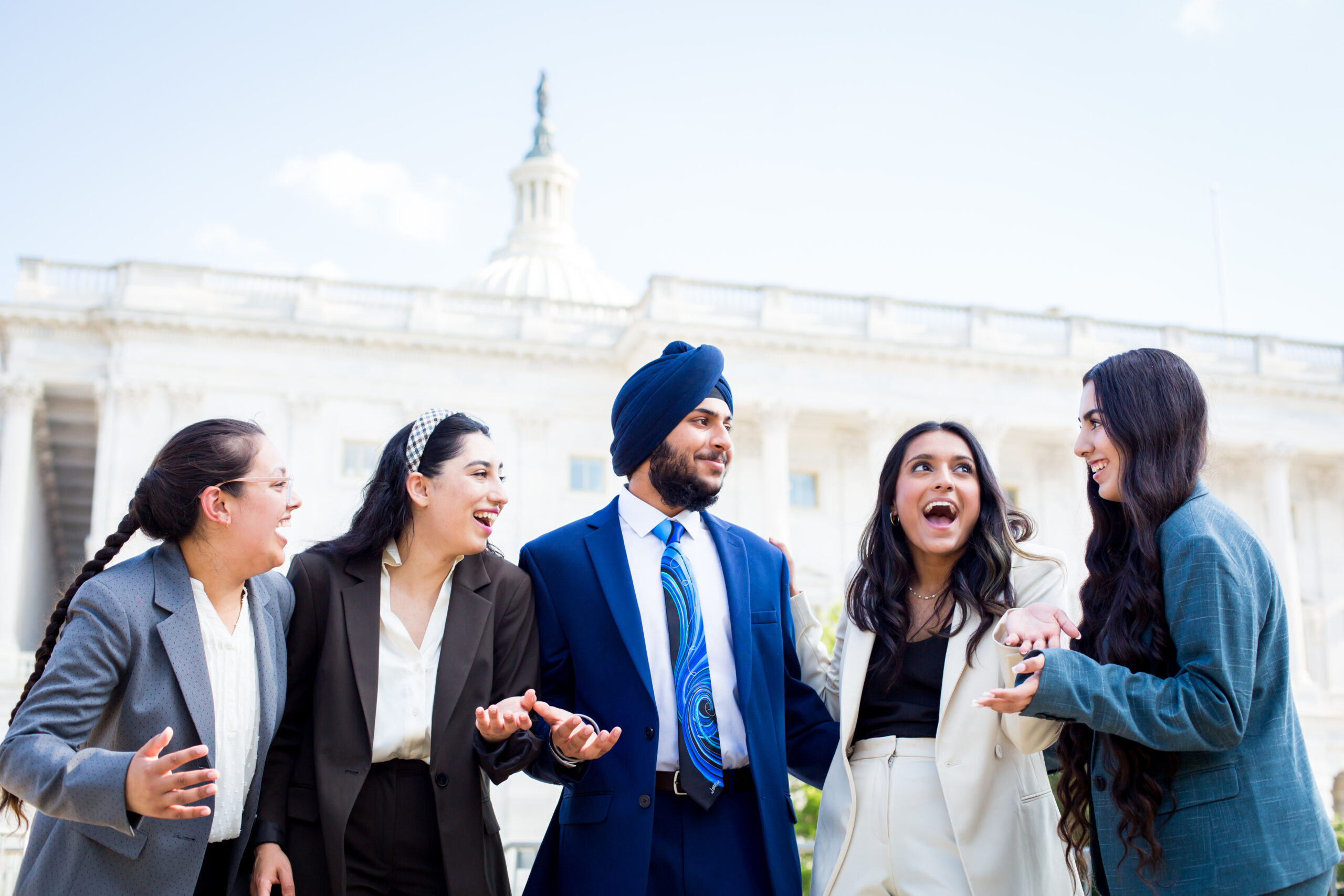
SMART is encouraging Sikh students across the United States to participate in the 5th Annual Series of Leadership Trainings Asian Pacific Islander American (APIA) college students. The mission of these leadership trainings is to provide APIA students an environment to develop leadership and organizing skills that are relevant to them, their campuses and their communities. The 1-1/2 day training will bring together students throughout the region to share experiences and develop tools to effectively serve as a catalyst for change and activism. These free trainings are being underwritten organized by the Organization of Chinese Americans, with whom SMART has a strong working relationship.
College Students Encouraged to Participate in Leadership Trainings
The Asian Pacific American Institute for Congressional Studies (APAICS) is currently accepting applications from college students for its summer internship program. The APAICS internship program encourages the political and civic involvement of young Asian Pacific Islander American, fosters their interest in careers in politics and public policy, and develops their leadership skills. SMART has worked with APAICS in the past and encourages Sikh American students to apply for this program, which includes a $2,500 stipend. Every year, APAICS selects ten to twelve students for a first-hand learning experience in American politics. Interns work in congressional offices, federal agencies, and non-profit organizations in Washington DC. Placements last summer included three offices in the House of Representatives, the Congressional Research Service, the Department of Housing and Urban Development, the Department of Labor, the U.S. Commission on Civil Rights, and the National League of Cities. Through a series of seminars, they learn about national Asian Pacific Islander American advocacy organizations and network with peers from the Congressional Hispanic Caucus Institute and the Congressional Black Caucus Foundation. The application deadline is January 30. Applications can be downloaded from the APAICS website at www.apaics.org. Please call 202/296-9200 or e-mail apaics@apaics.org for more information.
The U.S. State Department recently invited SMART President Manjit Singh to address participants of their International Visitor Program. The program entitled, “Managing Diversity in a Multi-Ethnic Society,” was designed to expose participants to the contributions and challenges of immigrants in the U.S. by examining policies on immigration, refugees and citizenship, and America’s cultural diversity. This year, several government officials, academics, and journalists from Europe were invited to tour the United States. Mr. Singh spoke about SMART’s efforts in the areas of protecting civil rights, encouraging political involvement, and participating in legislative efforts affecting the Sikh American Community. He was joined by panelists from the Arab American Institute (AAI) and the National Association for the Advancement of Colored People (NAACP), who also discussed political empowerment of minorities. The International Visitor Program is administered by the State Department’s Bureau of Educational and Cultural Affairs. The emphasis of the program is to increase mutual understanding through communication at the personal and professional levels. Participants are established or potential foreign leaders in government, politics, media, education, science, labor relations, and other key fields. Over the years, hundreds of former participants under the International Visitor Program have risen to important positions in their countries. Among the alumni are over 160 current and former chiefs of state or heads of government and more than 600 are cabinet-level ministers.
On June 6th, SMART’s Western Regional Director delivered its Sikhism 101: An Introduction to Sikh Beliefs and Culture presentation to members of the Our Brother Congregational Church in Fremont, CA. Members of the congregation attended the presentation which was followed by over one hour of questions and discussion. Tentative plans were also made to take the congregants to a local Gurdwara to show a standard Sikh divaan (congregation). If you, or someone you now would like to conduct a similar presentation in your neighborhood, please contact SMART.
Before the end of the school year, SMART’s National Director Preetmohan Singh addressed the Sikh Studies class at Stanford University in Palo Alto, CA. Organizers of the class, which consists of Sikh and non-Sikh students and as well as community members, invited Mr. Singh to provide an overview of the Sikh faith and discuss current issues within the Sikh Diaspora. SMART also held workshops with college students at the East Coast Asian American Students Union (ECAASU) annual conference at the University of Virginia in Charlottesville, VA. The workshops included information on critical issues facing the Asian American community, including hate crimes legislation, racial profiling, and immigration. If you would like to host a similar event on your college campus, please email SMART at info@sikhmediwatch.org.
SMART’s Western Regional Director Kavneet Singh recently testified before the California State Assembly Select Committee on Hate Crimes. The session was organized by the Applied Research Center and entitled, “California Civil Rights in an Era of National Security.” Attendees included representatives of the Asian Pacific, Black and Latino Legislative Caucuses. The event was organized to create a public record of the impact of national security policies on communities of color in California, assess the impact of some national security policies on civil rights, and explore policies to ensure protection for all California residents. SMART conducted the briefings at the State Capitol with representatives of the ACLU, California Human Relations Commissions, public policy advocates, and other civil rights organizations. If you would like to become more active with SMART’s legislative efforts, please email us at legislation@sikhmediwatch.org.
SMART’s National Director Preetmohan Singh recently conducted two congressional briefings to discuss the impact of the pending Workplace Religious Freedom Act (WRFA) on the Sikh American community. This legislation (Senate Bill 893) will require employers to reasonably accommodate the religious needs of their employees in the workplace. Typical examples covered by WRFA include allowing for religious clothing (such as turbans, yarmulkes, and head-scarves) and for flexible scheduling arrangements to facilitate holiday observances (such as agreeing to work on another holiday in order to observe Vaisakhi, the Sikh New Year). Mr. Singh conducted the briefings on Capitol Hill with leaders from the Christian, Jewish, and other civil rights organizations. If you would like to learn more about this bill, please see SMART’s Action Alert. If you would like to become more active with SMART’s legislative efforts, please email us at legislation@sikhmediwatch.org.
SMART Representative Tejinder Singh recently conducted the Sikhism 101: An Introduction to Sikh Culture, Practices and Beliefs for a dozen members of the Tri City Ministerial Association at its monthly meeting in Fremont, CA. The TCMA is a group of ministers casino online real money and religious leaders in the San Francisco Bay Area that work together to carry out interfaith events and support each other”s religious centers. SMART also talked with the TCMA members about possible in-house workshops at their respective houses of worship.
The Applied Research Center recently released the report of their third “The Public’s Truth” event held in Santa Clara, CA. SMART co-sponsored and presented at the event, which was a forum for community members of different races, colors and religions to communicate with legislators and civic officials about the ill-effects they have endured since 9/11. Speakers at the event shared their personal experiences of direct harassment and discrimination they faced from law enforcement, airport security, workplace supervisors and immigration officials. SMART’s representative, who is featured in the report, discussed the Sikh community’s response to hate crimes. The Applied Research Center is a public policy, educational and research institute whose work emphasizes issues of race and social change. The report is titled “Stories of Racial Profiling & The Attack on Civil Liberties.”
In the last several weeks, SMART has met with senior officials at the U.S. Department of Justice, the Federal Bureau of Investigation, Department of Justice, Department of Homeland Security and other federal agencies. These meetings have involved discussions about no-fly lists and training federal employees to ensure awareness of the Sikh articles of faith. During these meetings, SMART was assured that the Transportation Security Administration, which now oversees approximately 45,000 airport screeners, is using its resources to train current and new employees. Furthermore, since September 11, 2001, SMART has been part of a small working group headed by FBI Director Robert Muller, that meets regularly to address hate crimes and other law enforcement related issues of concern to the Sikh, Arab, and Muslim American communities. Although recent statistics indicate a reduction in the number of hate crimes, SMART is aware that many of these incidents go unreported with in our own community. Therefore, SMART will continue to work with the law enforcement and Sikh community to report, investigate, and prosecute hate crimes across the U.S.