Washington, D.C., November 13, 2007 — The Commonwealth of Virginia Medical Examiner has ruled the death of Simran Singh an “accident” despite evidence of dozens of severe bruises to Mr. Singh’s head, neck, and torso. Additionally, the report indicates that Mr. Singh was physically restrained and choked by his assailants for “four to five minutes.” On August 3, 2007, Simran Singh, a twenty-one year-old student from George Mason University, was reportedly found by police on I-395 in Arlington, Virginia, unconscious, badly bruised, and bleeding severely. Four individuals were with Mr. Singh at the time – to SALDEF’s knowledge, none have been charged or even investigated. During their investigation, the Arlington County Police Department engaged in a series of questionable practices which SALDEF considers police misconduct. Over the course of the investigation, SALDEF has come across numerous instances in which the Detective on the case hindered the criminal investigation. The Arlington County Board was contacted by SALDEF and key individuals who met with the family. The County Board has yet to assist the parents of Mr. Singh in their attempts to understand what happened to their son or addressing concerns about police misconduct during the investigation. The offices of Senator John Warner, Congressman Tom Davis, and Governor Tim Kaine have expressed their support and offered assistance to the family. SALDEF urges the community to ensure that justice is found in this case and that Simran Singh’s assailants are not allowed to escape justice. The Sikh American Legal Defense and Education Fund (SALDEF), the nation’s oldest Sikh American civil rights and advocacy organization, has expressed the deep concerns of the Washington, DC metropolitan Sikh American community over the investigation and handling of the incident by Arlington County. SALDEF has fielded countless calls from concerned community members regarding this incident. PRESS CONTACT: media@saldef.org
Virginia Calls Homicide of College Student “Accidental”
New Tool Developed to Help Protect Sikh Travelers’ Rights Washington, D.C.– October 26, 2007: On Saturday, October 27, 2007, new airport screening procedures will go into effect with respect to baggy clothing and all head coverings. To help Sikh travelers go through the screening process, the Sikh American Legal Defense and Education Fund (SALDEF), the Sikh Coalition, and UNITED SIKHS, have developed “A Sikh Traveler’s Guide” to screening procedures at American airports. The “Sikh Traveler’s Guide” contains a detailed description of Transportation Security Administration (TSA) head covering screening policy and steps to be taken if you are wearing a turban. The document also describes your rights as a traveler through America’s airports. It is available in English and Punjabi. To help Sikh travelers more easily navigate the screening process, SALDEF has created a simple visual guide available in English and Punjabi. This guide can easily be carried with you while you travel. In response to the efforts of the Sikh American community and concerns over improper searches of the turban, an article of faith, the TSA worked to develop screening procedures which help to ensure the safety of the nation’s airports and respects the religious practices of all travelers. In order to ensure the procedure is being effectively implemented SALDEF requests you document your airport screening experience. Your feedback will give us the data to inform TSA if the new security procedure is effective and respectful of the religious freedom of all Americans.
SALDEF receives Congressional Citation from Congressman Chris Van Hollen
Washington, DC: October 19, 2007 – On October 11, 2007, Sikh Americans and civil rights leaders from across the nation gathered to join the Sikh American Legal Defense and Education Fund (SALDEF), the nation’s oldest and largest Sikh American civil rights and advocacy organization, to recognize individuals who have helped in the empowerment and development of the Sikh American Community.
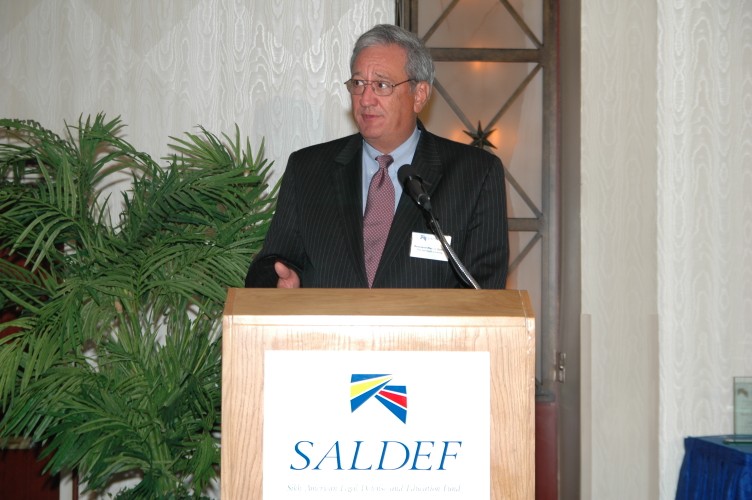 The Reverand Dr. C. Welton Gaddy, President of the Interfaith Alliance, set the tone of the evening with his keynote address, “When the next chapter of the Civil Rights struggle is written, not only will there be the names of King and Height, Bond and Parks, there will be the names Singh and Kaur.” Rev. Gaddy reflected on the recent controversy over the turban screening policy, “Your current struggle in the Sikh community, your current struggle with the TSA, highlights the sad challenge that stems from ignorance about religion, and the fear that is eroding the foundation of our Constitution.” Rev. Gaddy praised the efforts of the Sikh community, “Of all of the religious traditions that I know of in this nation, the Sikh community has done a better job identifying itself to the American public than any other religious group.” View Rev. Gaddy”s remarks .
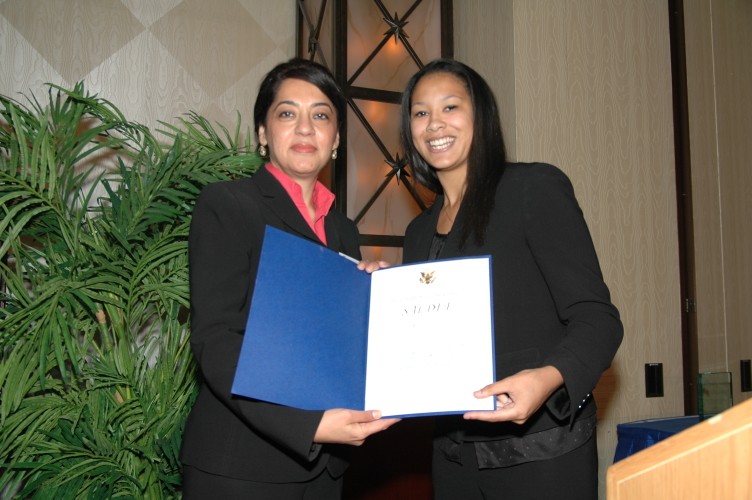 The Office of Congressman Chris Van Hollen (D-MD) presented a Congressional Citation to SALDEF for “working to guarantee civil rights…and encourage[ing] our community to embrace and appreciate its diversity.” SALDEF President Mirin Kaur, accepted the award on behalf of SALDEF and applauded Congressman Van Hollen’s commitment to the protection of Sikh American civil rights in Maryland.
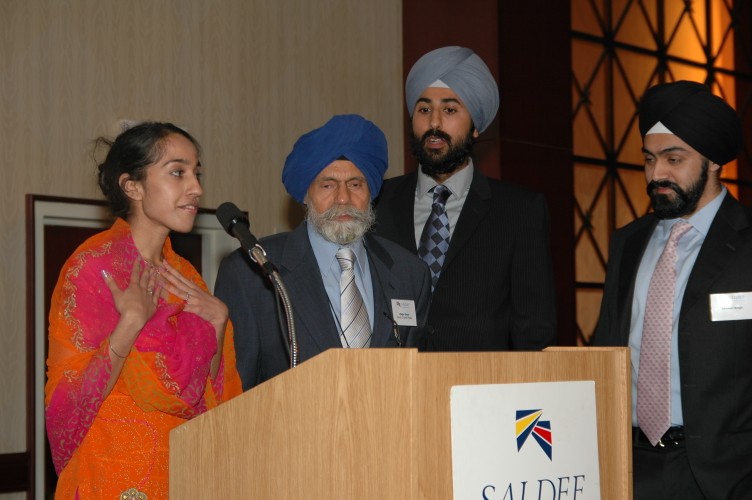 Sardar Ujagar Singh was honored with the Bhagat Singh Thind Community Empowerment Award for his decades of sewa (selfless-service) and dedication to Sikh American youth. Through Camp Chardi Kala, Sardar Ujagar Singh has educated and inspired countless Sikh American youth and filled them with the pride in their faith. Sardar Singh noted the success of his campers and the work SALDEF is doing for the community. Watch Sardar Ujagar Singh”s remarks .
 Danial Sutherland, Officer for Civil Rights and Civil Liberties in the Department of Homeland Security, received the SALDEF Public Service Award for developing a more sustainable relationship between the Arab, Muslim, and Sikh American community and DHS which will help protect minority communities and better safeguard the United States
 Julian Bond, Chairman of the National Association for the Advancement of Colored People, received the Dorothy Height Coalition Building Award for his lifetime dedication to advancing the civil rights of all Americans. Rev. Gaddy praised Julian Bond as “a living example of a reason not to lose hope.” Mr. Bond shared, “You couldn’t help but sit through this evening and not recognize the commonality between us. If you are a human being you have equal rights, and those equal rights must be respected not only by your fellow humans, but by the states in which you live. It is encouraging to see others struggling for this common cause.”
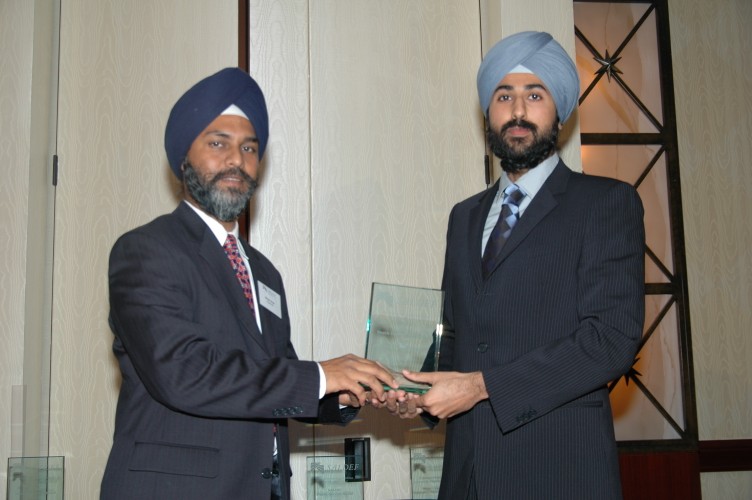 Sukhman Singh Dhami and Jaskaran Kaur, were both recognized with the inaugural SALDEF Youth Leadership Award as co-founders and co-directors of ENSAAF a premier Sikh human rights organization, dedicated to the struggle for justice of our brothers and sisters in Punjab and across the world. Their dedication to the cause of justice and equality is a true inspiration for young Sikhs across the country.
Local Sikh American community and SALDEF work together to secure apology Washington, DC: October 12, 2007 – Yesterday, the Sikh American Legal Defense and Education Fund (SALDEF), the nation’s oldest and largest Sikh American civil rights and advocacy organization, received a formal apology from Mr. Jaipal Reddy, Chairman and CEO of Radio Salaam Namaste in response to complaints from the Sikh American community in Texas and a letter from SALDEF. On the evening of October 6, 2007, Radio Salaam Namaste DJ’s Sadat and Talha made several jokes and disparaging remarks about ‘Sardars’ (male members of the Sikh faith). They then encouraged listeners to call-in to the station with more jokes about members of the Sikh faith. “Your comments demonstrate a significant lack of judgment and professionalism and perpetuate an extremely hurtful and demeaning stereotype about members of the Sikh faith. [Additionally] such stereotypes not only directly affect Sikh American listeners, but also color the perceptions of your listeners and affect their relationships with members of the Sikh American community,” wrote SALDEF to the DJs and station management. In addition to the written apology, Radio Salaam Namaste is playing a taped apology on the air every hour. Listen to the apology here. “We appreciate the prompt response from Mr. Reddy and his willingness to meet with members of the community,” said SALDEF National Director, Rajbir Singh Datta. “This resolution is a prime example of the positive results that come from community partnership and action.” SALDEF would like to acknowledge and thank Manmohan Singh of World Sikh Council for working locally with the radio station and facilitating a meeting with local community members and the station.
Representatives to discuss revised TSA screening procedure Washington D.C. – August 29, 2007: The Sikh American Legal Defense and Education Fund (SALDEF) will be represented live by Rajbir Singh Datta, Associate Director, on Fox News Channel’s “Your World with Neil Cavuto” this afternoon. 4:00pm EST. Additionally, Manjit Singh, SALDEF Chairman, will be appearing on Fox News Live hosted by Jon Scott and Ed Hill at NOON EST. Mr. Datta and Mr. Singh will discuss the Transportation Security Agency’s recent decision on August 4, 2007 to allow screening officers greater “discretion” regarding passenger screening and to enforce additional screening for individuals who wear head coverings. As per the TSA, the new procedure is aimed at head coverings that can possibly hide a threatening non-metallic object. The guidance regarding the new screening procedure, provided to the 43,000 TSOs, lists the Sikh turban among others (cowboy hats, straw hats, etc.), as an example of head coverings that may potentially hide a threatening non-metallic object. To send comments to program email: cavuto@foxnews.com. As with all live television programming, the show is subject to change without notice. For more information on your rights as a passenger, please see below: New Airport Security Screening Procedure Affects Sikh Turban SALDEF working with TSA to Address Improper Security New Procedure Announced for Individuals to Clear their Name from TSA Watch Lists SALDEF: Airport Security and Your Rights as a Passenger
LIVINGSTON — Hardeep Rai’s turban-wrapped head bobbed as the 40-year-old ambled along Peach Street beneath the shadows of the pointed golden bulbs of the Sikh Temple. With rich brown farm fields behind him and the garlic clove-shaped domes of the house of worship ahead, he almost could have been walking in his native India. God, as during many other moments in the day, was coursing through his thoughts as he strolled to one of the city’s two gurdwaras to pray for his wife, three daughters and everyone else. Admittedly, with a house, a 30-acre ranch in Cressey and his own business, he enjoys a life he’s thankful for. And he’s carved it out with grit and will in a land that promises rewards for just such virtues. Rai is just one of the estimated 1,500 Sikhs who’ve settled in Livingston seeking opportunities for themselves and future generations. Their presence has been marked at once by a willingness to assimilate with their Latino and other neighbors and by a desire to preserve their distinct religious identity. Although Sikhs have been streaming into the Central Valley for more than a quarter-century, contributing measurably to the region’s economy and culture, they remain an enigma to many residents. Whether they join other immigrant groups in America’s vaunted melting pot or, like some émigrés, become separate ingredients in an ethnic mixed salad, Sikhs will continue to influence events and trends throughout the community. “By accepting people at the fringes and people that are different, you are accepting the notion of democracy,” UC Merced sociology professor Simón Weffer said. “Each individual person has a say, and that can be shaped by whatever religion, ethnic or cultural background they have.” Sikhs in America stand at a crossroads where there’s a call to imprint their heritage on their children. They want the next generation to succeed as doctors, lawyers and politicians — all while retaining their religion. At the same time, Sikhs are trying to distinguish themselves from Muslims in a post-9-11 nation that’s watchful and fearful of men with bushy beards and turbans. Though they’ve been a fixture in some areas of California for more than 100 years, many residents know little about Sikhs, their culture and their beliefs. Punjabis first fled their fertile agricultural state in India during the late 1860s, though it wasn’t until a 1970s immigration boom that they began settling in Livingston. Most of the nation’s 500,000 Sikhs hail from the state of Punjab, which borders Pakistan in northwest India. Stoked by the dreams shared by almost all immigrants, their journey to the Central Valley town was guided by the prospect of better-paying jobs they heard could be found by working in Foster Farms’ chicken factory — a clear improvement over toiling in Punjab’s torrid wheat and sugar cane fields. The Sikhs and their temples decorated with portraits of their gurus can be found from Live Oak down to El Centro. California boasts the largest Punjabi population in the country with about 125,000 followers. Back at the Livingston temple, Rai knelt before a painting of the sacred Golden Temple that stands on the other side of the world. As Sikh hymns droned around him, he began to pray. The job heard across the world Sometime in early 1970, Foster Farms hired a Sikh woman from Winton to work in its chicken processing factory in Livingston, a city with a population then of about 2,000. One Sunday, while worshipping in Stockton’s temple, she told the other Sikhs about her new job. Fewer jobs were being found on the farms in Stockton and Yuba City, and the news shot across the Pacific Ocean. It may have been a steady paycheck for the woman, whose name has been lost over the decades, but she pinpointed the city as a prime destination for Punjabis seeking work in America. India, a 36-hour plane ride from California, has 1.2 billion residents and is one-third the size of the United States, which has about 300 million residents. Punjab is home to about 24 million and is considered the Indian equivalent of the Central Valley. It has a dry and hot summer climate, and its rich soil produces much of the country’s food. For many Punjabis, surviving every day is a challenge, said Nirinjan Singh Khalsa, executive director of the California Sikh Council, which was formed to educate Americans about Sikh culture after the attacks on the World Trade Center. There are thousands of small farms where families grow enough to eat and just a little to sell. “Nothing goes to waste,” Khalsa said. “It’s a struggle just to get a little bit.” In India, the Samras were growing wheat and sugar cane when, through their local temple, they learned of the jobs at Foster Farms. They’re believed to be the first Punjabi family to abandon the agrarian life for Livingston, and they didn’t see another Indian in the city for six months. The father, mother and two sons stepped off the plane on May 21, 1970, and weaved their way to what would become home. Sarwan Singh Samra was hired at Foster Farms, where he worked nights on the processing line to support his family, which lived in an apartment on Simpson Avenue. Though Samra retired after 30 years there, the 72-year-old still manages the apartments he bought in Merced and basks in his sons’ successes. One produces movies in Southern California, while the eldest, Gurpal, serves as the city’s second Sikh mayor. The family helped to forge a trend that continues today with about 20 Sikhs moving to the city every year; Foster Farms remains a magnet. “America has no boundaries,” Samra said. “Where else can you come in and have so many opportunities?” Today, the company employs close to 600 Asian employees in its 2,300-person plant. The majority are Sikhs, though the category includes Chinese and Japanese workers, spokesman Tim Walsh said. The number of Asian employees has grown about 6 percent in the last decade, though no statistics about the company’s work force date back to the 1970s. Foster Farms never made an effort to advertise to any nationalities, and hires the best-qualified candidates, he said. Workers often will refer family and friends to the plant. The West Coast poultry giant celebrates the differences among its employees with its annual Diversity Day event, Walsh said. “It’s not a push against their heritage,” he explained. “We embrace it.” Rai’s journey From the street, Rai’s two-story home in south Livingston blends with all the others in the middle-class neighborhood. His white work truck is parked in the driveway, and the blades of the lush lawn reach toward the sky. Inside, portraits of Sikh gurus and the local priest are arranged next to the flat-screen television playing an Indian soap opera about a woman being unable to decide which man to marry. All this was bought with $20 and an iron-fisted work ethic. After an arranged marriage with his wife in 1990, the couple flew to the United States to live with her parents, leaving India behind. “It’s very hard to find jobs over there,” he lamented. “There’s too much population.” The early years were dismal. Work was hard to find, even though Rai could speak English, and when he did land a job driving a tractor at a Chowchilla farm, he only pocketed $50 a day for 12 hours’ work. After spending four years spinning his wheels, he got behind an 18-wheel truck and began hauling processed chicken and other foods across the West all night long. The job kept him away from home for two or three days at a time, yet he could save money. He soon bought a home and a ranch in Cressey. In 2005, he founded Central Valley Truck School in Turlock, which teaches hundreds of Latinos and Sikhs how to drive freight haulers. Within the next few years, he plans to open more driving schools in the Central Valley. His three daughters, ages 3, 9 and 11, are all learning English and Punjabi, and one already dreams of becoming a dentist. As the family’s second generation in America, Rai wants to ensure that Sikhism burns bright within them, though it’s contending against Western culture. Sikhs are tasked with maintaining their culture, which abhors drugs, alcohol and illicit sex in a country where those habits are almost second-nature. With children in school and parents at work, the temples should offer classes to embed the language and religion in the religion’s youngest disciples, he believes. “If you forget your culture, you don’t know where you came from,” he explains, sitting barefoot and sipping spiced tea. Created for equality Sikhism was founded 500 years ago, making it one of the youngest major religions in the world. An estimated 24 million follow it, making it the fifth-largest creed. Guru Nanak, a high-class Hindu, founded the religion during a moment of enlightenment — he realized that everyone was equal, regardless of their wealth. Sikhism rejected the caste system in India that kept families from progressing socially and economically, and also elevated the importance of women at a time when men owned them like property. Mens’ last name became Singh and women adopted Kaur as a way to eliminate their caste identities. Over the next 200 years, nine more gurus followed Nanak, each building on the teachings of his predecessor. Sikhs believe in one God for everyone and that embarking on a spiritual journey is most important, said Khalsa, the director of the state’s Sikh council. “No ritual can make you holy, it’s your love of God,” he professed. Two main beliefs guide the religion. One, called simran, is a constant meditation on God; the second, sewa, dictates charity and service to everyone. Five articles comprise the faith — long hair, a small dagger, a steel bracelet, a comb and underwear. The uncut hair symbolizes obedience to God, while the the knife represents justice. The comb means cleanliness, and the boxer shorts lead to high moral character. The bracelet is a bond with God with no beginning or end. Battling ignorance While many families are trying to keep Sikhism alive, the religion’s advocacy groups in the United States are trying to chisel away American ignorance of their culture and beliefs. The stereotypes can be mostly harmless, but when heightened by fear of bearded and turban-wearing men, they have caused the murder of Sikhs thought to be Muslim terrorists. Americans unfamiliar with the religious tenets lump Middle Eastern and Asian religions together, ignoring their many fundamental differences. The 24 million Sikhs worldwide believe in one God, follow the teachings of 10 gurus and hold that there’s salvation for everyone — Christian, Jewish or Muslim. The 1 billion Muslims follow Islam, the world’s second-largest religion. They study the Quran, believe in the teachings of the Prophet Muhammad and call Allah their God. Hinduism is the world’s third-largest religion with 811 million followers who recognize many gods and believe that the soul is reincarnated in death. Buddhism has about 325 million adherents who believe that a soul will reach nirvana through thought and self-denial. With America’s attention focused on the Middle East, Sikh leaders are in a race against a ticking terrorist clock to differentiate themselves from fundamentalist Muslims before any events happen that could trigger attacks on their local communities. “There was always this fear of the turban and the beard,” said Rajbir Singh Datta, associate director of the Sikh American Legal Defense and Education Fund. “It’s the unknown and the differences.” Since the Sept. 11, 2001, terrorist attacks, Sikhs have felt compelled to make more of an effort to educate local governments, law enforcement and residents about their culture and beliefs. Locally, an annual Main Street parade brings residents out of their homes and showcases traditions that date back to colonial India. The Livingston Police Department has trained its officers to understand the cultural differences when they interact with the Sikh community. Chief Bill Eldridge said he knew nothing about Sikhism when he took the job 15 years ago and has channeled his own ignorance into bridging the gaps, though he concedes there’s always more that can be done. His officers know that men should be addressed before the women and that the small dagger is a religious symbol rather than a weapon. There have never been any racially motivated attacks reported on Sikh residents, both before and after 9/11, he said. Livingston’s 7,000 Latinos and 1,500 Sikhs have worked long and hard for a good life, and Eldridge thinks that’s why there haven’t been any tensions or fights. “There’s no reason for jealousy or animosity,” he said. “We don’t have the nose-in-the-air syndrome.” During his 15 years in Livingston, Rai said he’s never encountered prejudices either, adding that it’s because so much of the population has deep roots in other countries. Outside the temple, he munched one of the peaches that had been left in a basket there and spoke about how he will never retire or sell his business. Then Rai stripped the pit of all its sweet pulp. In a bountiful country that’s offered him so much, he won’t let its fruits go to waste. Reporter Scott Jason can be reached at 209-285-2453 or sjason@mercedsun-star.com. http://www.mercedsunstar.com/ Merced Sun-Star
A recent initiative by the Department of Homeland Security would expand communication between its agencies and Arab, South Asian and Muslim youth in America. A conference on the issue, called “Roundtable on Security and Liberty: Perspectives of Young Leaders Post 9-11,” is being hailed by participants as a positive first step in repairing years of mutual mistrust.
“We’re dealing with profiling within our communities, and this provides us with a voice to change these problems,” said Rajbir Singh Datta, 25, of the Sikh American Legal Defence & Education Fund (SALDEF) of Washington, D.C., who participated in the conference. “When you’re a high school or college student, you are always dealing with these problems, but not sure how to solve them.” Datta, who lives in Washington, was one of 30 or so young leaders from a wide range of backgrounds who met with several government and law enforcement agencies at the conference, held at George Washington University in Washington in late July. “The youth want — and got access to — government people,” Datta said. Panel discussions ranged from “The State of Arab, Muslim, South Asian, Sikh, and Middle Eastern American Young People Today,” to how to get a job with the federal government. Datta said the best part of the conference was the frank discussions that took place between government officials — including Homeland Security Director Michael Chertoff — and participants. “These are youth leaders within communities that are not already integrated with organizations that have a national voice,” Datta said. “You got an un-political response to questions from the government such as ‘How are we doing?’ ‘You’re doing horrible’; they knew they’d get a straight answer.” Datta’s group conducts educational outreach and sensitivity training about Sikhs — a group of non-Muslim South Asians that suffered intense post-Sept. 11 backlash as visible targets because of their traditional turbans. He said there are many positive steps the government has taken to improve community relations, but young people don’t seem to be aware of them. Hesham Mahmoud, of the New Jersey chapter of the American-Arab Anti Discrimination Committee, said his group regularly meets with law enforcement and government officials to try to improve relations. “We try to do as much as we can on the local level,” he said. “We meet to communicate our concerns when specific issues occur, and to keep lines of communication open.” Mahmoud said such relationships can benefit both groups — law enforcement feels they can build trust in more insular communities, and members of those communities feel their concerns are being heard. “It’s more a two-way communication,” Mahmoud said. “We always make it clear we are not spies in the community, but if we see something in the community of concern, we’ll definitely enforce the law.” Brett Hovington, chief of community relations for the FBI in Washington, one of the agencies that participated in the recent youth roundtable, said the agency is paying more attention to young people, especially in light of increasing radicalism among young immigrant groups throughout Europe. “For the FBI, it was an overall change in our mission, where we started to realize the importance of having a better understanding of the demographics in this country as they started to change,” Hovington said in a telephone interview from Washington Friday. “The community definitely wanted more communication with government, and at the FBI, we realized we had to make inroads into those communities — it was on both fronts.” Shaarik Zafar, of the Homeland Security’s Office for Civil Rights and Civil Liberties, which organized the conference, said it was refreshing to hear new perspectives on what it’s like to grow up as a Muslim, Arab-American or South Asian in a post-Sept. 11 world. “It was a very frank and constructive conversation with young people about the issues they face,” he said. “And we look forward to continuing the discussion.” Reach Samantha Henry at 973-569-7172 or henrys@northjersey.com [http://www.northjersey.com/]
Secretary Chertoff Engages with Arab, Muslim and Sikh American Youth Leaders Washington D.C. – August 2, 2007: Last week, the Sikh American Legal Defense and Education Fund (SALDEF) participated in a roundtable discussion, Security and Liberty: Perspective of Young Leaders Post-9/11, hosted by the Office for Civil Rights and Civil Liberties of the Department of Homeland Security (DHS) and the George Washington University Homeland Security Policy Institute. The roundtable presented an opportunity for thirty Arab, Muslim, South Asian, and Sikh American youth leaders to interface and engage with high level government officials, policy experts, and national community leaders including DHS Secretary Michael Chertoff. They primarily discussed issues of civil rights and how they relate to homeland security. “The roundtable presented us with an opportunity to explain the effects government security policies and initiatives have on our respective communities,” said SALDEF Legal Fellow Nitoj Singh. SALDEF Associate Director Rajbir Singh Datta served on a series of panels, highlighting both the challenges the Sikh American community has faced since 9/11 and the increased opportunities for positive community-government relationships. “The two-day roundtable was another step in creating a lasting dialogue between Arab, Muslim, and Sikh American youth and federal policymakers so that we may work together to jointly face the challenges of protecting the nation and its citizen’s civil rights,” said Mr. Datta. “The event highlighted the importance of engaging young leaders in the discussion and the contributions they can make.” SALDEF thanks DHS Secretary Michael Chertoff, Daniel Sutherland, Officer for Civil Rights and Civil Liberties of the DHS, and Frank J. Cilluffo, Associate Vice President for Homeland Security at The George Washington University, for organizing and hosting the July 24-25 roundtable at the George Washington University School of Law.
SALDEF works to create stronger bonds with EEOC and to ensure awareness of unique discrimination that Sikh Americans face Washington D.C. – July 11, 2007: Yesterday, the Sikh American Legal Defense and Education Fund (SALDEF), the oldest national Sikh American civil rights and advocacy organization in the country, met with Equal Employment Opportunity Commissioner Stuart Ishmaru. The goals of this meeting were to increase understanding of Sikh religious and cultural practices and to discuss strategies for ensuring that Sikhs are not illegally discriminated against in the workplace. Also attending the meeting were representatives from the Sikh Coalition and United Sikhs. In a prepared memo to the EEOC, SALDEF wrote that “(we) believe it is imperative that the EEOC further enhance its understanding of the cultural practices and traditions of Sikh Americans. Sikh Americans run into a number of employment issues, which are markedly different from other faith groups and culture.” SALDEF is currently involved in addressing over a dozen different legal complaints concerning workplace discrimination. It discussed with the EEOC cases where Sikh Americans were fired because of uniform policies that interfered with the wearing of the religiously mandated dastaar (turban) or kirpan, or because workplace drug testing policies that required the cutting of hair. In all of these cases, Sikh Americans were prohibited from full enjoyment of the right to freedom of religious expression. “The meeting was a great first step in developing a long term relationship between the EEOC and our community,” remarked SALDEF Associate Director Rajbir Singh Datta. “Our hope is to continue working with the EEOC nationally and locally to ensure their investigators understand the concerns and issues our community faces. It is important for there to be effective lines of communication between the Sikh community and the federal government if we are to ensure that every Sikh American is able to enjoy his full constitutional right to freedom of religion within the workplace.” SALDEF would like to thank EEOC Commissioner Stuart Ishimaru for taking the time to meet with and better understand the concerns of the Sikh American community. If you believe you are the victim of employment discrimination, please submit an online complaint, or contact SALDEF at 202-393-2700 ext 27 or info@saldef.org.
26 year-old Sikh American lies in critical condition after being attacked on July 3rd Washington D.C. – July 5, 2007: The Sikh American Legal Defense and Education Fund (SALDEF), the nation’s oldest Sikh civil rights and advocacy organization, urges the entire Sikh American community to be vigilant against possible bias motivated incidents during the July 4th holiday week. During the course of the past several days, the world has been in a degree of shock regarding the string of failed terrorist attacks in the United Kingdom. The attempts in front of a night club and Heathrow Airport earlier this week to the controlled bombing by law enforcement of two vehicles and the recent arrests of eight young suspects have pushed the nation into a relative state of fear. Earlier this week, 26 year-old Sikh American, Satender Singh of Sacramento, CA, was violently assaulted by a group of individuals while at a local park with several of his friends. The perpetrators of this vicious attack reportedly yelled xenophobic and homophobic remarks at Mr. Singh. As of this morning, Mr. Singh lies in critical condition in a local hospital on life support and with minimal brain activity. “Many hate crimes are perpetrated by individuals who have a history of making hate and bias-motivated speech,” remarked SALDEF Managing Director Kavneet Singh. “It is incumbent upon the community to track and report comments and hate-inspired conduct which may result in violent crimes in the future.” Over the past decade, SALDEF has observed that following any incident relating to terrorism, bias-motivated crimes against the Sikh American community have often increased. Over the July 4th holiday celebration and holiday weekend, SALDEF urges the Sikh American community to remain vigilant against possible bias motivated comments and hate crimes. Additionally, over the past week SALDEF has participated in conference calls with FBI Headquarters and the FBI Washington Field Office to discuss community concerns regarding the recent international events. SALDEF commends the FBI and the Department of Homeland Security on their efforts and the messages they and President Bush have used in an effort to minimize fears in the United States. A few precautions you can take during the July 4th Holiday: Ensure you know where you and your family are at all times. Make sure you know who the proper authorities in your community are and how to contact them. If someone makes a comment, ignore it, and document what happened and what was said against you or a family member as soon as possible. If physical action is taken against you, call 911 and document the incident as soon as possible so that nothing is forgotten. Please download and distribute SALDEF’s Know Your Rights Guide for a complete list of how to handle a number of different potential situations. SALDEF and the entire Sikh American community offer our sincere condolences to the family and friends of Satender Singh, and pray for his recovery. If you have any additional information about this case or have tips about the suspects, please contact investigators at 916-874-5115. If you believe you have been the victim of a hate crime or a bias incident (comment) report it immediately to SALDEF at http://saldef.wpengine.com/reportform.aspx or directly at 202-393-2700 ext 27 or info@saldef.org.