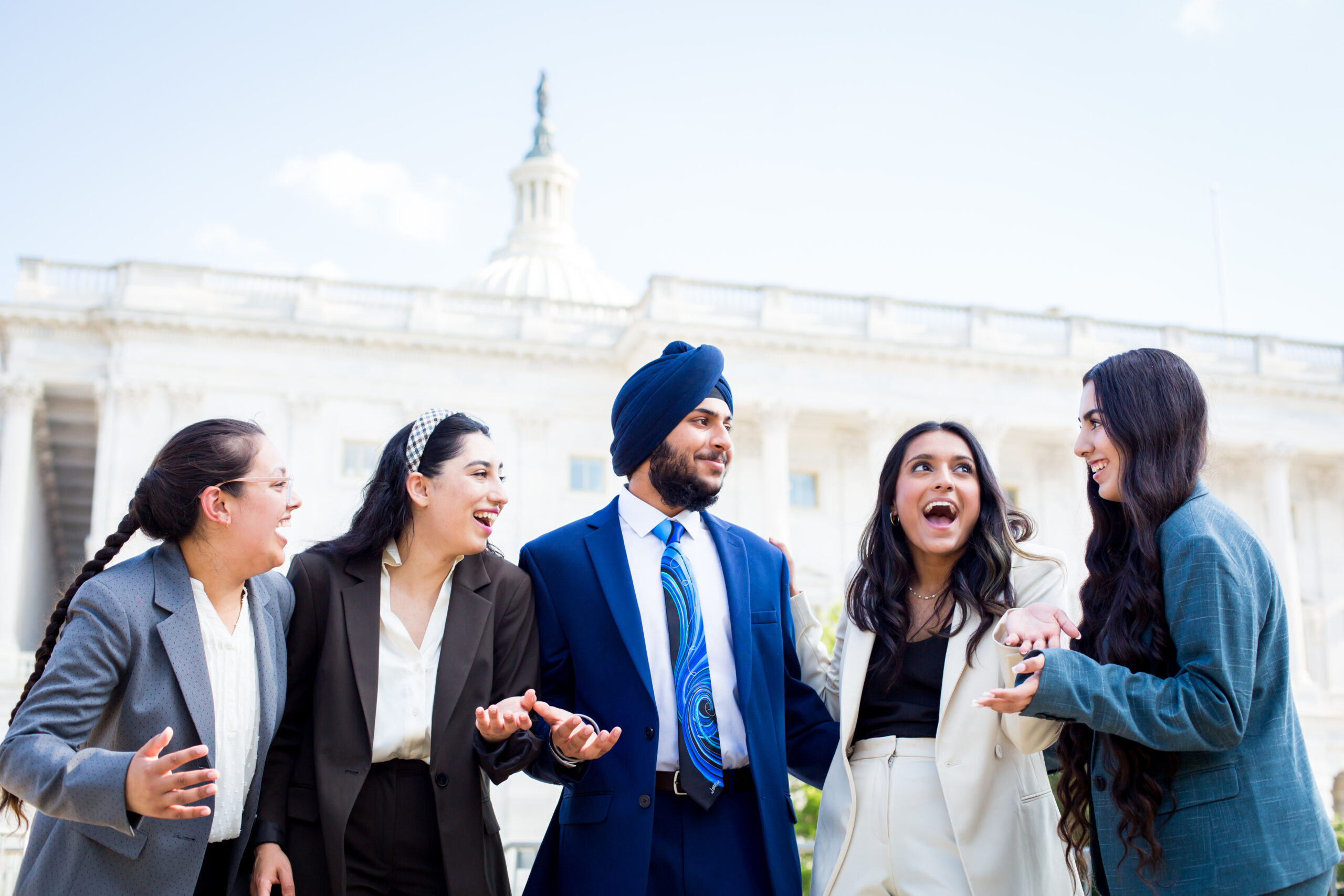
The SikhLEAD D.C. Cohort will be serving free langar on Capitol Hill to educate lawmakers about Sikhi and offer them a chance to connect directly with the Sikh American community.
All are welcome, but RSVP is required. Join us for this powerful moment of seva, education, and community—and help show that Sikhs do belong in every space where decisions are being made.
The Sikh community has long been known for its distinct practices, rich culture and history of resilience. However, as with any minority community in the United States, stereotypes and ignorance tend to cast a shadow over what being Sikh in America truly means.
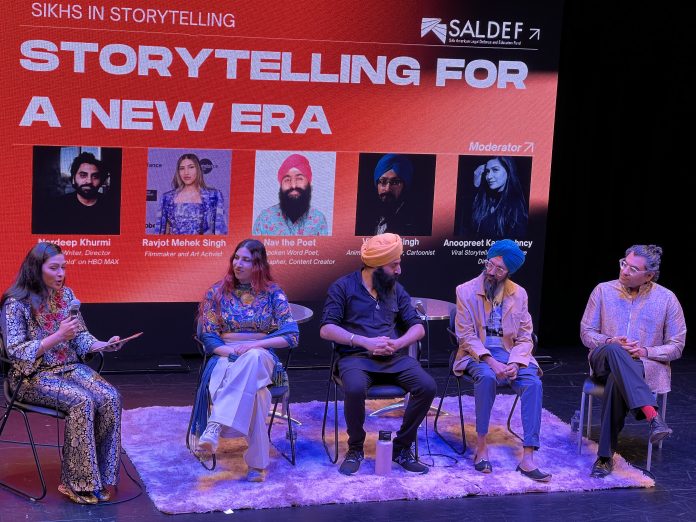
On Saturday, May 11th, the Sikh American Legal Defense and Education Fund (SALDEF) organized a community event called Sikhs in Storytelling which took place at the Five Angels Theatre in New York City. A first-of-its-kind event, Sikhs in Storytelling sought to highlight the accomplishments and stories of Sikh American community members who have made leaps and bounds in the activism, arts, and entertainment sectors.
Attendees included Nav the Poet, videographer and content creator; Nardeep Khurmi, actor, writer, and director best known for his film Land of Gold; Ravjot Mehek Singh, filmmaker and art activist; and Anoopreet Kaur Rehncy, storyteller and creative director- amongst many other notable participants.
“People always think that we, as Sikh Americans, will abide by the trope that we can only be doctors, lawyers, or engineers. No- we are so much more than that. We come from a culture and religion that is so rich in the arts. These are people who exemplify that heritage…” stated Amrita Kular, Communications Director for SALDEF.
The storytelling event began with a religious hymn invoking the blessings of the Sikh Gurus and then proceeded to move into panel events with enriching discussions. Simultaneously, artists, vendors, and members of the community mingled outside of the theater. Much of the art on display focused on bringing awareness to the essence of being Sikh and to the duality of being Sikh American. Other pieces depicted the history of the Sikh community and the horrors of the 1984 genocide perpetrated against the Sikh community in India.
“I went viral because I started making accessible content explaining Sikhi and Sikhi customs and symbols,” said Nav the Poet. “People really don’t know the basics about Sikhism- what wearing a pag [turban] means, how it is different and distinct from Hinduism, and so on.”
Other topics of discussion included the plight of Sikh Americans in the immediate aftermath of 9/11 and how many still bear the brunt of the fallout today.
“I think having an event like this is imperative…until we are depicted as real human beings who are nuanced and have depth, we only ever will be tokenized characters. I grew up in a post-9/11 America when I was the only brown person in my small town,” stated panelist Ravjot Mehek Singh.
This was the impetus for her to include Sikhi in her storytelling, Ravjot shared. It was disappointing to see that the only depiction of her people when she was growing up was of men who resembled her dad, with a turban and a beard, who were only ever depicted as savages. Ravjot knew she had to take action and change the way the media and the world saw her community.
Similarly, Vishvajit Singh, animator, filmmaker and cartoonist, recounted his own trying experience after 9/11. He was working in tech at the time and vividly recalled the sheer “heat” he felt being radiated at him from fellow Americans. He decided to work from home for two weeks and when he eventually did step out of his house, Vishvajit recalled how people would flip him off or call him names. It was this experience that informed his career decision to pivot from the engineering and tech world to a more creative media-focused career.
“My goal is not to just inform people about us but to normalize our people doing things that others would not imagine a Sikh person in a turban doing,” Vishvajit Singh said.
Exclusively covering the event was the Boston-based online TV channel Nishkam TV. Also a first of its kind, Nishkam TV is run by students from the Sikh community. It seeks to impart a range of skills to young adults such as script writing, production design, the importance of a social media presence, website management/development, and so on. Above all, it seeks to teach Sikh youth the importance of well-rounded media content told through a Sikhi lens.
Nishkam initially started out in 2016 as an annual film camp. Every year participating students would create short documentaries or films about the different teachings of Sikhism. Nishkam TV was officially launched in 2019, with the main goal of sharing information about different cultures so as to inspire interfaith dialogue.
“It teaches us that we need to take our narrative into our own hands,” a student member of the production team shared. To them, Nishkam TV was a powerful tool and opportunity to insert the Sikh community into mainstream media without giving into the same stereotype over and over. It was an opportunity to inspire a new generation of leading Sikh actors and Sikh directors.
When asked why Nishkam TV focused on students, the volunteers provided a message of hope to future generations to come.
For student team member Tanisha, the importance of informing and educating the future generation is paramount. Seeing as they will be the ones who will eventually take on leadership positions, it is up to them to improve upon what previous generations have done. The idea of Nishkam TV is to start engaging with younger generations earlier on so that they figure out a lot faster what they want to change and how. The youth are not only educated enough to know what is going on in the world but are also equipped to reach out to those younger than them. This is something older generations cannot do as well. By involving young adults as autonomous people and agents of change, there is surely hope that we are one step closer to shaping a more just and inclusive future.
To learn more about the panelists at Sikhs in Storytelling, please click here.
Click here to learn more about the critically acclaimed documentaries produced by Nishkam TV.
Even in difficult times of division on the world stage, the Arts Council of Princeton and Muslim Center of Greater Princeton – through art – have found a way to bring local people of different faiths together to talk about spirituality and what each share.
This local event called the “Art of Contemplating Spirituality and Art” is part of the Arts Council of Princeton’s “ART OF” series.
“With everything going on in the world and seeing how divided our world was becoming, I wanted to host an event that would bring all of the communities together especially the Muslim and Jewish communities,” said Samira Ghani, chair of the event and a board trustee of the Arts Council of Princeton.
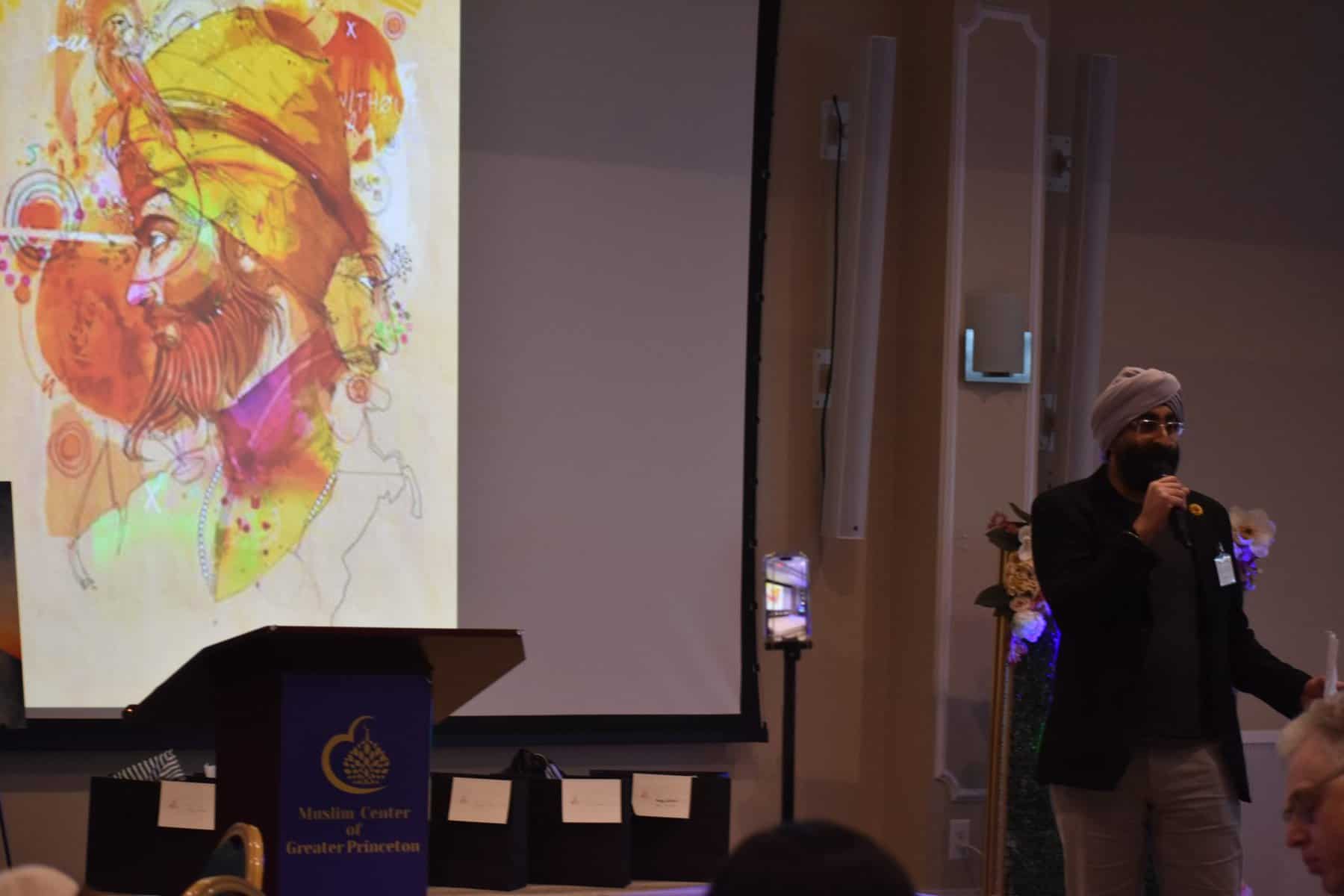
The event took place inside the Muslim Center of Greater Princeton in West Windsor on March 3 and was designed for faith leaders to speak about spirituality and how art resonates with their faith.
“My passion is interfaith and when I’m able to unite us through faith and art, it’s a labor of love for me,” Ghani said. “Seeing all the faiths come together and talk about spirituality, art and love, it truly makes me feel like all the hard work that comes with putting on an event is worth its weight in gold.”
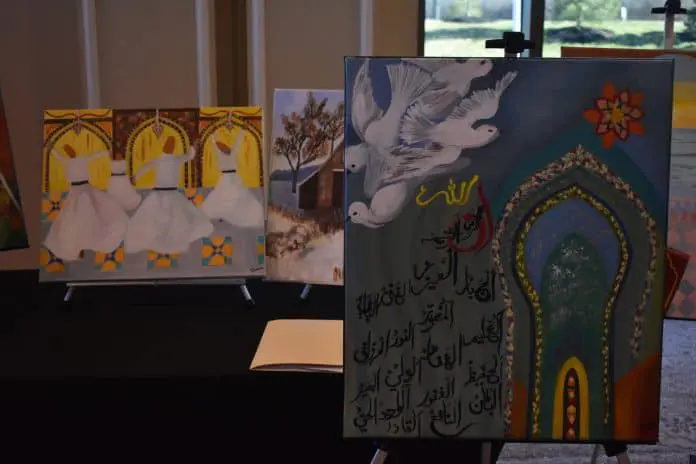
Featuring faith leaders and people from Christian, Muslim, Jewish, Sikh and Buddhist faiths, people in attendance broke bread, listened and had conversations through the Art of Contemplating Spirituality and Art as various works of art were displayed throughout a large multi-purpose room at the mosque.
Faith leaders included Rev. Jan Willem van der Weff from Dutch Neck Presbyterian Church in Princeton Junction, Father Peter Baktis from Mother of God Orthodox Church in Princeton, Amman Seehra, vice chair of the Sikh American Legal Defense and Education Fund (SALDEF), Beverly Sanford from Princeton Buddhist Meditation Group, Rabbi Andrea Merow from the Jewish Center in Princeton and Imam Safwan of the Muslim Center of Greater Princeton. They each shared art that resonates with their faith, spoke about spirituality and connecting with others.
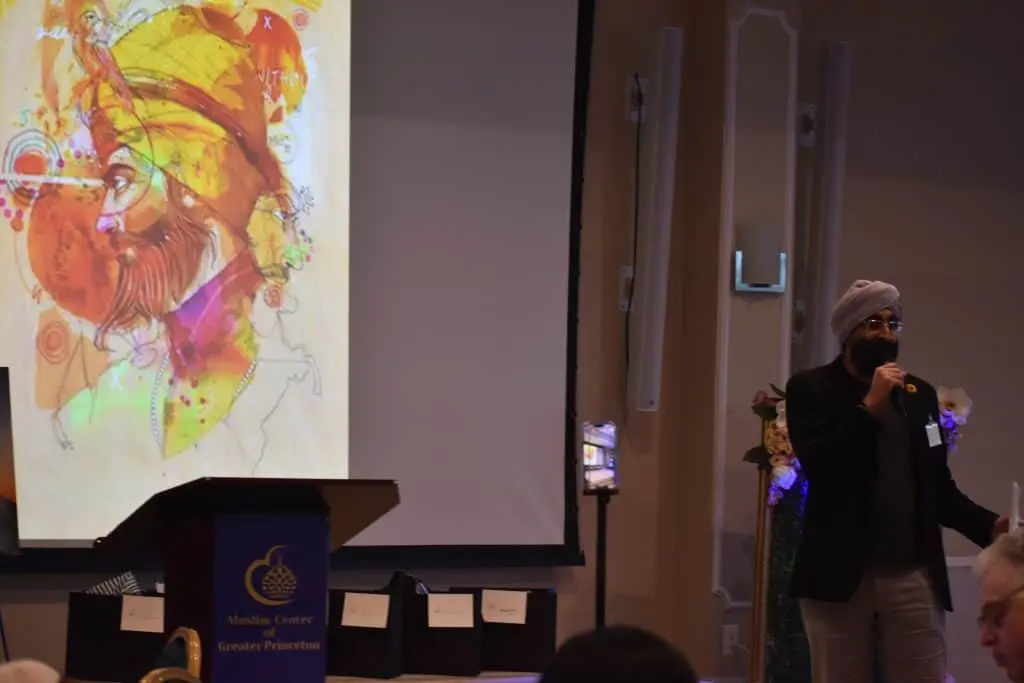
Seehra shared an art piece, “King without a Crown” by Amandeep Singh, who is also known as Inkquisitive Art. He explained through the artwork’s elements how it describes the Sikh faith and the direction of how people should lead their lives.
“The title of this is a ‘King without a Crown.’ The artist wanted to make a distinction between a crown that is man made and given to people and the turban which is a responsibility you take on,” Seehra said. “It is your responsibility to treat yourself and others with respect, but also help those in need.”
He described the three components of what the turban stands for. There was a time when turbans were only worn by royalty and there was the thought that everybody should be treated as royalty, and everybody is deserving of that type of respect, Seehra explained.
“It was essentially for everybody,” he said. “The second meaning is the process of tying [the turban] which should be something you are doing every day and is a constant reminder to do what is good, what is right, and to help others for yourself.”
And third, the turban symbolizes someone being approachable.
“If you see someone with a turban that means you can go to them if you are in need and need help,” he said. “It is a symbol for others to see you are supposed to stick out in a crowd, you are supposed to be there to help others.”
Sanford shared what faith means to the Buddhist community and how Buddhist implement this in their everyday lives. She described and explained the art of Rene Magritte in “The Key of the Fields” (La Clef des champs), which is a landscape framed by a window that has been broken.
“We live in a world that is very complicated and full of uncertainty, it always has been and always will be,” she said. “It is very [easy to] hide behind our stories and painted windows and not see the world around us which is so much bigger than we are.”
Sanford expressed that if there is any faith common to all of the Buddhist community, it is the “faith or the confidence that we can wake up and that we can break through, that we can see what our minds are doing. That we can open our hearts wider.
“…When we do …what comes through a broken window, fresh air … Something new and different, something magical even,” she added, noting “life is indeed extraordinary, precious and rare.”
Sanford said that in her Buddhist tradition they believe “we can open our hearts and minds in this messy, sorrowful, glorious, amazing world and find the fresh air in any moment.”
Merow, a rabbi from Jewish Center of Princeton, said it was a wonderful process for her to think about art and her spirituality.
“The word spirituality has varied connotations among all our different religions. I define spirituality as an attempt by each of us to encounter the holy one through our actions,” she said.
“The art I want to share with you references and elevates one religious practice, the idea of a Sabbath, a day of rest. For me this painting illustrates spiritual values I want to practice, and my community wants.”
Merow displayed a painting from a series called Hebrew letters by artist Debra Kapnek.
“For me this piece showcases values of universalism, what we share and particularism, our own story,” she said. “Concepts that touch each of us in this room.
“We share the Earth and care for it. We are connected to each other. Each of our religious communities has its own foundational stories. May each of our souls here find the Sabbaths that we need to bring true creativity to this world.”
The Muslim Center of Greater Princeton’s Imam Safwan expressed that “what gives light is the presence of truth inside of it.”
“We live when we make meaning and art brings us closer to those essential meanings and truths,” Safwan said. “That beauty, that love, so what I have chosen for my art is mamluk architecture. Mamluk society was part of the great Ottoman movement within what we could call the golden society of Islam.”
He explained how mamluk architecture created spaces with beauty in every point and function. The art of the building preserves its legacy and function.
“People behold these spaces for us to just ponder on its beauty and beauty of its people,” Safwan said. “Ultimately, the message I wish to close with is that buildings are generally not preserved for function. What makes something a legacy is the meaning that sustains it, not its function.
“The meaning will pay off generationally in the preservation of beauty.”