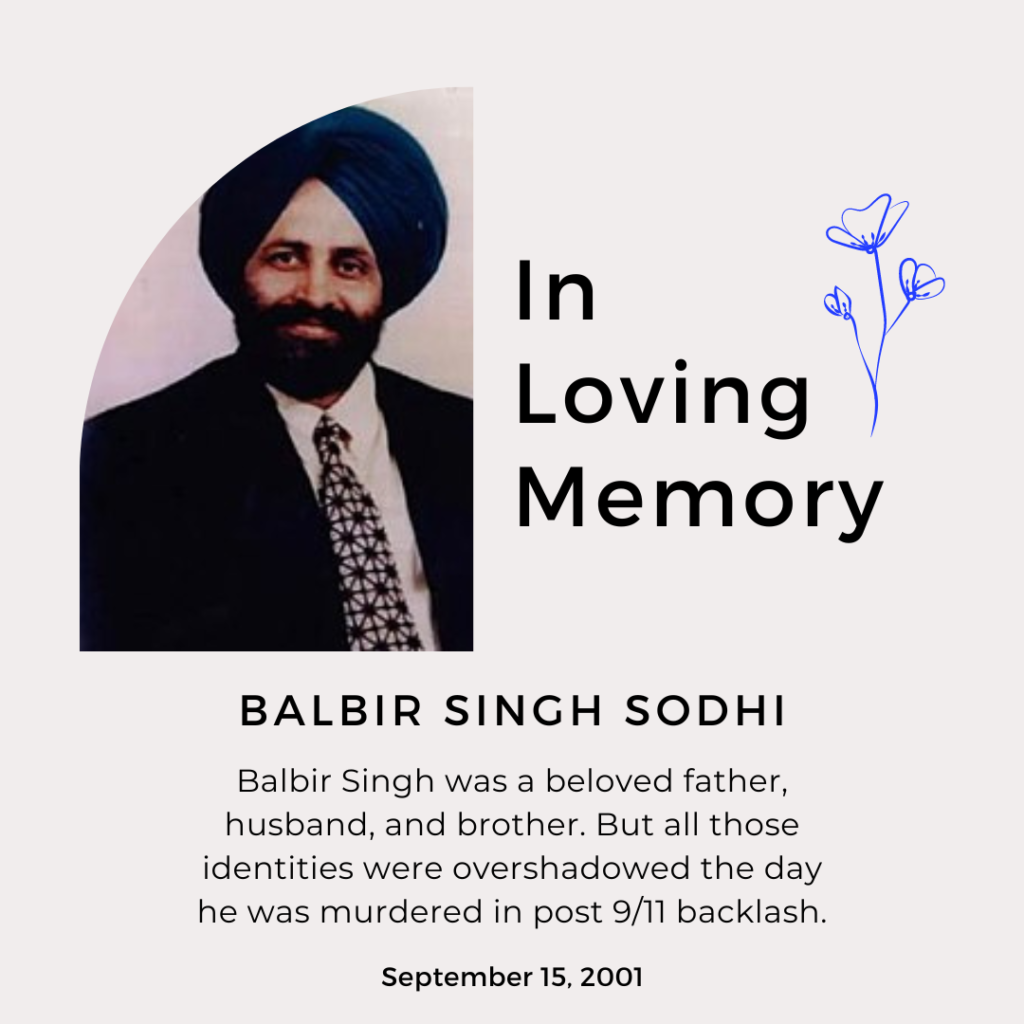
SALDEF Endorses September 11th Congressional Resolution

FOR IMMEDIATE RELEASE
September 19, 2025
Contact: media@saldef.org

SALDEF Endorses September 11th Congressional Resolution

Washington, D.C. – SALDEF endorses a House Resolution introduced by Representative Pramila Jayapal, which acknowledges the hate and targeting that the Sikh, Muslim, Arab, Middle Eastern, and South Asian communities faced in the aftermath of September 11, 2001. 

We are grateful that the bill acknowledges the murder of Balbir Singh Sodhi, a Sikh man who was murdered in Mesa, Arizona on September 15th, 2001. This was the first fatal act of hate violence in the post 9/11 aftermath.

The same divisive and xenophobic rhetoric that resulted in hate violence against the Sikh community continues to cause harm. Communities are often targeted with overreaching policing, surveillance, and criminalization, as outlined by the bill. 

The bill does not simply recognize the attacks against our communities, but also advocates for the creation of an independent commission to work with community-based organizations to review harmful government policies and to provide recommendations for dismantling them, as well as build out support avenues for victims of hate and State violence. 

We thank the co-leads and sponsors of the resolution: Rep. Pramila Jayapal (WA-07), Rep. Ilhan Omar (MN-05), Rep. Rashida Tlaib (MI-12), Rep. Judy Chu (CA-28), Rep. André Carson (IN-07), Rep. Jim Costa (CA-21), Rep. Hank Johnson (GA-04), and Rep. Lateefah Simon (CA-12)

Midwest University Tour Creates Awareness and Highlights Post 9/11 Challenges

Washington DC; September 27, 2011 – Earlier this month, the Sikh American Legal Defense and Education Fund (SALDEF) was invited to participate in a series of  presentations and panel discussions at the University of Illinois, Urbana-Champaign and the University of Indiana-Bloomington. On September 6th, speaking as part of the Food for Thought discussion series at the Asian American Cultural Center of the University of Illinois, SALDEF Associate Executive Director, Jasjit Singh, provided the over 100 attendees, comprised of students and faculty, with an introduction to Sikh Americans and the challenges Sikh Americans have faced post 9/11. Later that day, SALDEF participated in the Interfaith Speaker Series hosted by the Office of Inclusion and Intercultural Relations. The Interfaith Speaker Series featured a panel of representatives from several faiths and focused on the topic of what “service” means in each faith. Mr. Singh spoke of the prominent place ‘service’ has in the Sikh scriptures (Gurbani) and throughout Sikh history. The panel discussion was followed by a lively question and answer session. Then, on September 7th, the University of Indiana, hosted an interfaith panel to discuss the impact of 9/11 on religious communities.  Some of the topics included the changes in America since 9/11, media reports and the rise against multiculturalism, and how the events of 9/11 affected the United States in terms of diversity education. If you would like SALDEF to make a presentation about the Sikh religion and Sikh American civil rights issues to your college, law school, or graduate school, please contact us via email.

By Jose G. Santos, CNN View the video here. Fairfax Station, Virginia (CNN)– Ten years ago, Balbir Singh Sodhi was gunned down, apparently because he looked Muslim or Arab. He was neither. Sodhi was a Sikh. Members of the religious tradition say he was the first person to be murdered in retaliation for the 9/11 attacks. That claim has been backed up by the Justice Department. “The first person killed in post-9/11 violence, Balbir Singh Sodhi, was a Sikh, shot while pumping gas at his gas station in Arizona four days after 9/11,” said Assistant Attorney General Thomas E. Perez in congressional testimony earlier this year. Sodhi’s killer, 45-year-old aircraft mechanic Frank Roque, gunned down the bearded, turban-wearing Indian immigrant outside the gas station Sodhi owned in Mesa, Arizona. Roque drove up to the station, fired a handgun  at Sodhi five times, then fled. Roque would go on to shoot at a Lebanese-American gas station clerk and fire into the home of an Afghan-American family later that same day. In 2003, Roque was sentenced to death for Sodhi’s murder. On appeal, his sentence was reduced to life in prison. Blending in, standing out Ten years after the September 11 attacks, which provoked a wave of organizing among Sikhs worried about being mistakenly targeted in retaliatory attacks, adherents of the religion remain both visible and enigmatic. “Most of the challenges we face can be traced to people not knowing who we are,” said Jasjit Singh, assistant executive director at the Sikh American Legal Defense and Education Fund. “I don’t feel there is a specifically anti-Sikh bias, because people don’t know what Sikhs are.” Singh’s group estimates that there are about 500,000 Sikhs in the United States, nearly all of Indian origin. Sikh women are less identifiable than men, identifiable by their beards and turbans. Many American Sikh women dress like other Westerners or wear the salwar kameez, a traditional north Indian garment of a long shirt and loose-fitting pants.
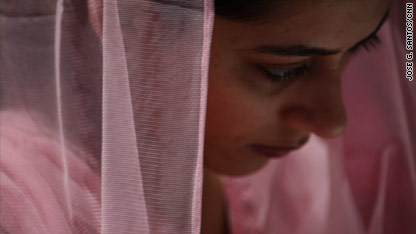
A woman prays during a Sikh service.

Sikhism emerged more than 500 years ago in Punjab, in what is now India. Adherents of the monotheistic faith believe in “devotion, remembrance of God at all times, truthful living, equality between all human beings, social justice, while emphatically denouncing superstitions and blind rituals,” according to the website of the Sikh Coalition, a U.S.-based group. “The ultimate goal in Sikhism is to merge into the divine love we know is God,” said Navdeep Singh, a policy adviser to the Sikh American Legal Defense and Education Fund. “We believe in the cycle of reincarnation,” he said. “That you will be judged by your deeds, and come back, and each time you come back you move one step closer to the divine.” There are 25 million Sikhs around the world, according to the Sikh Coalition, which was formed after the September 11 attacks.
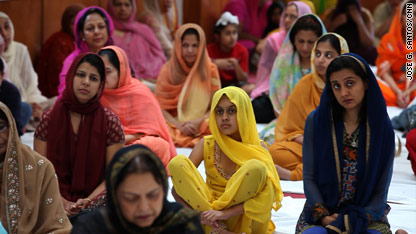
Congregants meet inside a Sikh temple in Virginia.

Inside the temple A Sikh temple is called a gurdwara, which means door to the guru, or teacher. Gurdwara refers to both a place and a practice, encompassing temple, teachings and ceremony. Gurdwaras around the world variously incorporate clinics, schools, guest quarters and community centers, which Sikhs say is a sign of the religion’s values of service and equality. “Sikhism was founded in an area and in a time in which inequality was rampant,” said Navdeep Singh. “If you were a woman, you were less than a man. If you were poor you were less than a rich person. Based on what caste you were, that defined your entire life. Sikhism was a rejection of those ideas.” At the gurdwara known as the Sikh Foundation of Virginia,  the muffled trills of a harmonium blended with birdsong on a recent Sunday morning.
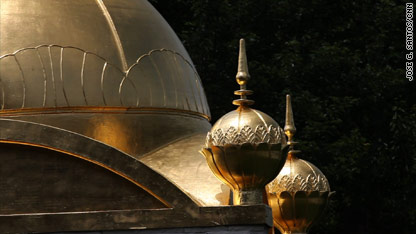
The golden dome of the Sikh Foundation of Virginia.

The temple’s  golden dome shimmers among the rustling dark green woods like a crown atop a velvet cushion. As worshipers enter, shoeless and with heads covered, they approach the Guru Granth Sahib, a book elaborately enthroned beneath a canopy at the head of the building’s main hall. Obeisance is made, and a gift, usually of money, is placed on the dais. Music, song, prayer, readings from the Guru Granth Sahib and sermons comprise most of the ceremony. Everyone sits on the floor, men on one side, women on the other, children wherever suits them.
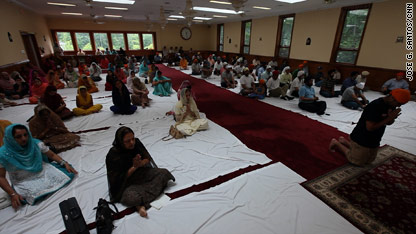
Congregants meet for prayer and study in Virginia.

“The beginning of our Guru Granth Sahib, and Sikh philosophy is really encapsulated in the first phrase: ‘Ik Onkar,’ which means ‘there is one God,’ ” said Navdeep Singh. More than a book of scripture, the Guru Granth Sahib is considered to be a living teacher, or guru.
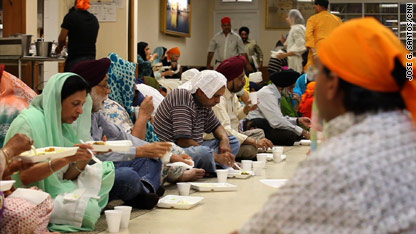
After the service congregants share a communal meal.

After the worship service, called Diwan, comes Langar, a simple meal eaten while sitting on the floor, which Sikhs say reinforces the ethic of egalitarianism. “Langar is based on this idea of equality, and making sure that no one goes away hungry,” said Navdeep Singh. “Because as Sikhs, we’re kind of like Italians. We view everyone as one family. And if you’re part of that family, you can’t go away hungry. You have to have a meal together.” SOURCE: http://religion.blogs.cnn.com/2011/09/15/10-years-after-sikh-murder-over-911-community-continues-to-blend-in-and-stand-out/
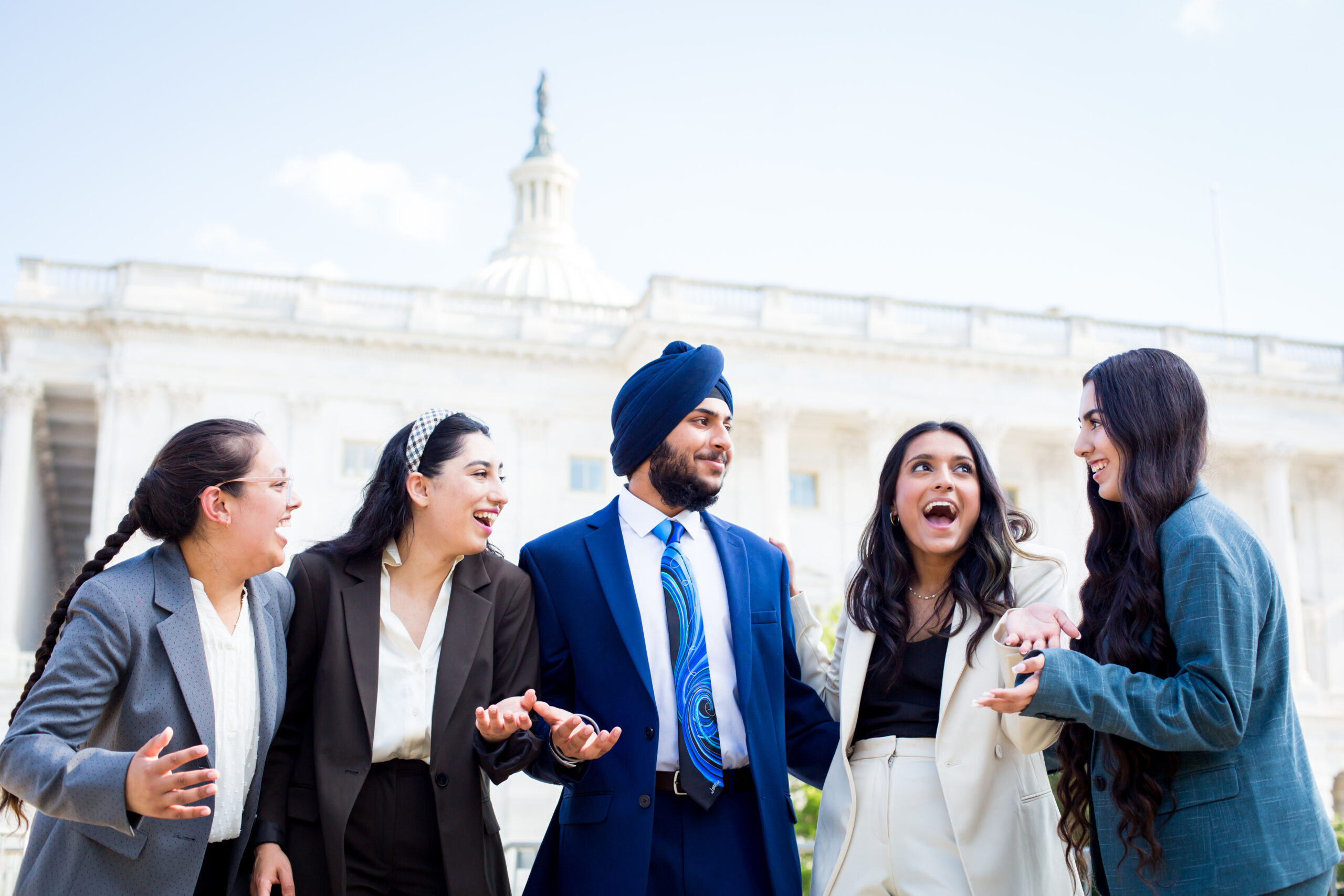
Remembering Balbir Singh Sodhi

The Story of Balbir Singh Sodhi: The First 9/11 ‘Backlash’ Fatality

Balbir Singh Sodhi was shot and killed on Saturday, September 15, 2001 in Arizona by Frank Roque.  Mr. Roque wanted to “kill a Muslim” in retaliation for the attacks on September 11. It was the first fatal act of hate violence resulting from 9/11.  Mr. Roque was convicted of first degree murder and sentenced to life in prison for the hate crime. Just a few months before the tenth anniversary of his death and the attack on America, the Arizona legislature decided to remove Mr. Sodhi’s name from the state 9/11 memorial because he was not deemed “a victim of 9/11″.  After advocacy by community groups, Governor Jan Brewer would veto the bill and continue to honor the memory of Mr. Sodhi.

The events of September 11, 2001, affected each and every American in pointed and distinct ways. Many thousands perished during the attack, others lost loved ones. Many reacted with fervent patriotism for their country in order to overcome the devastation in progressive and constructive ways, while others lashed out with fear and hate towards the unknown and who they perceived to be ‘the enemy’. Despite the myriad of reactions to that day, it is clear that the tragedy and loss of 9/11 did not end on that fateful Tuesday. The aftermath is still very real for the families of those that were lost in the attacks, for the families of those that were attacked in the backlash, and those that still fear for their safety in America.

Mr. Sodhi was a 49 year old Sikh American man, who owned a Chevron gas station in Mesa, Arizona. He was shot while arranging American flags in front of his gas station. His assailant, Frank Roque, wanted to ‘kill a Muslim’ in retaliation for the terrorist attacks. He selected Mr. Sodhi simply because he had a beard and wore a turban in accordance with his Sikh faith. Mr. Roque shot at Mr. Sodhi three times, then shot at another service station owned by a Lebanese American, and finally shot at a home of a family of Afghan descent. Fortunately, no one else was injured.

Balbir Singh Sodhi was the oldest of five brothers. Mr. Sodhi immigrated to the United States from India in 1988  to realize the American dream. He joined his brother Harjit Sodhi in Los Angeles, CA, where he worked at a 7-Eleven for several years until he moved to Walnut Creek, CA to become a cab driver. He had moved to Mesa a year prior to his death, bought a house, and the gas station across the street.   “He worked 12, 14 hours a day,” said his brother Harjit, “and he saved his pennies.” He regularly sent money to his family still in India. Jagjit Sodhi, his older brother, stated, “We depended on the money he sent us from time to time.” After hearing about his younger brother’s tragic death, he was shocked: “He could never have any enemy. He is innocent.” Mr. Sodhi was a husband and a father of two daughters. Mr. Sodhi was “known by friends and neighbors as a quiet, gentle man….Children have told reporters how Balbir Singh would let them buy candy from his store, even if they didn’t have enough money. The homeless shed tears as they recounted tales of his generosity to them.”  Many Arizona state representatives and citizens of all backgrounds rallied around the Sodhi family and the Sikh American community in support, with over 3,000 people attending Mr. Sodhi’s memorial service.

The day after the attack, Arizona Attorney General Janet Napolitano held the first of many press conferences.  She said, “we will not tolerate acts of bigotry against our fellow Arizonans.”  “No individual should have to be afraid of their safety because of the color of their skin, the way they dress or the religion they choose to practice.” She encouraged the state to honor his memory.   In 2006, the Arizona legislature unveiled a memorial to the victims of 9/11 which included the name of Balbir Singh Sodhi. Mesa’s Mayor, Keno Hawker, firmly stood against such hate-motivated attack, saying “senseless acts of violence will do nothing to help our nation heal or bring peace to the victims of the horrific tragedy that occurred this week…now is the time for all Mesa resident to display solidarity by taking a clear stand against violence. We are all Americans. We are all grieving. Let us unite in peace and determination that violence will never be the answer.”  At the memorial service, Maricopa County Attorney, Rick Romley, stated: “On September 11, America was attacked from abroad. However, with the murder of Mr. Sodhi, we have now been attacked from within.”

Frank Roque boasted during his arrest: “I’m a patriot.” “I stand for America all the way.” “Two years later, he learned the American way included a fair trial by jury. On September 30, 2003, an Arizona jury found Frank Roque guilty of first-degree murder for his hate crime murder of Mr. Sodhi, along with five other charges, including attempted murder and reckless endangerment related to drive-by shootings at other individuals he perceived to be Middle Eastern that same day in 2001. On October 9, 2003, Frank Roque was sentenced to the death penalty. The sentence was later commuted to life in prison.

In 2011, the state of Arizona proposed a bill to remove Balbir Singh Sodhi’s name from the state’s 9/11 Memorial. The bill’s original sponsor, Rep. John Kavanaugh (R), claimed that Sodhi was “not a victim of 9/11.” Adding insult to injury, along with stripping the late Mr. Sodhi’s name from the memorial, the legislation even enumerated that the removed plaque to be sold to a scrap metal dealer. Ten years after 9/11, Rep. Kavanaugh stated, “It’s part of a myth that, following 9/11, Americans went into a xenophobic rage against foreigners. That’s not true. America’s reaction towards foreigners was commendable.” Following a wave of local and national outcry, Governor Jan Brewer vetoed the bill on April 29, 2011.  The bill, which passed both Houses on party lines, would have automatically gone into effect on May 2, 2011.

·    Keeping Media Accountable – CNN, Financial Times, ABC ·    Victory: AZ Governor Vetoes Bill to Remove 9/11 Victim from Memorial ·    Sikh Families Attend White House Easter Egg Roll ·    SALDEF Internships Available ·    Share Your Post-9/11 Story ·    Students: Apply for a Khoj Scholarship! Keeping Media Accountable – CNN, Financial Times, ABC On May 6, two major news outlets, CNN and Financial Times (FT), published online articles about Osama bin Laden using images of a Sikh to supplement the news stories. Both images were featured on the outlets’ homepages and were likely viewed by millions of readers. SALDEF contacted editors at both outlets and alerted them to the inappropriate use of the image, at which point both news outlets removed the images. FT acknowledged the error and provided a written apology. SALDEF is currently pursuing an apology from CNN. To read more, click here. SALDEF also contacted ABC regarding the What Would You Do? episode that was aired on May 6, 2011. During this episode, a Sikh American was portrayed to highlight the issue of employment discrimination, an experience many Sikh Americans face. While the programming certainly served to educate the public on Sikh Americans, SALDEF expressed concern that the individual in the segment was not an actual Sikh. To truly and accurately depict the situation in question, it would have been more effective to use an observant Sikh American. To view the segment, click here. Victory – AZ Governor Vetoes Bill to Remove 9/11 Victim from Memorial During a meeting on April 29 with the family of Balbir Singh Sodhi, Arizona Governor Jan Brewer vetoed HB 2230, a bill that would remove Balbir Singh Sodhi’s memorial from the state’s 9/11 memorial. SALDEF thanks the community for its immediate response to our Action Alert; over 7,500 letters were signed in less than three days asking that the Governor veto HB 2230. This success would not be possible without your support! SALDEF commends Rana Singh Sodhi, as well as the entire Sodhi family, and representatives of the Arizona Sikh American community for directly engaging with Rep. Kavanaugh, the bill’s sponsor, and Gov. Brewer to ensure the bill would be vetoed. Sikh Families Attend White House Easter Egg Roll On April 25, 2011, President Obama and the First Family hosted 30,000 people in their backyard for the 133rd White House Easter Egg Roll This year’s theme “Get Up and Go!” focused on promoting health and wellness. The White House specifically gave SALDEF 25 tickets to provide to Sikh American families. This is the second year the Obama administration has given SALDEF tickets to ensure Sikh Americans are represented at this festive event. SALDEF Internships Available The SALDEF Internship Program offers opportunities for political advocacy and leadership development to passionate and motivated youth. Students gain direct insight into issues of civil rights, public policy, and the legislative process. Interns gain practical experience in community organizing, research and writing, legal issues, political action, and educational outreach. We are currently seeking a Legislative Intern, Communications Intern, and Media Intern; click here for more information on each of these positions and how to apply. Share Your Post-9/11 Story As we approach the ten year anniversary of 9/11, SALDEF would like to hear your personal stories and experiences as a Sikh American. What did you or your family experience? How have the events of 9/11 affected you? Along with documenting specific incidents, we want to preserve our community’s story. Submit your written testimony, pictures, and videos at info@saldef.org. Students: Apply for a Khoj Scholarship! Khoj has announced three scholarships, worth $1000 each, for undergraduate students. The scholarships award students who have demonstrated humanitarian, academic, or all-around excellence. Applicants must be 17-25 years of age, currently pursuing an undergraduate degree at a four year institution, and a U.S. resident. The application, which can be downloaded here, must be submitted by July 1, 2011. Candidates that are short-listed will be interviewed to determine successful scholarship recipients.

CNN and FT.com Remove Images Promptly, FT Apologizes

CNN Homepage on May 6, 2011

On Friday, May 6th, two major news outlets, CNN and Financial Times (FT), published online articles about Osama bin Laden using images of a Sikh to supplement the news stories. Both images were featured on the outlets’ homepages and were likely viewed by millions of readers.

Article on FT Homepage on May 6,2011

Within minutes of the images being published, SALDEF contacted editors at both outlets and alerted them to the inappropriate use of the image. CNN removed the image from its homepage within thirty minutes and FT removed the image within three hours. FT acknowledged the error and provided a written apology. SALDEF is currently pursuing an apology from CNN and seeking an opportunity to conduct a presentation for the CNN staff, as this is the third instance within the last two years that they have inappropriately used images of Sikhs. In letters to the media outlets, Jasjit Singh, SALDEF Associate Executive Director, stated, “Normally, we would be pleased that [CNN / FT] is using the image of a Sikh to show how the general public is reacting to a story. In this case however, the image negatively impacts the Sikh American community and increases the likelihood of bias against community members by conflating our identity with that of Osama bin Laden.” SALDEF appreciates the rapid response from both news outlets and is thankful to community members who alerted us about this issue. If you see misrepresentations of Sikhs or the Sikh faith in the media, please contact us.

SALDEF Commends Sodhi Family, Local Community, and Arizona Governor

May 2, 2011: During a meeting with the family of Balbir Singh Sodhi, Arizona Governor Jan Brewer vetoed HB 2230 on Friday, April 29, 2011. The family, who had requested the meeting with the Governor, is overjoyed that the plaque listing the name of Mr. Sodhi will not be removed from the state’s 9/11 memorial. The memorial commemorates Mr. Sodhi’s death on September 15, 2001 as the first individual to be murdered as a result of post-9/11 backlash. On September 15, 2001, Balbir Singh Sodhi, a Sikh American, was murdered outside of his Chevron gas station in Mesa, Arizona by a man who wanted to ‘kill a Muslim’ in retaliation for the terrorist attacks. He selected Mr. Sodhi simply because he had a beard and wore a turban in accordance with his Sikh faith. Governor Brewer expressed her deep condolences for the family’s loss and concern over the problematic bill. The Sodhi family and members of the Arizona Sikh American community also met with Representative John Kavanaugh, the bill’s sponsor, on Tuesday, April 26, 2011, during which he apologized for his poorly conceived bill. “This is why we love this country. The leadership is responsive. When we met with the Governor today and Representative Kavanaugh Tuesday they each honored my brother, our family, and our Sikh community with caring concern. We humbly requested that they help us so that our brother’s part in the local and national 9/11 history would not be denied. Our brother represents all 9/11 backlash victims,” stated Harjit Singh Sodhi. SALDEF commends Rana Singh Sodhi, as well as the entire Sodhi family, and representatives of the Arizona Sikh American community, including Dr. Jaswant Sachdev and Gururoop Kaur Khalsa, for directly engaging with Rep. Kavanaugh and Gov. Brewer to ensure the bill would be vetoed. Furthermore, the composure and poise consistently demonstrated by the Sodhi family despite their loss should serve as an exemplar for the entire Sikh American community. SALDEF thanks Governor Brewer for her prompt response in vetoing the bill and our local community partners, especially the Anti-Defamation League of Arizona for its involvement since the outset of this issue. SALDEF thanks the community for its immediate response to our Action Alert; the Governor’s office received over 7,500 letters in less than three days asking that she veto HB 2230. This success would not be possible without your support! To read Governor Brewer’s letter explaining why she vetoed the bill, click here.

Arizona Bill Automatically Becomes Law if Not Vetoed by Monday, May 2 April 28, 2011: The Sikh American Legal Defense and Education Fund (SALDEF) and thousands of Americans from all backgrounds are demanding that Arizona Governor Jan Brewer veto HB 2230, a bill that removes the memorial of Balbir Singh Sodhi, a Sikh American who was the first post-9/11 fatality caused by hate violence on September 15, 2001. The bill proposes the removal of Mr. Sodhi’s name from the state’s 9/11 memorial and subsequently selling the memorial plaque as scrap metal. Over 4700 letters have been sent in the past two days to Governor Brewer demanding that she veto the bill. SALDEF encourages Americans to continue to voice their outrage to Governor Brewer and demand that she veto HB 2230 by the Monday deadline, at which point the bill becomes law. TAKE ACTION: Sign the petition urging Gov. Brewer to veto the bill The bill’s sponsor, Republican Representative John Kavanaugh, outrageously claimed that Mr. Sodhi “was not a 9/11 victim” after conducting a cursory Internet search. In fact, Mr. Kavanaugh believes the tragic hate crime was unconnected to 9/11. The bill has passed both houses in the Arizona legislature on party-line votes and is now on the desk of Governor Brewer, who has until Monday to veto the bill before it automatically becomes law. The efforts of the Arizona legislature come as a blow to the entire Sikh American community, which has endured a decade of hate crimes. Whereas Arizona rallied behind the Sodhi family and Sikh American community in the wake of Mr. Sodhi’s tragic murder, the state is now seeking to erase him from its history. In addition to signing the petition, contact Governor Brewer asking that she veto HB 2230:

  • Call: 602.542.4331, then dial option 4
  • Facebook: facebook.com/govjanbrewer
  • Twitter: @govbrewer

Take action now and forward this to your family and friends.

UPDATE 5/2/11: Arizona Governor Brewer vetos bill.  Read more here. April 26, 2011: Arizona Governor Jan Brewer is deciding on signing a bill to remove Balbir Singh Sodhi’s name from the state’s 9/11 memorial and sell his memorial plaque as scrap metal. TAKE ACTION: Sign the petition urging Gov. Brewer to veto the bill Arizona Representative John Kavanagh introduced the bill because Sodhi “was not a 9/11 victim.” In fact, Mr. Kavanagh believes the tragic hate crime was unconnected to 9/11. SALDEF is outraged at the disrespect the Arizona state legislature has shown Mr. Sodhi’s memory, family, and the Sikh American community. The efforts by Mr. Kavanaugh and his colleagues to deny the fact that Mr. Sodhi’s murder was a consequence of 9/11 is completely unfounded, unacceptable, and shows a complete failure in leadership. READ MORE: Mesa man pushes to keep brother’s name on Sept. 11 memorial (Arizona Republic) On September 15, 2001, Balbir Singh Sodhi, a Sikh American gas station owner, was the first hate-crime related murder fatality in the wave of post-9/11 backlash. He was murdered outside of his Chevron gas station in Mesa, Arizona by a man who wanted to ‘kill a Muslim’ in retaliation for the terrorist attacks. He selected Mr. Sodhi simply because he had a beard and wore a turban in accordance with his Sikh faith. SALDEF implores the Sikh American community to take action against letting Arizona rewrite history and trivialize the first hate crime in the wake of 9/11. Sign the petition urging Gov. Brewer to veto this insensitive and offensive bill. As we approach the ten year anniversary of Mr. Sodhi’s death, do not allow the voice of victims of hate to be silenced. Take action now and forward this to your family and friends. Share this on Facebook.

•    Sikhs Attend White House Reception for AAPI Month •    Panel Discussion on Post 9/11 Era at U.S. Social Forum •    Arizona’s Immigration Law: SALDEF gives an opinion to the Court •    Meeting Assistant Attorney General Tom Perez •    Presentation at the Chaplaincy Institute •    SALDEF Invited to Participate on Diversity Panel at California High School •    Follow us on Twitter Sikhs Attend White House Reception for AAPI Month Earlier this summer, SALDEF was invited to attend a White House reception celebrating Asian American and Pacific Islander (AAPI) heritage month.  In his remarks, President Obama highlighted the Whitehouse’s engagement with Sikh Americans by saying, “[W]e’re always welcoming your input – from meetings with Sikh Americans to Native Hawaiians. The goal is to make sure that our government is successfully working to address disparities in health care, in education, and economic opportunity that exists within various AAPI communities.” The reception, held in the East Room, was also attended by House Speaker Nancy Pelosi, Education Secretary Arne Duncan, Senator Daniel Akaka (D-HI), Rep. Judy Chu (D-CA), and Rep. Mike Honda (D-CA).  We were pleased to be joined by members of the Sikh Coalition and UNITED SIKHS. Panel Discussion on Post 9/11 Era at U.S. Social Forum During this year’s US Social Forum Conference, SALDEF Community Relations Associate Birpal Kaur was a panelist on a session entitled “The 9/11 Movement: Intersections and Movement Building Strategies”. The Forum brought together more than 10,000 activists from across the country who are interested in social justice. Panel attendees learned about challenges affecting the South Asian communities in the post 9/11 era. Topics of discussion included hate crimes, racial profiling and the mental and social abuses that have increased dramatically since the attacks. To read more about the experience on, please click here to visit our blog. SALDEF Signs on to Amicus Brief to Inform Department of Justice about SB1070 Earlier this month, SALDEF joined a national coalition of civil rights groups to voice concern over Arizona’s controversial SB 1070 law by signing on to an amicus brief.  The document, which provides useful information for the judge evaluating a case, highlighted the consequences of the law on minority and immigrant communities.  Taking our brief into consideration, Judge Susan Bolton prevented the most concerning aspects of the Law from being implemented on July 28th. To read more about SB1070 click here. To read more about the Judge’s ruling, click here. Meeting Assistant Attorney General Tom Perez On July 12, 2010 members of the SALDEF team attended a reception hosted by the America Constitution Law Society. Among the presenters in attendence was Assistant Attorney General Thomas E. Perez. Mr. Perez delivered an inspiring speech on the need to push the frontiers of civil rights in America and later, acknowledged SALDEF’s strong relationship with the Department of Justice. SALDEF Conducts Presentation for Students of the Chaplaincy Institute in California On June 27, 2010, SALDEF Managing Director Kavneet Singh delivered a presentation to over a dozen ministers and chaplains from the Chaplaincy Institute on the Sikh religion at the El Sobrante Gurdwara in California’s Bay Area. The presentation covered the core Sikh beliefs and traditions, discussed the manners in which Sikhs pray and conduct services, and also addressed the history of Sikhs in the United States, including post-9/11 challenges facing the Sikh American community. Prior to the presentation, attendees watched the SALDEF produced DVD On Common Ground as a primer. Students also received copies of SALDEF’s 2010 Pocket Calendars and Who are the Sikhs educational brochures and took a tour of the Gurdwara, partaking in langar and sitting with the congregation. SALDEF Invited to Participate on Diversity Panel at California High School Last month, SALDEF was invited to participate in an interfaith religious panel at Laguna Hills High School in Orange County, CA.   The panel was an opportunity to educate students about Sikh beliefs and practices and also build connections with local leaders of other faiths. The students were engaged throughout the presentation and received SALDEF publications. The high school administration also agreed to keep SALDEF posted on future educational opportunities as they arise and utilize SALDEF as a content expert going forward.  If you would like to coordinate a presentation at your high school, or in your local community, please contact us. Follow us on Twitter Become a follower of SALDEF on Twitter and get realtime updates about issues we are working on, meetings we are attending and the people we are working with.  Check out recent activity and signup at twitter.com/saldef.