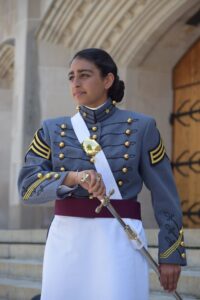
June 15th 2020 (Washington, DC) – Second Lieutenant Anmol Narang, a Georgia native and a member of the Sikh community, graduated from the United States Military Academy at West Point. While she is not the first Sikh female to graduate from West Point, Sikhs all over the world have applauded the U.S. Army’s efforts towards improving diversity and inclusion.
Approximately 1,100 cadets received their diplomas this past Saturday. There are 230 women in the graduating class this year. While West Point and the military overall have placed strategic importance in improving their diversity in recent years, the academy is still predominantly white and male. The 2020 graduating class is 12 percent black, 9 percent Latino, 9 percent Asian and less than 1 percent Native American.
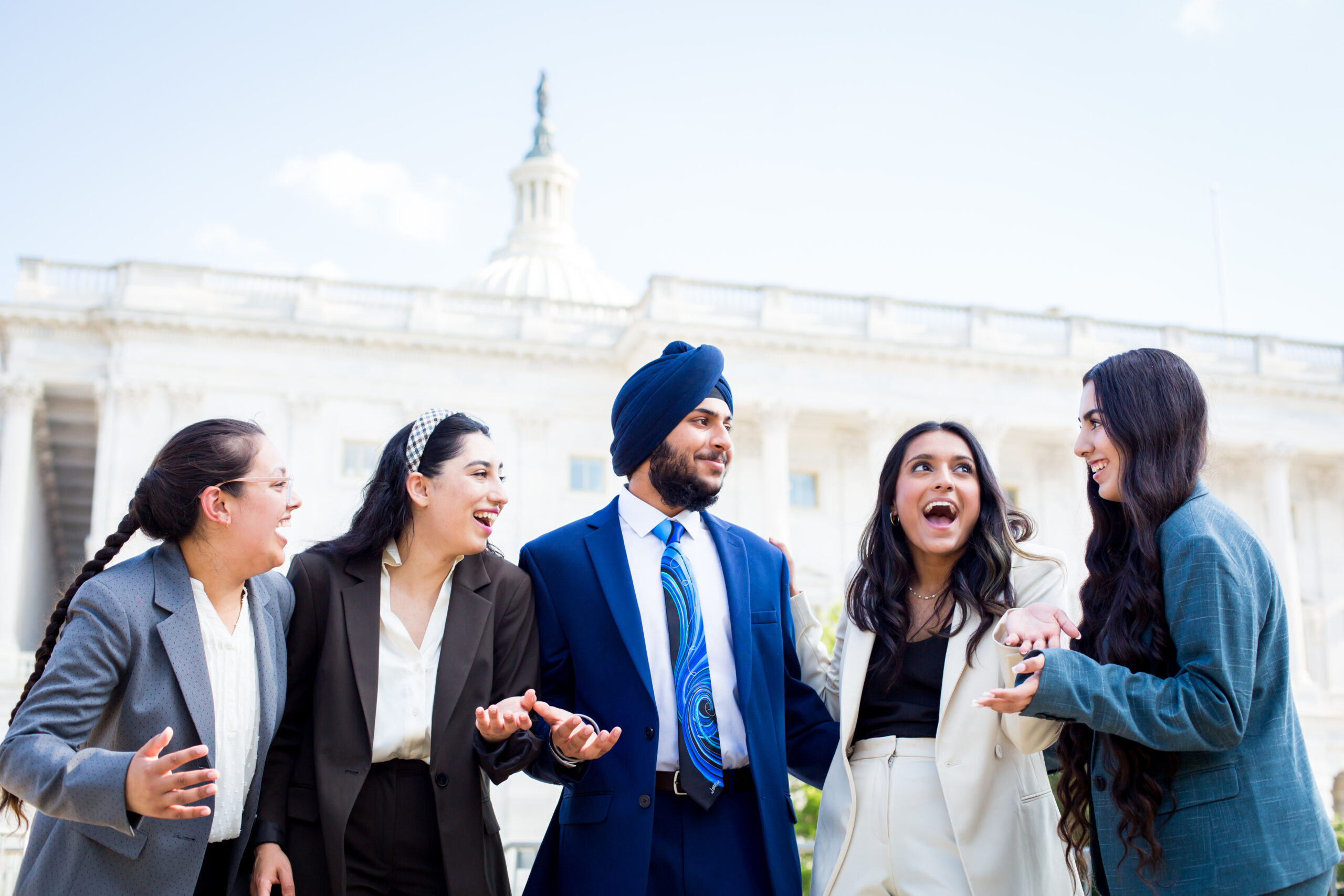
 SAVA and SALDEF have worked closely with the ACLU to secure historic accommodations in the US Army and Air Force. Airmen Harpreet Singh Bajwa, Jaspreet Singh and Sunjit Rathore paved the way for the policy change in the USAF earlier this year.
“It’s important that we establish a forward-thinking philosophy for all employers in the United States. The military represents one of the largest employers in our nation and is no exception,” stated Kiran Kaur Gill, Executive Director, SALDEF.
The U.S. Army and Air Force implemented diversity initiatives during both the Obama and Trump administrations which led to the current policy changes that allow Sikhs and other minorities to serve freely with their articles of faith. However, the Department of Defense does not have a consistent or department wide policy on religious accommodations. Sikhs turbans and beards are still not allowed in the U.S. Navy, Marines, Coast Guard or the U.S. Public Health Service.
“We need to remove barriers to service for patriotic young men and women from all minority communities. Sikh turbans, Muslim hijabs and traditional African hairstyles were deemed unprofessional or unsafe by our military during the Reagan administration. We must recognize that many of these uniform restrictions are part of a pattern of institutionalized discrimination practiced by some of our oldest institutions. Sikhs have served honorably in the U.S. military with our turbans and beards since the early 1900’s” remarked LTC Kamal S. Kalsi, D.O., President of SAVA.
“If we want our battle formation to look more homogenous, well, that will just take us the way of the redcoats, and we can’t afford to do that.” The Asian American and Pacific Islander (AAPI) population in the U.S. has more than doubled in the past two decades, and recruiting interest is soaring in places such as California and New Jersey. “Our recruiting efforts have to account for this demographic change, and prevent us from locking out eligible candidates who want to serve their country.” says Lieutenant Colonel Ravi Chaudhary (ret.) who has commanded the Washington DC recruiting squadron.
“While we applaud the military’s efforts to create a stronger, more diverse and inclusive fighting force, there is a great deal of work that needs to be done in the days ahead to ensure individuals from all backgrounds are able to serve,” States Kiran Kaur Gill, Executive Director of SALDEF.