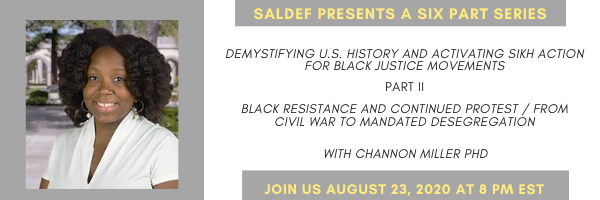
SALDEF will present the second part of the series Demystifying U.S. History and Activating Sikh Action for Black Justice Movements. Part II of the series Black Resistance and Continued Protest / From Civil War to Mandated Desegregation with Channon Miller PHD will take an in-depth look at how the meaning of “race” changed after the civil war, in law, education, theology, and social practice. It will also look at Reconstruction and why it mattered and what role the KKK played in the overthrow of the movement.
WATCH NOWSunday August 23, 2020 8:00 PM EST –Black Resistance and Continued Protest / From Civil War to Mandated Desegregation with Channon Miller PHD
Channon S. Miller, PhD joined Boston University’s History Department as a Diversity Postdoctoral Fellow in Fall 2017 and became an Assistant Professor in Spring 2019. Born and raised in Hartford, Connecticut, Miller received her B.A. in American Studies from Trinity College in 2011 and her Ph.D. in American Studies from Boston University in 2017. She is an interdisciplinary Americanist and Historian that writes and teaches across various fields including African American History and Studies, Women’s and Gender Studies, Critical Race and Gender Theory, African Diaspora Studies, Cultural Studies, and American Studies. She teaches a range of courses on African American History and Women’s History.
To watch Episode I Colonial Uprisings and The Creation of “Race” / From the colonial period to the eve of Civil War with Dr. Nneka D. Dennie CLICK HERE
To watch Episode II Black Resistance and Continued Protest / From Civil War to Mandated Desegregation with Channon Miller PhD CLICK HERE
For more information on the series CLICK HERE
The six-part racial justice series will provide viewers with the basis to understand the current historical moment through a substantive introduction to the history of race and protest against white supremacist violence and legislation. The series will also highlight the societal articulation of white supremacy, race, class, gender, and sexuality. We hope to help correct the mistaken history in most Americans’ minds, and also the historical erasure of the women and LGBTQ folks who were so central to every part of the struggles we will study.
Without a historical appreciation of what African Americans have endured and survived, we as Sikh Americans cannot be good allies. We cannot be legitimate participants in the discussion regarding race now being undertaken in this country. If we do not know what has happened in the past, we cannot learn from the lessons of history, nor benefit from the mistakes of those who fought for justice in the past.