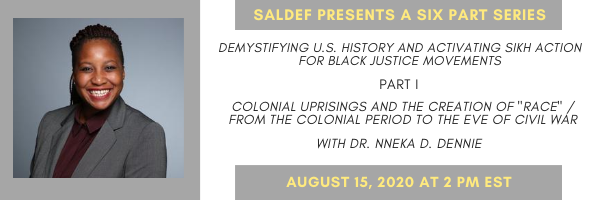
This weekend SALDEF will present the first part of the series Demystifying U.S. History and Activating Sikh Action for Black Justice Movements. Part I of the series Colonial Uprisings and The Creation of “Race,” From the colonial period to the eve of Civil War with Dr. Nneka D. Dennie will take an in-depth look at the early history of the U.S. and the relationship this country has formed with “race.”
WATCH NOWColonial Uprisings and The Creation of “Race” / From the colonial period to the eve of Civil War with Dr. Nneka D. Dennie.
Dr. Nneka D. Dennie is a black feminist scholar with specializations in nineteenth- and twentieth-century African-American history. Her research examines black intellectual history, black feminist thought, transnational feminism, and black radicalism. She will be joined with SALDEF Co-Founder Dr. Jaideep Singh who is a U.S. historian with a focus on race in America. Dr. Singh will guide the discussion diving into the real history of the U.S., exploring the formation of race in America and finding parallels in Sikhi that drive the Sikh American community both to become allies and the importance of educating themselves on the truth.
Sikhs Americans, like most in the United States, are unaware of the true history of race. In many cases, we as a society need to relearn the history that has been taught and take a hard look at the true reality within this country. Colonial Uprisings and The Creation of “Race,” From the colonial period to the eve of the Civil War will be a substantive analysis of the meaning of race and how it changed after the civil war.
For more information on the series CLICK HERE
The six-part racial justice series will provide viewers with the basis to understand the current historical moment through a substantive introduction to the history of race and protest against white supremacist violence and legislation. The series will also highlight the societal articulation of white supremacy, race, class, gender, and sexuality. We hope to help correct the mistaken history in most Americans’ minds, and also the historical erasure of the women and LGBTQ folks who were so central to every part of the struggles we will study.
Without a historical appreciation of what African Americans have endured and survived, we as Sikh Americans cannot be good allies. We cannot be legitimate participants in the discussion regarding race now being undertaken in this country. If we do not know what has happened in the past, we cannot learn from the lessons of history, nor benefit from the mistakes of those who fought for justice in the past.