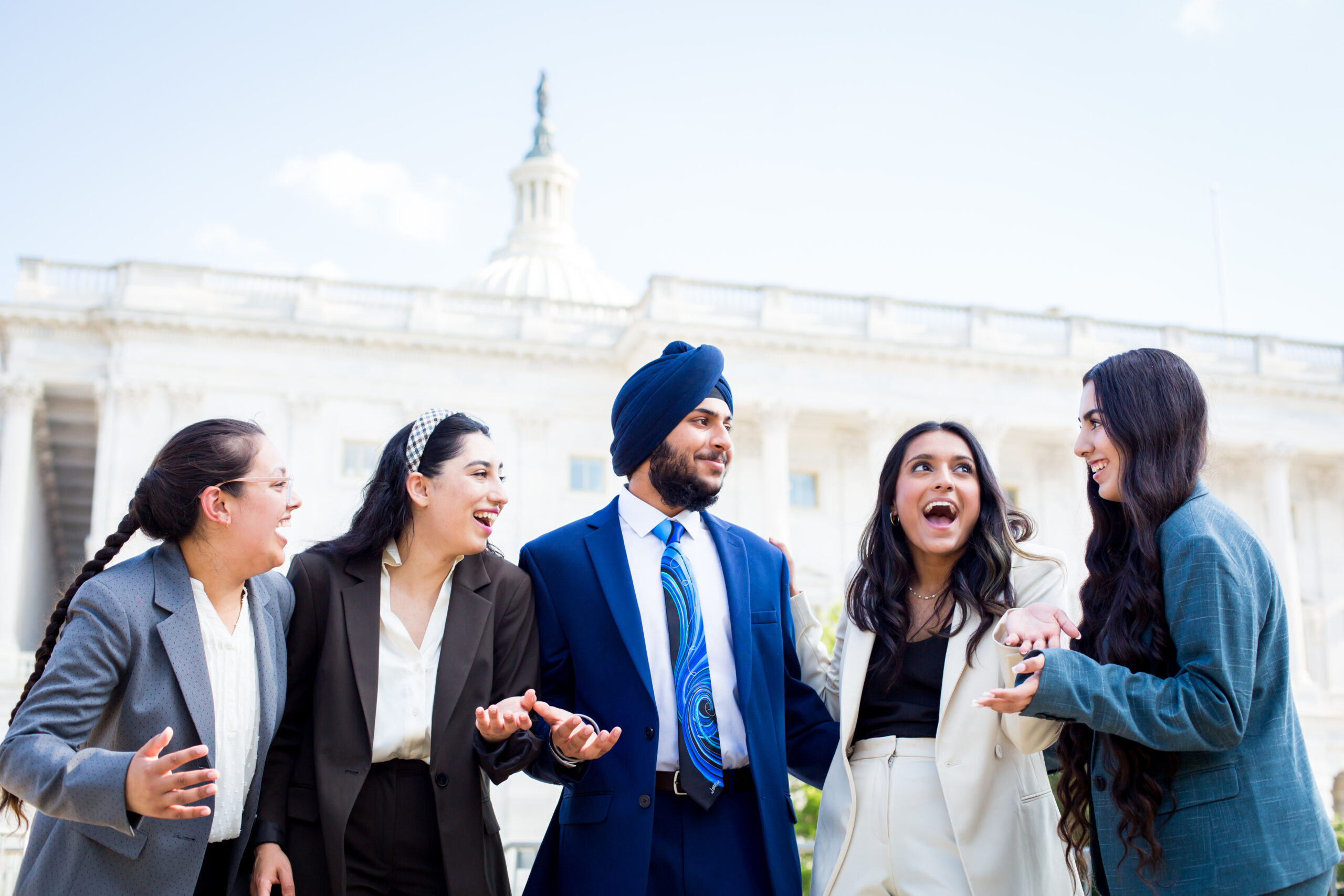
The Becket Fund is a non-profit law firm as well as a think-tank that defends the religious liberties of any and all faiths, domestically and internationally. Last Thursday, the Washington DC SALDEF team attended the Becket Fund’s Freedom Summit. When Navdeep Singh, a former SALDEF intern-turned-volunteer, forwarded me an e-mail about the Summit, I immediately RSVP-ed for the slightly selfish reason that it was being held at the Library of Congress, a DC landmark I had been waiting to visit. Also promised was an “after-hours tour” of the Capitol Building, but that part of the day is for another time.
  The Summit was held in the “Member’s Room” of the Library. This room, purposely designed to look like the most prestigious English library, was where members of our Congress would come to read and study the thousands (now turned millions) of books. I already felt cool. Representatives of the Becket Fund discussed three major topics that day: Religion in the Public Sphere, Conscience and Healthcare, and Religious Liberty and the Growth of a Regulatory State. Perhaps the most compelling discussion focused on the Pledge of Allegiance, under “Religion in the Public Sphere.” A prelude to the not-so-old Pledge debate is an overall consensus that the government should remain neutral in matters of the religion, as established by Thomas Jefferson’s separation between church and state. The definition of neutral, however, becomes the first point of argument. Becket Fund identifies two views: first, that neutral implies that government should remain completely absent from religion and second, that excluding all religion would in fact indicate a governmental bias, not neutrality. I personally believe the latter. “God” is mentioned four times in the Declaration of Independence; even if some argue that these mentions are not necessarily religious, they are inspired by some degree of spirituality. Thus, from the very beginning, spirituality, often embodied by religion, has been a part of the “state” aspect of society.
  Now back to the Pledge. Opponents to the phrase “under God” claim that it is a purely religious phrase that indirectly coerces children, who repeat it in schools, to repeat words that their family might not necessarily believe in or they themselves do not believe in. It predisposes them to believe in God. Proponents of “under God,” such as the Department of Justice, have justified the phrase by the idea of ceremonial deism. Basically, because it has been repeated so much, the phrase has lost all religious meaning, if it ever had any, and is said for merely ceremonial purposes. Becket Fund takes a different approach. The firm is defending the right to say “under God” by arguing that government is supposed to be defending pre-existing rights; it cannot create rights. Jefferson wrote that it is God that has bestowed us with inalienable rights, one of which is liberty. We should thus have the liberty to say “under God” on an individual basis. Because no child, no adult is required to say the Pledge of Allegiance, I believe they should have the right to say it the way they believe is correct, whether that includes “under God” or not.” With a rise in American diversity, and consequently religious diversity, there has been a simultaneous rise in the hostility to public expression of religion. What role will government take? Will it start banning religious headgear in DMV photographs, or will “freedom and liberty for all” actually be respected? And how far will people of religious persuasions go to protect our first amendment right to practice our faiths, whatever they may be? Coming to you from 1413 K Street, Jasleen Kaur Singh For Part 2 of this blog, click here.